



Question: TL BUSINESS SCHOOL c. (3 marks) Suppose both countries are now free to trade. Draw a graph depicting the global market of bread and wine
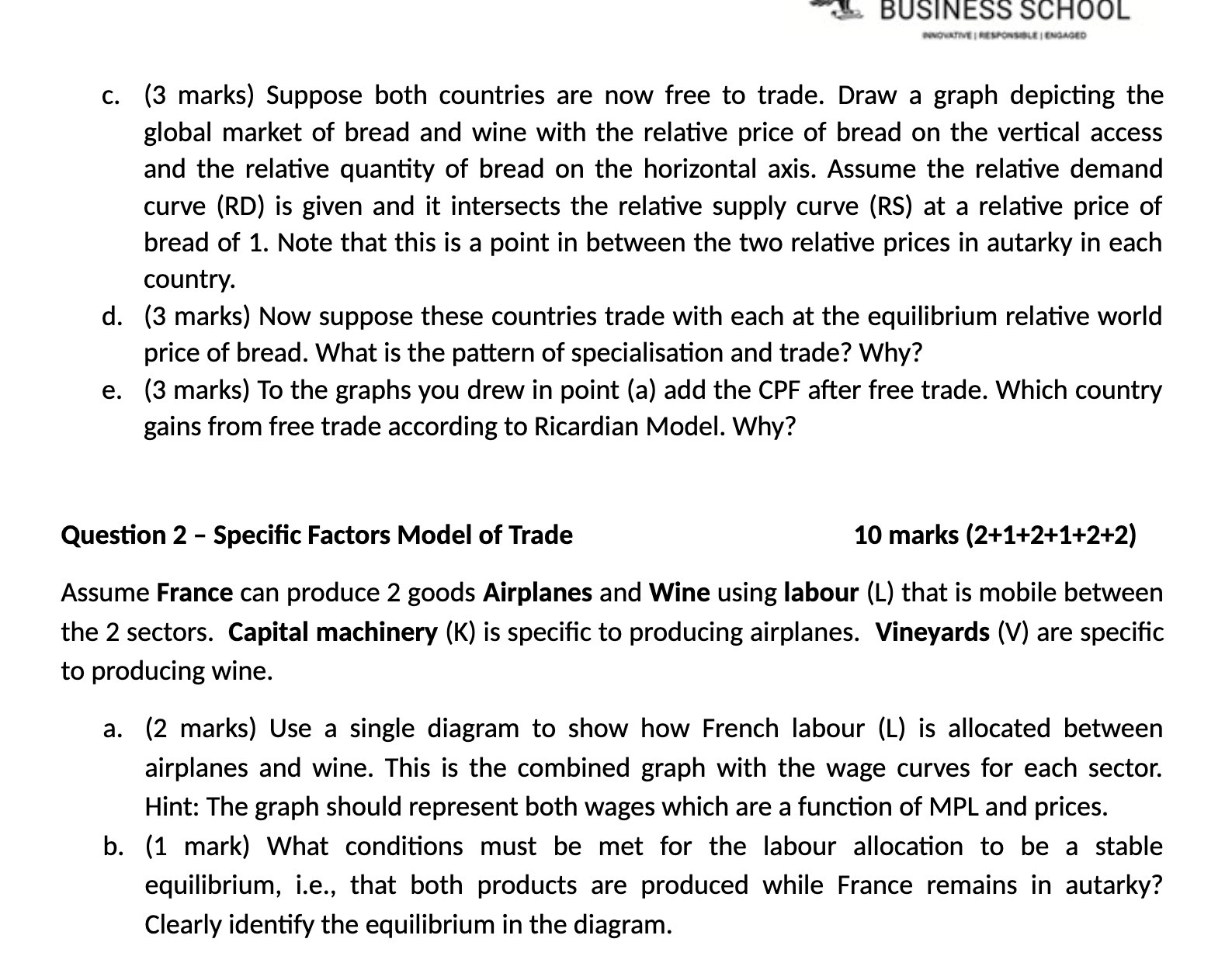
\"TL BUSINESS SCHOOL c. (3 marks) Suppose both countries are now free to trade. Draw a graph depicting the global market of bread and wine with the relative price of bread on the vertical access and the relative quantity of bread on the horizontal axis. Assume the relative demand curve (RD) is given and it intersects the relative supply curve (R5) at a relative price of bread of 1. Note that this is a point in between the two relative prices in autarky in each country. d. (3 marks) Now suppose these countries trade with each at the equilibrium relative world price of bread. What is the pattern of specialisation and trade? Why? e. (3 marks) To the graphs you drew in point (a) add the CPF after free trade. Which country gains from free trade according to Ricardian Model. Why? Question 2 - Specic Factors Model of Trade 10 marks (2+1+2+1+2+2) Assume France can produce 2 goods Airplanes and Wine using labour (L) that is mobile between the 2 sectors. Capital machinery (K) is specic to producing airplanes. Vineyards (V) are specic to producing wine. a. (2 marks) Use a single diagram to show how French labour (L) is allocated between airplanes and wine. This is the combined graph with the wage curves for each sector. Hint: The graph should represent both wages which are a function of MPL and prices. b. (1 mark) What conditions must be met for the labour allocation to be a stable equilibrium, i.e., that both products are produced while France remains in autarky? Clearly identify the equilibrium in the diagram
Step by Step Solution
There are 3 Steps involved in it

Get step-by-step solutions from verified subject matter experts