







Question: to 2 decimal places before multiplying by one and one-haif to determine the overtime rate) 2 If the third decimal place is 5 or more,
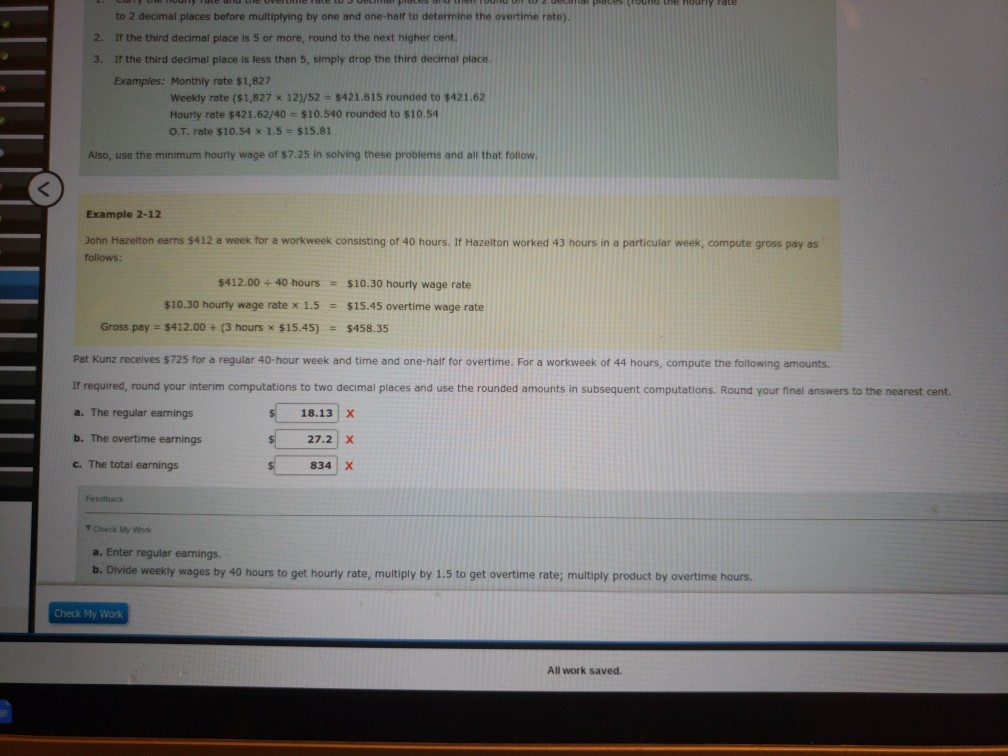
to 2 decimal places before multiplying by one and one-haif to determine the overtime rate) 2 If the third decimal place is 5 or more, round to the next higher cent 3. If the third decimal place is less than 5, simply drop the third decimal place Examples: Monthly rate $1,827 Weekly rate ($1,827 x 12)/52 $421.615 rounded to $421.62 Hourly rate $421.62/40 $10.540 rounded to $10.54 OT. rate $10.54 x 1.5 = $15.81 Also, use the minimum hourly wage of $7.25 in solving these problems and all that follow Example 2-12 John Hazelton earns $412 a week for a workweek consisting of 40 hours. If Hazeilton worked 43 hours in a particular week, compute gross pay as follows: $412.00 + 40 hours -$10.30 hourly wage rate $10.30 hourly wage rate x 1.5$15.45 overtime wage rate Gross pay $412.00+ (3 hours x $15.45) $458.35 Pat Kunz receives $725 for a regular 40-hour week and time and one-halr for overtime. For a workweek of 44 hours, compute the following amounts. If required, round your interim computations to two decimal places and use the rounded amounts in subsequent computations. Round your final answers to the nearest cent. a. The regular earnings b. The overtime earnings c. The total earnings 18.13 X 27.2 x 834 X Feedbac Check My Work a. Enter regular earnings b. Divide weekly wages by 40 hours to get hourtly rate, mutiply by 1.5 to get overtime rate; multiply product by overtime hours. Check My Work All work saved
Step by Step Solution
There are 3 Steps involved in it

Get step-by-step solutions from verified subject matter experts
 Study Help