



Question: to a DFA, including the dead state, if necessary. Which of the following sets of NFA states is not a state of the DFA that
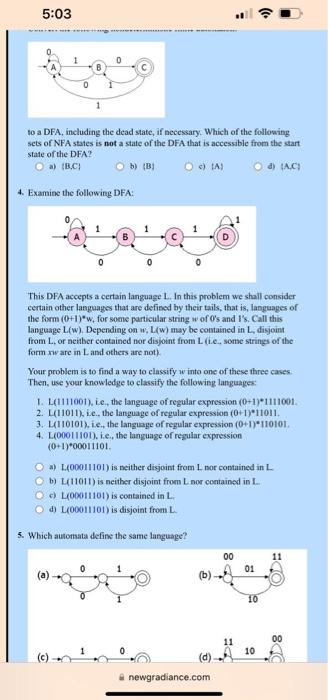
to a DFA, including the dead state, if necessary. Which of the following sets of NFA states is not a state of the DFA that is accessible from the start state of the DFA? a) {[B,C] b) {B} c) {A} d) {A,C 4. Examine the following DFA: This DFA accepts a certain language L. In this problem we shall consider eertain other languages that are defined by their tails, that is, languages of the form (0+1)w, for some particular string w of 0 s and 1s. Call this language L.(w). Depending on w, L.(w) may be contained in L, disjoint from L, or neiaber contained nor disjoint from L (t.e., some strings of the form nw are in L and others are not). Your problem is to find a way to classify w into one of these three cases: Then, use your knowledge to classify the following langeages: 1. L(1111001). ic., the language of regular expression (0+1)1111001. 2. L(11011), ie., the language of regular expression (0+1)11011. 3. L(110101), ie., the language of regular expression (0+1)110101. 4. L (0001101). i.e., the language of regular expression (0+1)00011101. a) L.(00011101) is neither disjoint fram 1 nor contained in L b) L(11011) is neither disjoint from L nor contained in I. c) L(00011101) is contained in L. d) L(00011101) is disjoint from L. 5. Which automata define the same language? (b) (c (d) newgradiance.com
Step by Step Solution
There are 3 Steps involved in it

Get step-by-step solutions from verified subject matter experts