







Question: To allow authors to distribute their work while maintaining certain ownership rights. B. to allow authors to maintain ownership of their ideas. C. to restrict
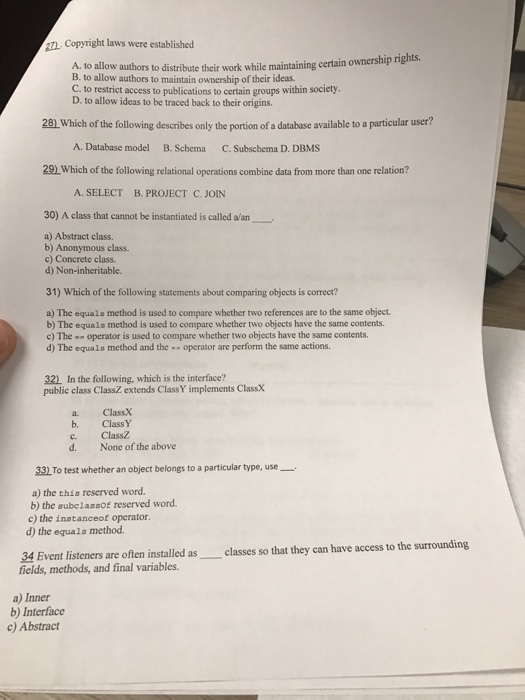
To allow authors to distribute their work while maintaining certain ownership rights. B. to allow authors to maintain ownership of their ideas. C. to restrict access to publications to certain groups within society. D. to allow ideas to be traced back to their origins. Which of the following describes only the portion of a database available to a particular user? A. Database model B. Schema C. Subschema D. DBMS Which of the following relational operations combine data from more than one relation? A. SELECT B. PROJECT C. JOIN A class that cannot be instantiated is called a/an ____. a) Abstract class. b) Anonymous class. c) Concrete class. d) Non-inheritable. Which of the following statements about comparing objects is correct? a) The equals method is used to compare whether two references are to the same object. b) The equal s method is used to compare whether two objects have the same contents. c) The operator is used to compare whether two objects have the same contents. d) The equals method and the .. operator are perform the same actions. In the following, which is the interface? public class ClassZ extends ClassY implements ClassX a. ClassX b. ClassY c. ClassZ d. None of the above To test whether an object belongs to a particular type, use ___. a) the this reserved word. b) the subclassOf reserved work. c) the instanceof operator. d)the equals method. Event listeners are often installed as ____ classes so that they can have access to the surrounding fields, methods, and final variables. a) Inner b) Interface c) Abstract
Step by Step Solution
There are 3 Steps involved in it
Certainly Here are the answers to the questions 27 Copyright laws were established A to allow ... View full answer

Get step-by-step solutions from verified subject matter experts
 Study Help