







Question: To answer these questions, you can use the math tool in this text editor, click the Insert Math Equation icon to start, or you can
To answer these questions, you can use the math tool in this text editor, click the "Insert Math Equation" icon to start, or you can just type them out in your own way, 2^5 means "two to the five".Suppose that a number is represented as its prime factorization 523143, Is 11 a factor of the given number? How about 3? Note that once a number is represented as its prime factorization, it is quite easy to find factors of the number. This method is possible because the prime factorization of any number is unique and this principle is the Unique Factorization Theorem. Can you find a whole number m to make the following equation be true? Please explain your answers with reasons connected to the Unique Factorization Theorem. 29?173?672=27?172?34?67?mThe Unique Factorization Theorem (also called the Fundamental Theorem of Arithmetics) seems simple enough to understand, but research shows that many students have difficulty applying this theorem. Consider the following example.Patty was asked whether 33527 is divided by 7 or 5. Patty said yes because these factors were clearly visible. When asked whether 11 was a factor, she multiplied the given factors and obtained 4725. She said she would divide 4725 by 11 to find out whether or not 11 is a factor. Do you agree with her? Is there any other way to answer this question? Do you think Patty really understands the Unique Factorization Theorem?
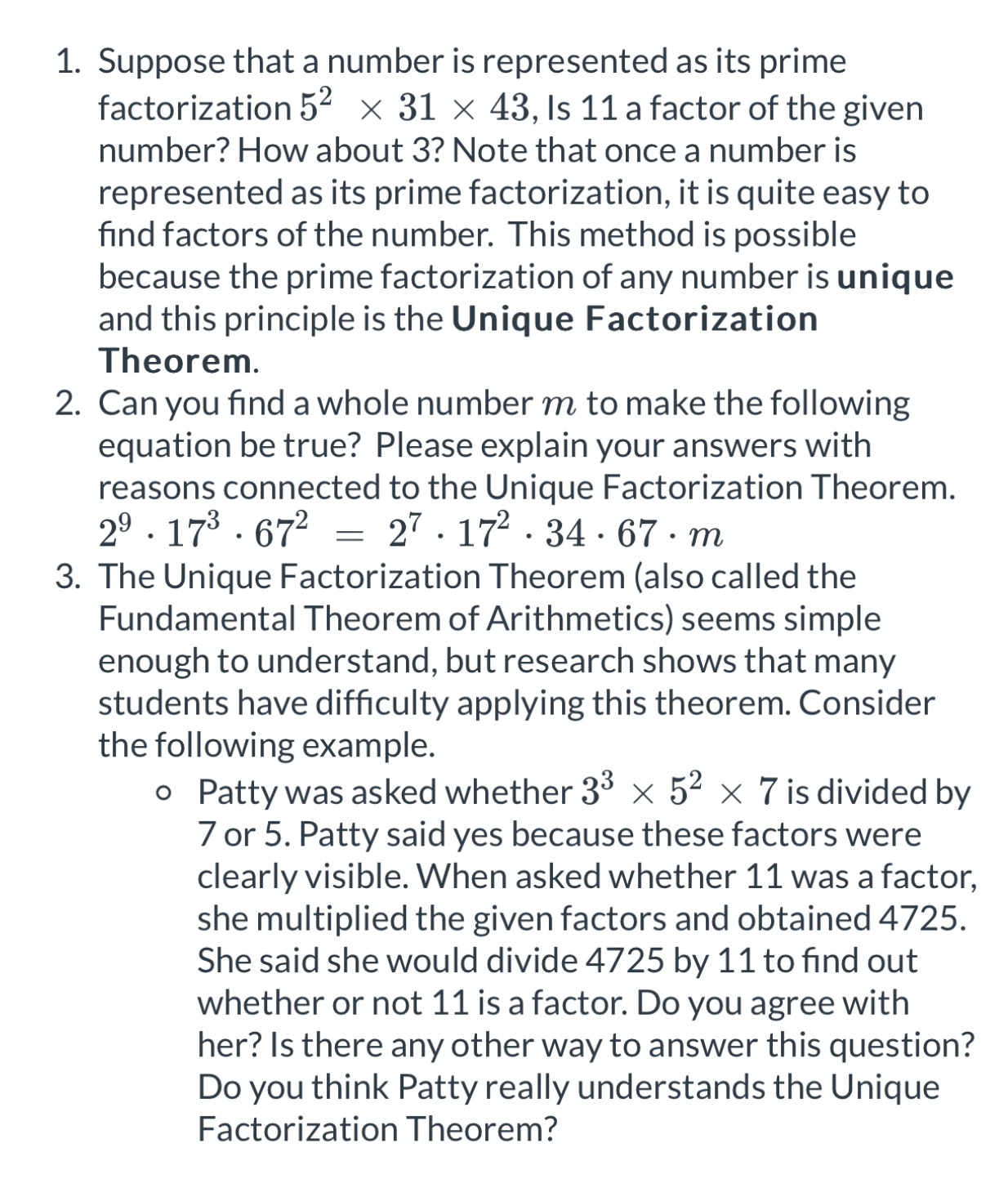
1. Suppose that a number is represented as its prime factorization 52 x 31 x 43, s 11 a factor of the given number? How about 37 Note that once a number is represented as its prime factorization, it is quite easy to find factors of the number. This method is possible because the prime factorization of any number is unique and this principle is the Unique Factorization Theorem. 2. Canyou find a whole number m to make the following equation be true? Please explain your answers with reasons connected to the Unique Factorization Theorem. 29.17% .67 = 27-17.34-67-m 3. The Unique Factorization Theorem (also called the Fundamental Theorem of Arithmetics) seems simple enough to understand, but research shows that many students have difficulty applying this theorem. Consider the following example. o Pattywas asked whether 33 x 5% x 7 isdivided by 7 or 5. Patty said yes because these factors were clearly visible. When asked whether 11 was a factor, she multiplied the given factors and obtained 4725. She said she would divide 4725 by 11 to find out whether or not 11 is a factor. Do you agree with her? Is there any other way to answer this question? Do you think Patty really understands the Unique Factorization Theorem
Step by Step Solution
There are 3 Steps involved in it

Get step-by-step solutions from verified subject matter experts
 Study Help