Question: To answer this question you should read the article below article and use the Corporate and Social Responsibility/Sustainability/ESG) policies for an engineering company of your
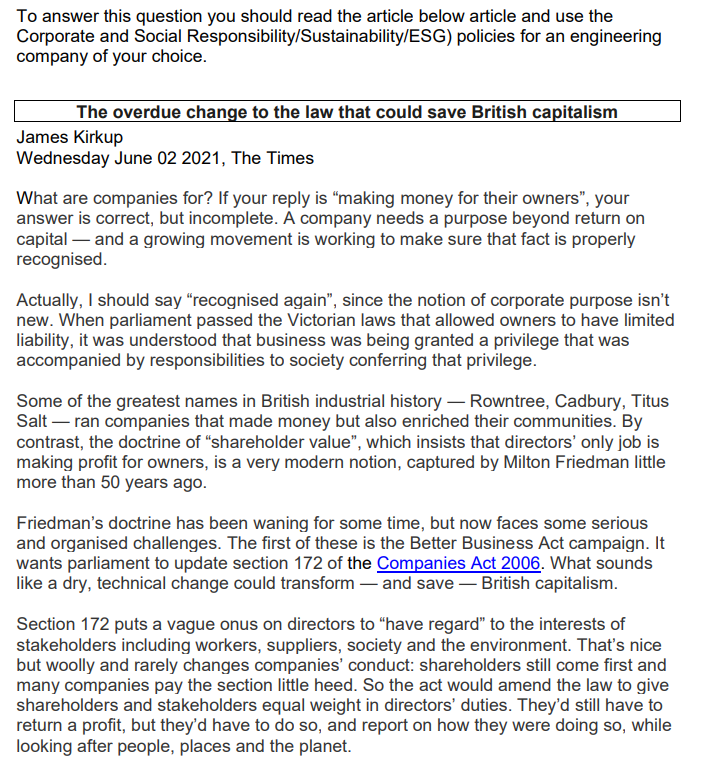
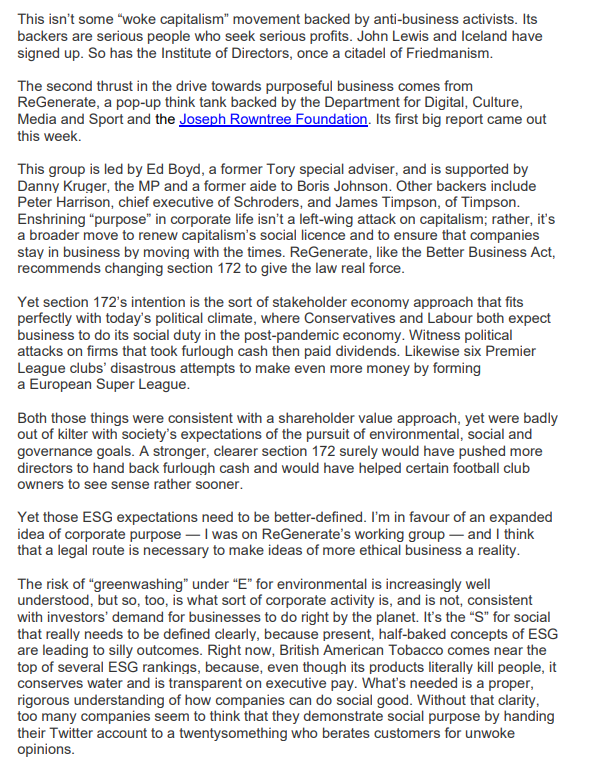
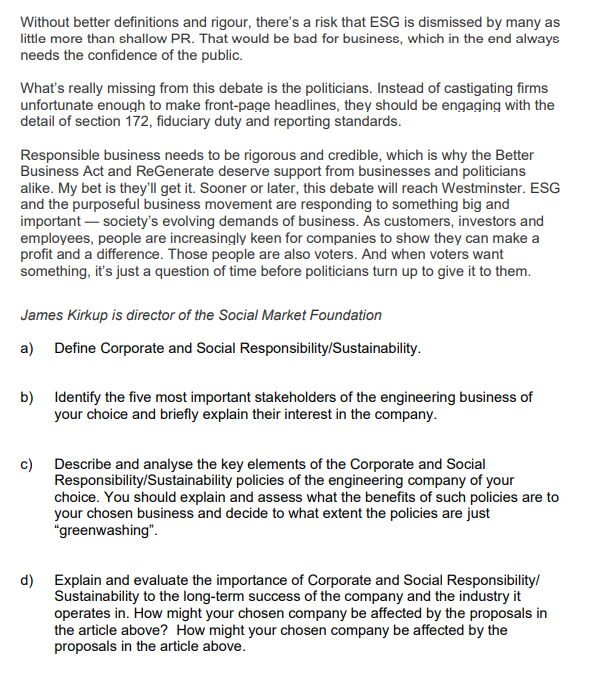
To answer this question you should read the article below article and use the Corporate and Social Responsibility/Sustainability/ESG) policies for an engineering company of your choice. The overdue change to the law that could save British capitalism James Kirkup Wednesday June 02 2021, The Times What are companies for? If your reply is making money for their owners, your answer is correct, but incomplete. A company needs a purpose beyond return on capital and a growing movement is working to make sure that fact is properly recognised. Actually, I should say recognised again", since the notion of corporate purpose isn't new. When parliament passed the Victorian laws that allowed owners to have limited liability, it was understood that business was being granted a privilege that was accompanied by responsibilities to society conferring that privilege. Some of the greatest names in British industrial history - Rowntree, Cadbury, Titus Salt - ran companies that made money but also enriched their communities. By contrast, the doctrine of "shareholder value", which insists that directors' only job is making profit for owners, is a very modern notion, captured by Milton Friedman little more than 50 years ago. Friedman's doctrine has been waning for some time, but now faces some serious and organised challenges. The first of these is the Better Business Act campaign. It wants parliament to update section 172 of the Companies Act 2006. What sounds like a dry, technical change could transform - and save - British capitalism. Section 172 puts a vague onus on directors to have regard" to the interests of stakeholders including workers, suppliers, society and the environment. That's nice but woolly and rarely changes companies' conduct: shareholders still come first and many companies pay the section little heed. So the act would amend the law to give shareholders and stakeholders equal weight in directors' duties. They'd still have to return a profit, but they'd have to do so, and report on how they were doing so, while looking after people, places and the planet. This isn't some "woke capitalism" movement backed by anti-business activists. Its backers are serious people who seek serious profits. John Lewis and Iceland have signed up. So has the Institute of Directors, once a citadel of Friedmanism. The second thrust in the drive towards purposeful business comes from ReGenerate, a pop-up think tank backed by the Department for Digital, Culture, Media and Sport and the Joseph Rowntree Foundation. Its first big report came out this week. This group is led by Ed Boyd, a former Tory special adviser, and is supported by Danny Kruger, the MP and a former aide to Boris Johnson. Other backers include Peter Harrison, chief executive of Schroders, and James Timpson, of Timpson. Enshrining "purpose" in corporate life isn't a left-wing attack on capitalism; rather, it's a broader move to renew capitalism's social licence and to ensure that companies stay in business by moving with the times. ReGenerate, like the Better Business Act, recommends changing section 172 to give the law real force. Yet section 172's intention is the sort of stakeholder economy approach that fits perfectly with today's political climate, where Conservatives and Labour both expect business to do its social duty in the post-pandemic economy. Witness political attacks on firms that took furlough cash then paid dividends. Likewise six Premier League clubs' disastrous attempts to make even more money by forming a European Super League. Both those things were consistent with a shareholder value approach, yet were badly out of kilter with society's expectations of the pursuit of environmental, social and governance goals. A stronger, clearer section 172 surely would have pushed more directors to hand back furlough cash and would have helped certain football club owners to see sense rather sooner. Yet those ESG expectations need to be better-defined. I'm in favour of an expanded idea of corporate purpose I was on ReGenerate's working group- and I think that a legal route is necessary to make ideas of more ethical business a reality. The risk of "greenwashing under E for environmental is increasingly well understood, but so, too, is what sort of corporate activity is, and is not consistent with investors' demand for businesses to do right by the planet. It's the "S" for social that really needs to be defined clearly, because present, half-baked concepts of ESG are leading to silly outcomes. Right now, British American Tobacco comes near the top of several ESG rankings, because, even though its products literally kill people, it conserves water and is transparent on executive pay. What's needed is a proper, rigorous understanding of how companies can do social good. Without that clarity, too many companies seem to think that they demonstrate social purpose by handing their Twitter account to a twentysomething who berates customers for unwoke opinions. Without better definitions and rigour, there's a risk that ESG is dismissed by many as little more than shallow PR. That would be bad for business, which in the end always needs the confidence of the public. What's really missing from this debate is the politicians. Instead of castigating firms unfortunate enough to make front-page headlines, they should be engaging with the detail of section 172, fiduciary duty and reporting standards. Responsible business needs to be rigorous and credible, which is why the Better Business Act and ReGenerate deserve support from businesses and politicians alike. My bet is they'll get it. Sooner or later, this debate will reach Westminster. ESG and the purposeful business movement are responding to something big and important - society's evolving demands of business. As customers, investors and employees, people are increasingly keen for companies to show they can make a profit and a difference. Those people are also voters. And when voters want something, it's just a question of time before politicians turn up to give it to them. James Kirkup is director of the Social Market Foundation a) Define Corporate and Social Responsibility/Sustainability. b) Identify the five most important stakeholders of the engineering business of your choice and briefly explain their interest in the company. c) Describe and analyse the key elements of the Corporate and Social Responsibility/Sustainability policies of the engineering company of your choice. You should explain and assess what the benefits of such policies are to your chosen business and decide to what extent the policies are just "greenwashing". d) Explain and evaluate the importance of Corporate and Social Responsibility/ Sustainability to the long-term success of the company and the industry it operates in. How might your chosen company be affected by the proposals in the article above? How might your chosen company be affected by the proposals in the article above









 Study Help