







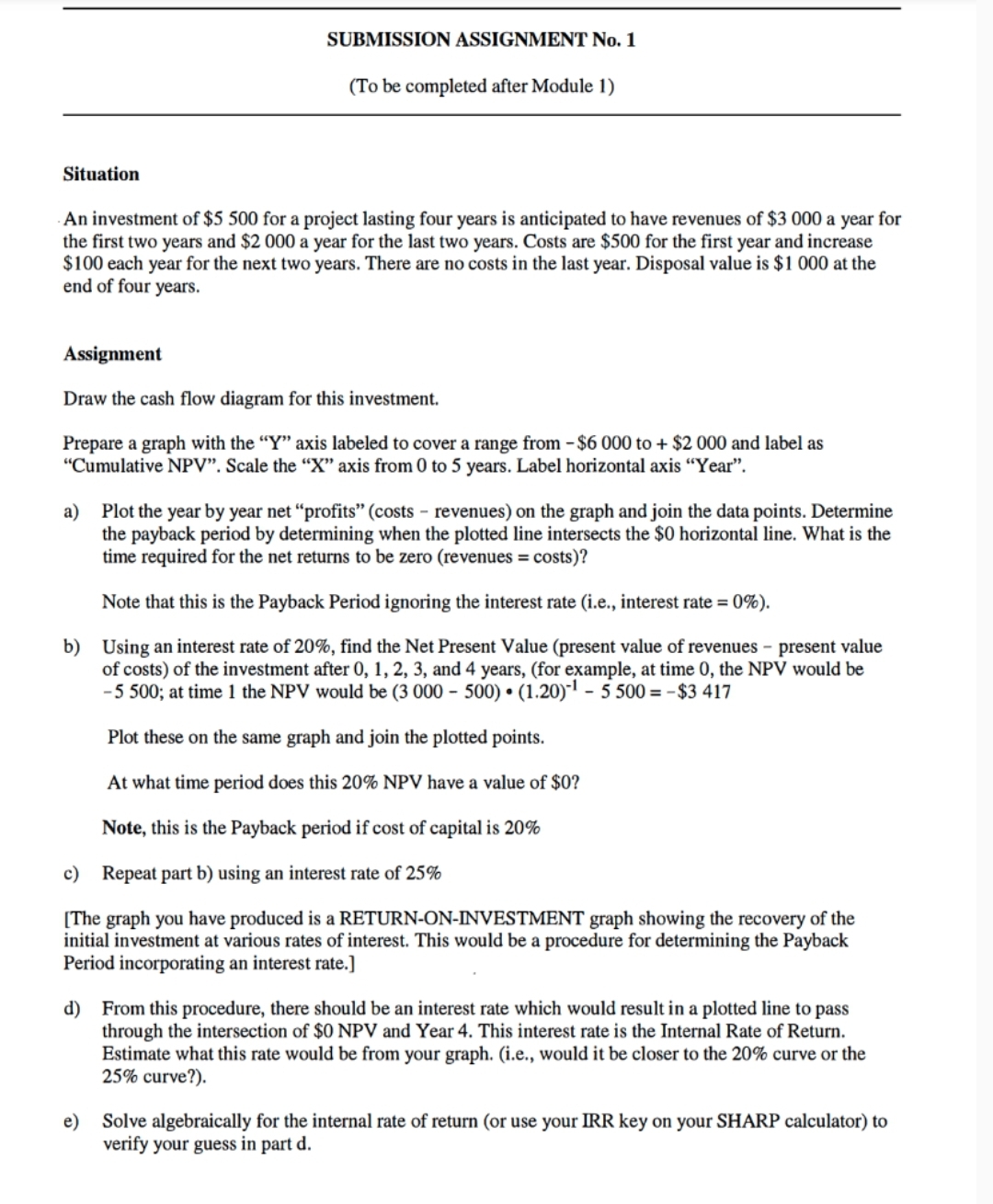
Question: ( To be completed after Module 1 ) Situation An investment of $ 5 5 0 0 for a project lasting four years is anticipated
To be completed after Module
Situation
An investment of $ for a project lasting four years is anticipated to have revenues of $ a year for
the first two years and $ a year for the last two years. Costs are $ for the first year and increase
$ each year for the next two years. There are no costs in the last year. Disposal value is $ at the
end of four years.
Assignment
Draw the cash flow diagram for this investment.
Prepare a graph with the Y axis labeled to cover a range from $ to $ and label as
"Cumulative NPV Scale the axis from to years. Label horizontal axis "Year".
a Plot the year by year net "profits" costs revenues on the graph and join the data points. Determine
the payback period by determining when the plotted line intersects the $ horizontal line. What is the
time required for the net returns to be zero revenues costs
Note that this is the Payback Period ignoring the interest rate ie interest rate
b Using an interest rate of find the Net Present Value present value of revenues present value
of costs of the investment after and years, for example, at time the NPV would be
; at time the NPV would be $
Plot these on the same graph and join the plotted points.
At what time period does this NPV have a value of $
Note, this is the Payback period if cost of capital is
c Repeat part b using an interest rate of
The graph you have produced is a RETURNONINVESTMENT graph showing the recovery of the
initial investment at various rates of interest. This would be a procedure for determining the Payback
Period incorporating an interest rate.
d From this procedure, there should be an interest rate which would result in a plotted line to pass
through the intersection of $ and Year This interest rate is the Internal Rate of Return.
Estimate what this rate would be from your graph. ie would it be closer to the curve or the
curve?
e Solve algebraically for the internal rate of return or use your IRR key on your SHARP calculator to
verify your guess in part
Step by Step Solution
There are 3 Steps involved in it
1 Expert Approved Answer
Step: 1 Unlock

Question Has Been Solved by an Expert!
Get step-by-step solutions from verified subject matter experts
Step: 2 Unlock
Step: 3 Unlock
 Study Help