







Question: To be solved using DrRacket in ISL+ (Intermediate Student with Lamda) Exercise 1 Design cartesian-product, which takes a list of lists and returns a list
To be solved using DrRacket in ISL+ (Intermediate Student with Lamda)
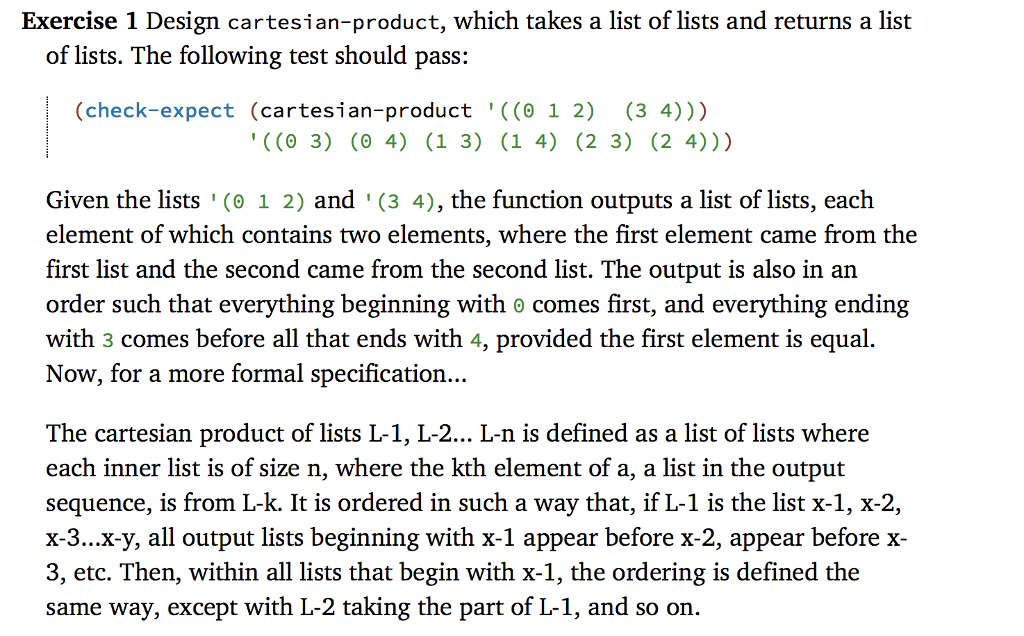
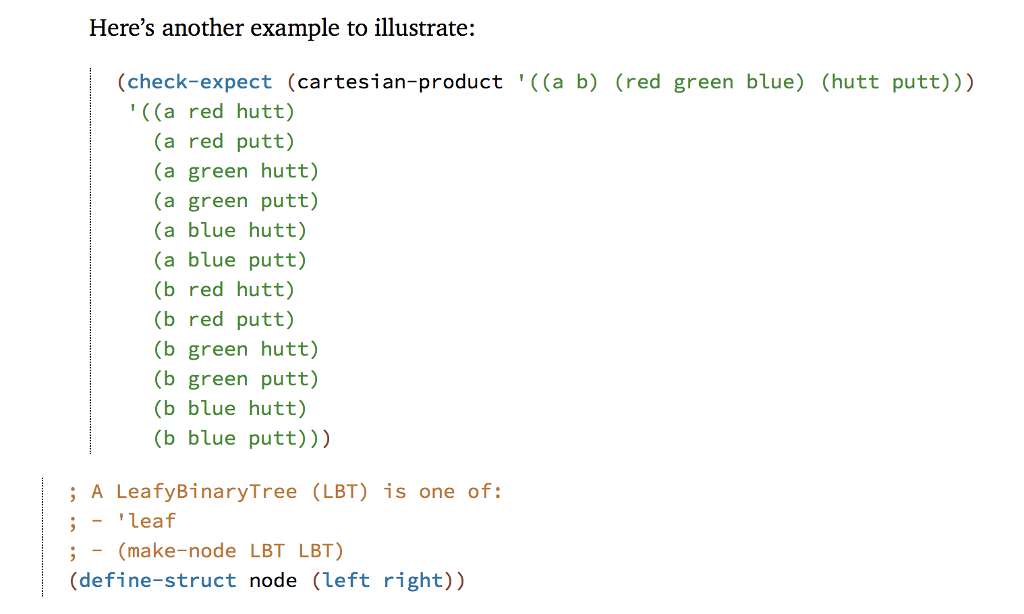
Exercise 1 Design cartesian-product, which takes a list of lists and returns a list of lists. The following test should pass: (check-expect (cartesian-product ((012) (3 4))) '((0 3) (0 4) (1 3) (1 4) (2 3) (2 4))) Given the lists '(0 1 2) and '(3 4), the function outputs a list of lists, each element of which contains two elements, where the first element came from the first list and the second came from the second list. The output is also in an order such that everything beginning with o comes first, and everything ending with 3 comes before all that ends with 4, provided the first element is equal. Now, for a more formal specification... The cartesian product of lists L-1, L-2... L-n is defined as a list of lists where each inner list is of size n, where the kth element of a, a list in the output sequence, is from L-k. It is ordered in such a way that, if L-1 is the list x-1, x-2 x-3...x-V, all output lists beginning with x-1 appear before x-2, appear before x- 3, etc. Then, within all lists that begin with x-1, the ordering is defined the same way, except with L-2 taking the part of L-1, and so on. Exercise 1 Design cartesian-product, which takes a list of lists and returns a list of lists. The following test should pass: (check-expect (cartesian-product ((012) (3 4))) '((0 3) (0 4) (1 3) (1 4) (2 3) (2 4))) Given the lists '(0 1 2) and '(3 4), the function outputs a list of lists, each element of which contains two elements, where the first element came from the first list and the second came from the second list. The output is also in an order such that everything beginning with o comes first, and everything ending with 3 comes before all that ends with 4, provided the first element is equal. Now, for a more formal specification... The cartesian product of lists L-1, L-2... L-n is defined as a list of lists where each inner list is of size n, where the kth element of a, a list in the output sequence, is from L-k. It is ordered in such a way that, if L-1 is the list x-1, x-2 x-3...x-V, all output lists beginning with x-1 appear before x-2, appear before x- 3, etc. Then, within all lists that begin with x-1, the ordering is defined the same way, except with L-2 taking the part of L-1, and so on
Step by Step Solution
There are 3 Steps involved in it

Get step-by-step solutions from verified subject matter experts
 Study Help