Question: To begin, select the concept that you will use for the concept map assignment. Identify a concept. Once you have selected your concept, you will
To begin, select the concept that you will use for the concept map assignment. Identify a concept. Once you have selected your concept, you will identify a patient case to which you can apply your chosen concept. You may use a Patient situation from a previous encounter.
Build your concept map around the concept you chose; For example, you chose the concept of 'Infection', COMPLETE your map according to cues (signs and symptoms) and appropriate interventions related to 'Infection'. You now have your concept and your patient.
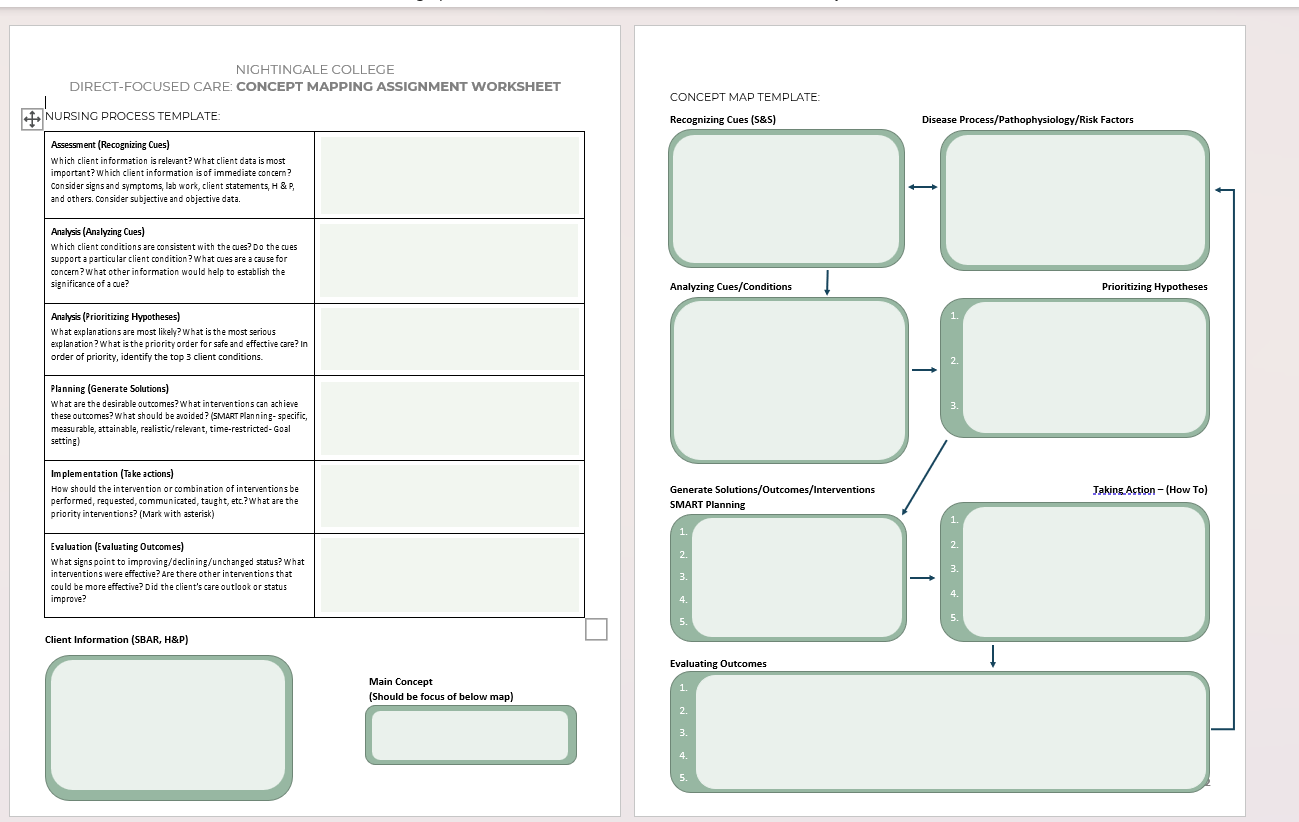
Gather the patient data and organize the information on the nursing process template of the Concept Map Worksheet. After completing the nursing process template, utilize this information to help you build the concept map assignment. The arrows in the map show you the order in which the map is intended to be completed. All boxes should be completed related to the concept you chose.
Give credit to your references. You do not need a separate reference, but if used, it should be identified at the bottom of the assignment. In this case, my concept would be glucose regulation, and the exemplar(condition) is type 1 diabetes. both images need to be filled out.
NIGHTINGALE COLLEGE DIRECT-FOCUSED CARE: CONCEPT MAPPING ASSIGNMENT WORKSHEET CONCEPT MAP TEMPLATE: NURSING PROCESS TEMPLATE: Recognizing Cues (S&5) Disease Process/Pathophysiology/Risk Factors Assessment (Recognizing Cues) which client information is relevant? What client data is most important? which client information is of immediate concern consider signs and symptoms, lab work, client statements, H & P, and others. Consider subjective and objective data. Analysis (Analyzing Cues) which client conditions are consistent with the cues? Do the cues support a particular client condition? What cues are a cause for concern? what other information would help to establish the significance of a cue? Analyzing Cues/Conditions Prioritizing Hypotheses Analysis (Prioritizing Hypotheses) 1. what explanations are most likely? what is the most serious explanation? What is the priority order for safe and effective care? In order of priority, identify the top 3 client conditions 2. Planning (Generate Solutions) What are the desirable outcomes? What interventions can achieve these outcomes? what should be avoided? (SMART Planning- specific, measurable, attainable, realistic/relevant, time-restricted- Goal setting Implementation (Take actions) How should the intervention or combination of interventions be Generate Solutions/Outcomes/Interventions Taking Action - (How To) performed, requested, communicated, taught, etc.? What are the SMART Planning priority interventions? (Mark with asterisk) 1. 1. Evaluation (Evaluating Outcomes) N 2. what signs point to improving/declining/unchanged status? What interventions were effective? Are there other interventions that could be more effective? Did the client's care outlook or status improve? 4 Client Information (SBAR, H&P) Evaluating Outcomes Main Concept (Should be focus of below map) 2
Step by Step Solution
There are 3 Steps involved in it
1 Expert Approved Answer
Step: 1 Unlock
Question Has Been Solved by an Expert!
Get step-by-step solutions from verified subject matter experts
Step: 2 Unlock
Step: 3 Unlock
Students Have Also Explored These Related Accounting Questions!









 Study Help