







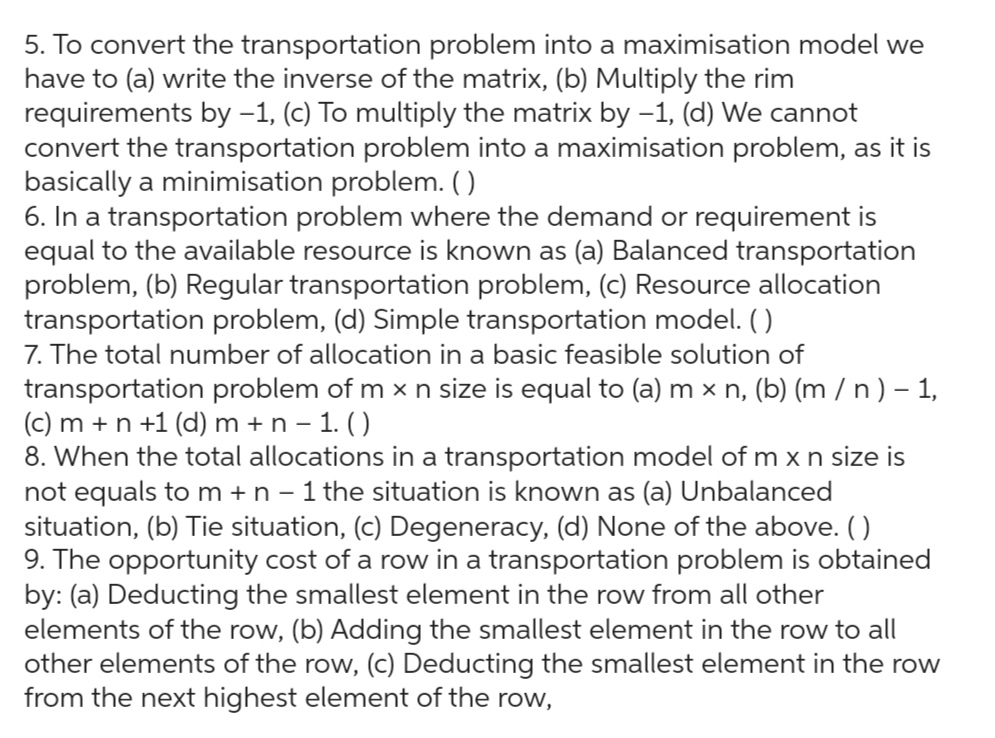
Question: To convert the transportation problem into a maximisation model we have to ( a ) write the inverse of the matrix, ( b ) Multiply
To convert the transportation problem into a maximisation model we
have to a write the inverse of the matrix, b Multiply the rim
requirements by c To multiply the matrix by d We cannot
convert the transportation problem into a maximisation problem, as it is
basically a minimisation problem.
In a transportation problem where the demand or requirement is
equal to the available resource is known as a Balanced transportation
problem, b Regular transportation problem, c Resource allocation
transportation problem, d Simple transportation model.
The total number of allocation in a basic feasible solution of
transportation problem of size is equal to a
cd
When the total allocations in a transportation model of size is
not equals to the situation is known as a Unbalanced
situation, b Tie situation, c Degeneracy, d None of the above.
The opportunity cost of a row in a transportation problem is obtained
by: a Deducting the smallest element in the row from all other
elements of the row, b Adding the smallest element in the row to all
other elements of the row, c Deducting the smallest element in the row
from the next highest element of the row,
Step by Step Solution
There are 3 Steps involved in it
1 Expert Approved Answer
Step: 1 Unlock

Question Has Been Solved by an Expert!
Get step-by-step solutions from verified subject matter experts
Step: 2 Unlock
Step: 3 Unlock
 Study Help