







Question: to do calculations and answer Question: [30] (1) i. Fill in the predicted velocity with sign and % difference between the predicted and measured values.
![to do calculations and answer Question: [30] (1) i. Fill in](https://s3.amazonaws.com/si.experts.images/answers/2024/07/66898c1505979_32466898c14d7e79.jpg)
![measured values. (Express answers to 3 sig. figs.) [8] Collision predicted v2,f](https://s3.amazonaws.com/si.experts.images/answers/2024/07/66898c15c489d_32566898c159d3f6.jpg)
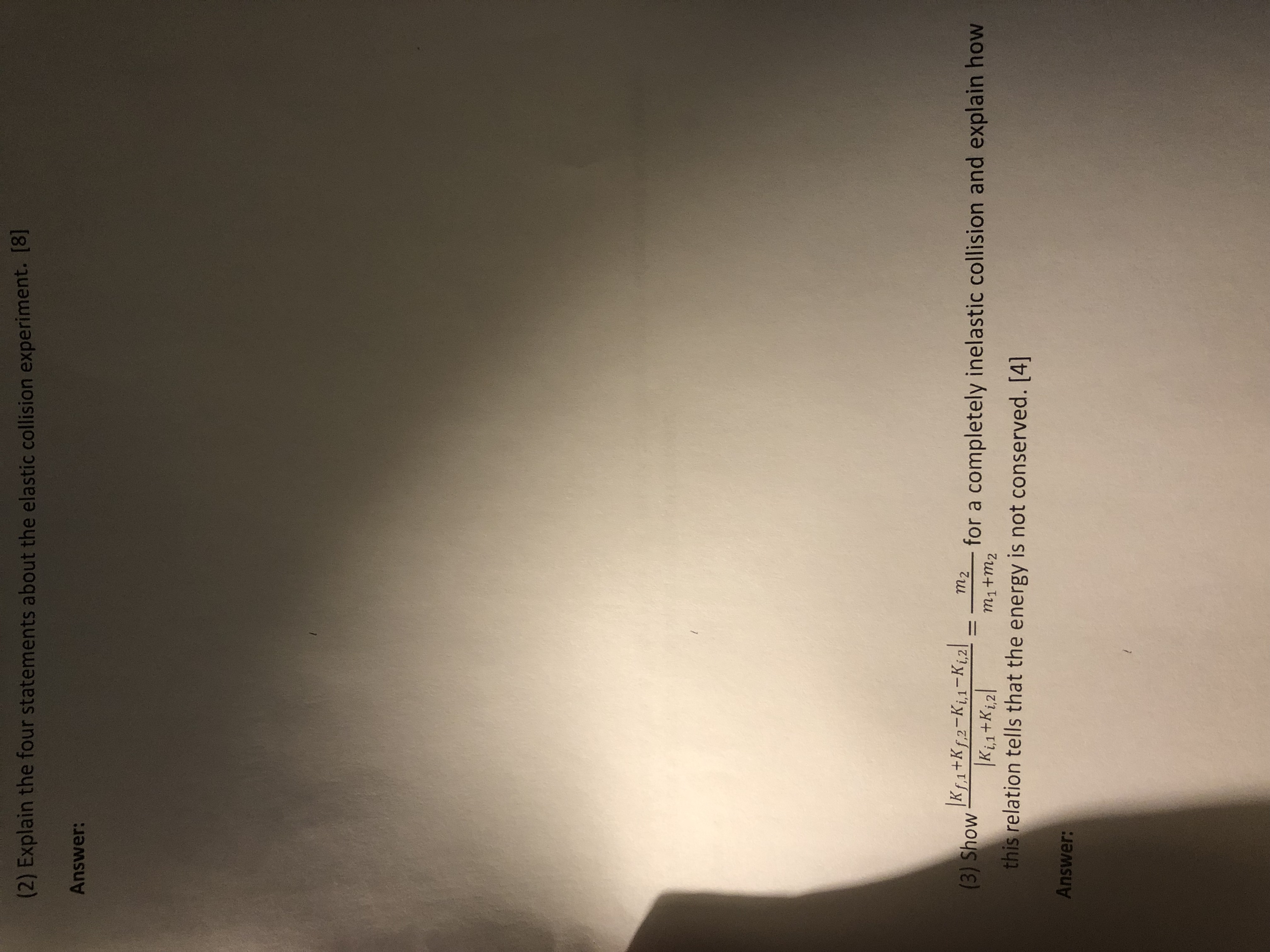
to do calculations and answer Question: [30] (1) i. Fill in the predicted velocity with sign and % difference between the predicted and measured values. (Express answers to 3 sig. figs.) [8] Collision predicted v2,f % diff in v2,f predicted v1,f % diff in V1,f type Elastic Completely inelastic ii. Fill in the initial value, final value, and % loss. (Express answers to 3 sig. figs.) [6] Momentum (kg x m/s) Kinetic Energy (kg x m2/s2) Collision Final type Initial Final Initial % loss % loss P1,i + Pz,i P1,f + P2,f K1,i + K2,i K1,f + K2,f Elastic Completely inelastic(2) Explain the four statements about the elastic collision experiment. [8] Answer: (3) show - KfatKf2-Ki,1-Ki,2 | Ki,1+Kizl mitm z m2 for a completely inelastic collision and explain how this relation tells that the energy is not conserved. [4] Answer:(4) Show that V1,f = V1,i and v2,f = V2,i satisfy the conservation equations and explain why it is not a solution to an elastic collision problem. [4] Answer: W
Step by Step Solution
There are 3 Steps involved in it

Get step-by-step solutions from verified subject matter experts
 Study Help