







Question: To do: Find the break points associated with each source of capital, and use them to specify each of the ranges of total new financing
To do:
Find the break points associated with each source of capital, and use them to specify each of the ranges of total new financing over which the firms weighted average cost of capital (WACC) remains constant.
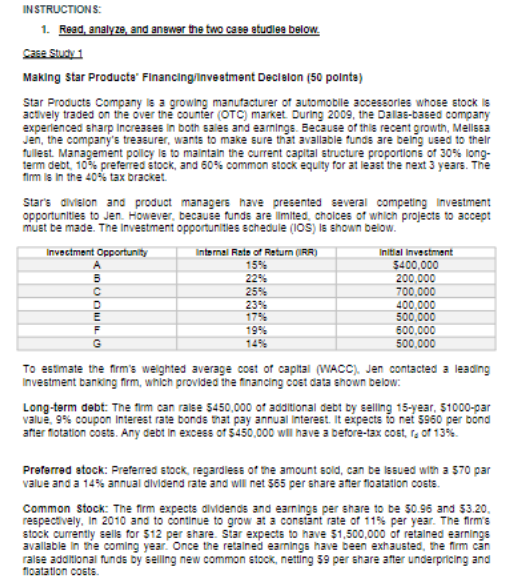
INSTRUCTIONS: 1. Read, analyze, and anewer the two case atudles below Case Study 1 Making star Producte' Financing/inveatment Decielon (50 pointa) Star Products Company is a growing manufacturer of automoblle aosessorles whose stock is actiely traded on the over the counter (OTC) market. During 2009 , the Dalas-based company experienced sharp increases in both sales and earnings. Because of this recent growth, Mellissa Jen, the company's treasurer, wants to make sure that avallible funds are belng used to their fullest. Management polloy is to maintain the current capltal atructure proportiona of 30% longterm deot, 10% preferred stock, and 60% common stock equity for at least the next 3 years. The film is in the 40% tax bracket. Star's divion and product managers have presented several competing Investment opportunities to Jen. However, because funds are Ilmited, cholces of which projects to accept must be made. The investment opportunities schedule (IOS) is ghown below. To estmate the firm's weighted average cost of caplial (WACC). Jen contacted a leading Investment banking firm, which provided the enancing cost data shown below: Long-term debt: The firm can ralse 5450,000 of additional debt by selling 15-year, 51000par value, 9% coupon interest rate bonds that pay annual interest. It expects to nat 5960 per bond after fotation oosts. Any debt in excess of 5450,000 will nave a before-tax cost, rd of 13%. Preferred atock: Preferred stock, regardless of the amount sold, can be lssued with a $70 par value and a 14% annual dividend rate and will net 565 per share atter fioatation costs. Common stock: The firm expects olvidends and earnings per share to be 50.96 and 53.20, respectively, In 2010 and to continue to grow at a constant rate of 11% per year. The firm's stock currently sells for $12 per share. Star expecte to have $1,500,000 of retained earnings avallable in the coming year. Once the retained earnings have been exhausted, the firm can ralse additional funde by selling new common stock, netting 59 per share after underpricing and floatation costs. INSTRUCTIONS: 1. Read, analyze, and anewer the two case atudles below Case Study 1 Making star Producte' Financing/inveatment Decielon (50 pointa) Star Products Company is a growing manufacturer of automoblle aosessorles whose stock is actiely traded on the over the counter (OTC) market. During 2009 , the Dalas-based company experienced sharp increases in both sales and earnings. Because of this recent growth, Mellissa Jen, the company's treasurer, wants to make sure that avallible funds are belng used to their fullest. Management polloy is to maintain the current capltal atructure proportiona of 30% longterm deot, 10% preferred stock, and 60% common stock equity for at least the next 3 years. The film is in the 40% tax bracket. Star's divion and product managers have presented several competing Investment opportunities to Jen. However, because funds are Ilmited, cholces of which projects to accept must be made. The investment opportunities schedule (IOS) is ghown below. To estmate the firm's weighted average cost of caplial (WACC). Jen contacted a leading Investment banking firm, which provided the enancing cost data shown below: Long-term debt: The firm can ralse 5450,000 of additional debt by selling 15-year, 51000par value, 9% coupon interest rate bonds that pay annual interest. It expects to nat 5960 per bond after fotation oosts. Any debt in excess of 5450,000 will nave a before-tax cost, rd of 13%. Preferred atock: Preferred stock, regardless of the amount sold, can be lssued with a $70 par value and a 14% annual dividend rate and will net 565 per share atter fioatation costs. Common stock: The firm expects olvidends and earnings per share to be 50.96 and 53.20, respectively, In 2010 and to continue to grow at a constant rate of 11% per year. The firm's stock currently sells for $12 per share. Star expecte to have $1,500,000 of retained earnings avallable in the coming year. Once the retained earnings have been exhausted, the firm can ralse additional funde by selling new common stock, netting 59 per share after underpricing and floatation costs
Step by Step Solution
There are 3 Steps involved in it

Get step-by-step solutions from verified subject matter experts
 Study Help