



Question: to explain why the highlighted area would be my biggest takeaway from this article based on empirical support with a reference cited. link for article
to explain why the highlighted area would be my biggest takeaway from this article based on empirical support with a reference cited. link for article provided in case needed.
https://www.ncbi.nlm.nih.gov/pmc/articles/PMC5503273/pdf/pone.0180544.pdf
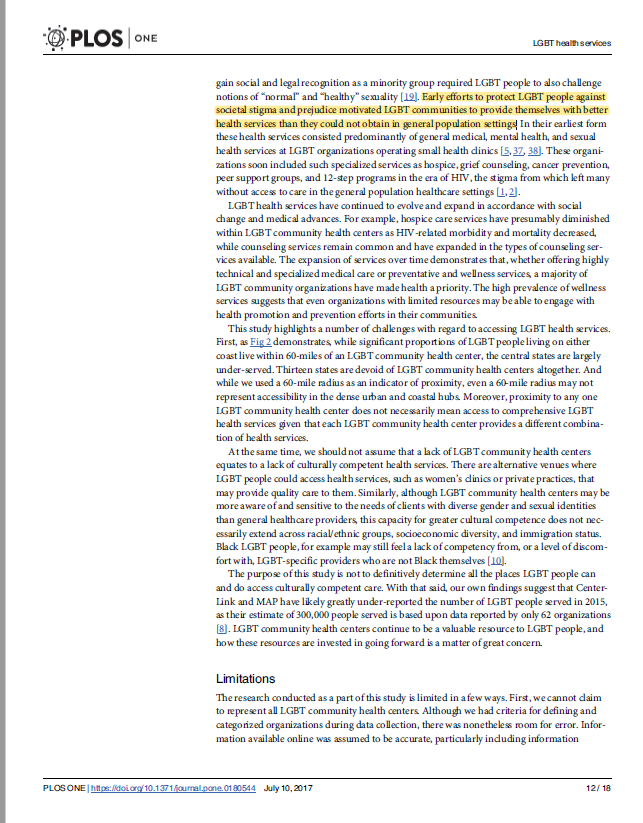
PLOS ONE LGBT health services gain social and legal recognition as a minority group required LGBT people to also challenge notions of "normal" and "healthy" sexuality [19]. Early efforts to protect LGBT people against societal stigma and prejudice motivated LGBT communities to provide themselves with better health services than they could not obtain in general population settings In their earliest form these health services consisted predominantly of general medical, mental health, and sexual health services at LGBT organizations operating small health clinics [5, 37, 38]. These organi- zations soon included such specialized services as hospice, grief counseling, cancer prevention, peer support groups, and 12-step programs in the era of HIV, the stigma from which left many without access to care in the general population healthcare settings [1,2]. LGBT health services have continued to evolve and expand in accordance with social change and medical advances. For example, hospice care services have presumably diminished within LGBT community health centers as HIV-related morbidity and mortality decreased, while counseling services remain common and have expanded in the types of counseling ser- vices available. The expansion of services over time demonstrates that, whether offering highly technical and specialized medical care or preventative and wellness services, a majority of LGBT community organizations have made health a priority. The high prevalence of wellness services suggests that even organizations with limited resources may be able to engage with health promotion and prevention efforts in their communities. This study highlights a number of challenges with regard to accessing LGBT health services. First, as Fig 2 demonstrates, while significant proportions of LGBT people living on either coast live within 60-miles of an LGBT community health center, the central states are largely under-served. Thirteen states are devoid of LGBT community health centers altogether. And while we used a 60-mile radius as an indicator of proximity, even a 60-mile radius may not represent accessibility in the dense urban and coastal hubs. Moreover, proximity to any one LGBT community health center does not necessarily mean access to comprehensive LGBT health services given that each LGBT community health center provides a different combina- tion of health services. At the same time, we should not assume that a lack of LGBT community health centers equates to a lack of culturally competent health services. There are alternative venues where LGBT people could access health services, such as women's clinics or private practices, that may provide quality care to them. Similarly, although LGBT community health centers may be more aware of and sensitive to the needs of clients with diverse gender and sexual identities than general healthcare providers, this capacity for greater cultural competence does not nec- essarily extend across racial/ethnic groups, socioeconomic diversity, and immigration status. Black LGBT people, for example may still feel a lack of competency from, or a level of discom- fort with, LGBT-specific providers who are not Black themselves [10]. The purpose of this study is not to definitively determine all the places LGBT people can and do access culturally competent care. With that said, our own findings suggest that Center- Link and MAP have likely greatly under-reported the number of LGBT people served in 2015, as their estimate of 300,000 people served is based upon data reported by only 62 organizations [8]. LGBT community health centers continue to be a valuable resource to LGBT people, and how these resources are invested in going forward is a matter of great concern. Limitations The research conducted as a part of this study is limited in a few ways. First, we cannot daim to represent all LGBT community health centers. Although we had criteria for defining and categorized organizations during data collection, there was nonetheless room for error. Infor- mation available online was assumed to be accurate, particularly including information PLOS ONE https://doi.org/10.1371/journal.pone.0180544 July 10, 2017 12/18
Step by Step Solution
There are 3 Steps involved in it

Get step-by-step solutions from verified subject matter experts