Question: To get us started on Essay #3, we need to pick our arguments to evaluate. You will first select a topic from the list provided
To get us started on Essay #3, we need to pick our arguments to evaluate. You will first select a topic from the list provided, then find an article or video on that topic that expresses a clear argument on this issue. All of the sites allow you to search by topic, so dig around and skim through to find one that you feel will work for this assignment. Read through the article first before posting to make sure it's the one you want. In your post, 1) identify the article you've chosen (title, author, and link to the article), 2) identify his/her thesis/overall argument, and 3) why you chose this article. What is it that you agree or disagree with the author about?
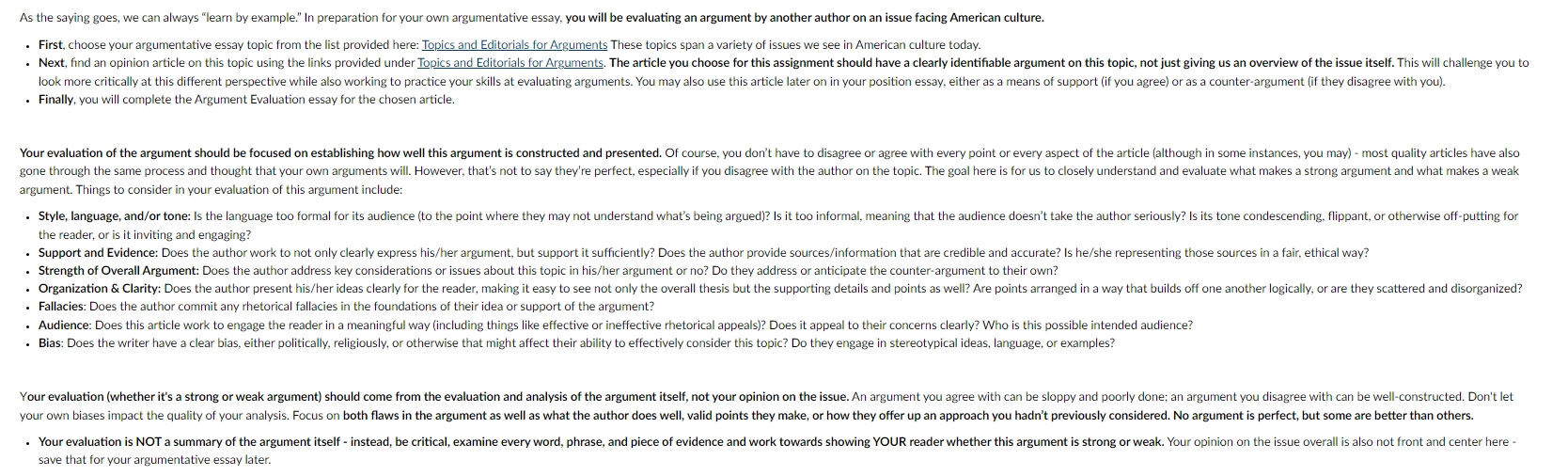
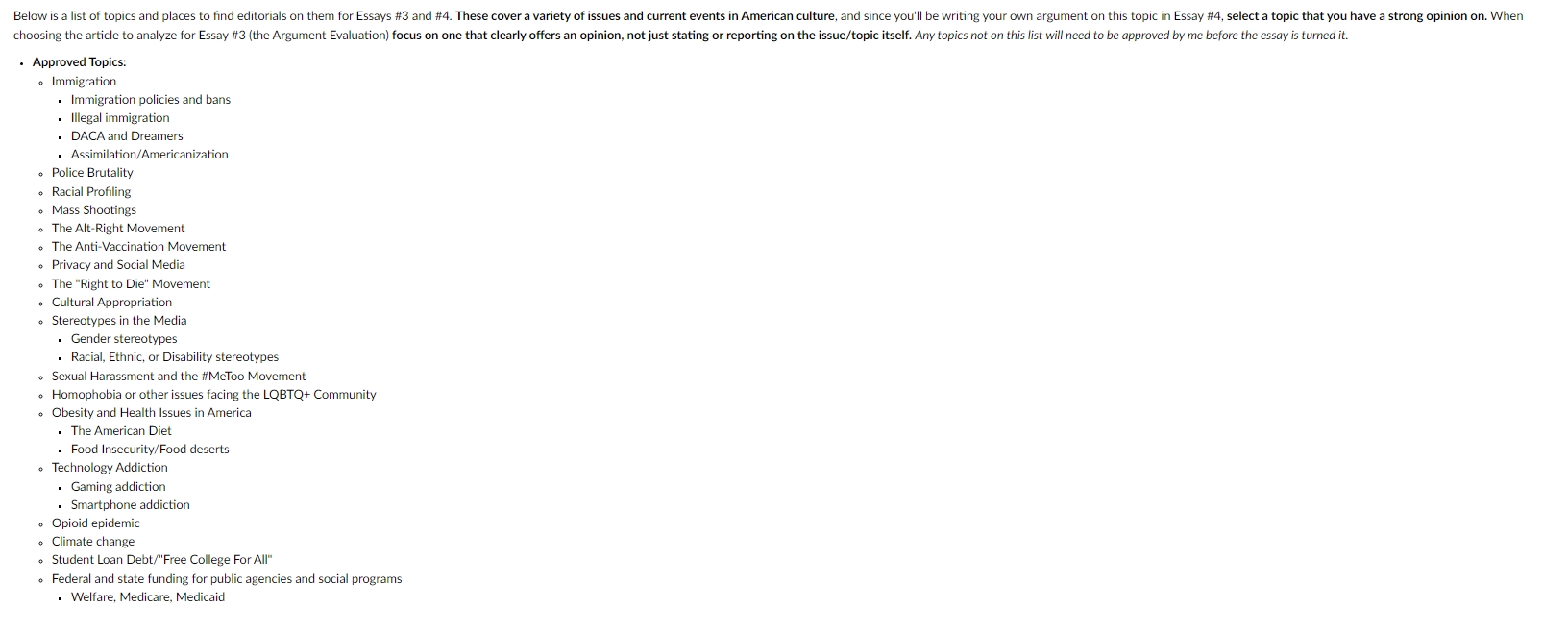
s the saying goes, we can always \"learn by example.\" In preparation for your own argumentative essay, you will be evaluating an argument by another author on an issue facing American culture. First. cheose your argumentative essay tepic fram the list provided here: Topics and Editorials for Arguments These topics span a variety of issues we see in American culture today. + Next, find an opinion article on this topic using the links provided under Topics and Editorials for Arguments. The article you choose for this assignment should have a clearly identifiable argument on this topic, not just giving us an overview of the issue itself. This will challenge you to look more critically at this different perspective while also working to practice your skills at evaluating arguments. You may also use this article later on in your position essay, either as a means of support (if you agree) or as a counter-argument (if they disagree with you). Finally, you will complete the Argument Evaluation essay for the chosen article Your evaluation of the argument should be focused on establishing how well this argument is constructed and presented. Of course. you don't have to disagree or agree with every point or every aspect of the article (although in some instances, you may) - most quality articles have also gone through the same process and thought that your own arguments will. However, that's not to say they're perfect. especially if you disagree with the author on the topic. The goal here is for us to closely understand and evaluate what makes a strong argument and what makes a weak argument. Things to consider in your evaluation of this argument include: . Style, language, and/or tone: Is the language too formal for its audience (to the point where they may not understand what's being argued)? Is it too informal, meaning that the audience doesn't take the author seriously? Is its tone condescending, flippant, or otherwise off-putting for the reader, or is it inviting and engaging? Support and Evidence: Does the author work te not only clearly express his/her argument, but support it sufficiently? Does the author provide sources/information that are credible and accurate? Is he/she representing those sources in a fair, ethical way? Strength of Overall Argument: Does the author address key considerations or issues about this topic in his/her argument or no? Do they address or anticipate the counter-argument to their own? Organization & Clarity: Does the author present his/her ideas clearly for the reader, making it easy to see not only the overall thesis but the supporting details and points as well? Are points arranged in a way that builds off ane another logically, or are they scattered and disorganized? Fallacies: Does the author commit any rhetorical fallacies in the foundations of their idea or support of the argument? Audience: Does this article work Lo engage the reader in a meaningful way (including things like effective or ineffective rhetorical appeals)? Does it appeal to their concerns clearly? Who is this possible intended audience? Bias: Does the writer have a clear bias, either politically, religiously, or otherwise that might affect their ability to effectively consider this topic? Do they engage in stereotypical ideas, language, or examples? 'Your evaluation (whether it's a strong or weak argument) should come from the evaluation and analysis of the argument itself, not your opinion on the issue. An argument you agree with can be sloppy and peorly done; an argument you disagree with can be well-constructed. Don't let your own biases impact the quality of your analysis. Focus on both flaws in the argument as well as what the author does well, valid points they make, or how they offer up an approach you hadn't previously considered. No argument is perfect, but some are better than others. Your evaluation is NOT a summary of the argument itself - instead, be critical, examine every word, phrase, and piece of evidence and work towards showing YOUR reader whether this argument is strong or weak. Your opinion on the issue overall is also not front and center here - save that for your argumentative essay later. Below is a list of topics and places to find editorials an them for Essays #3 and #4. These cover a variety of issues and current events in American culture, and since you'll be writing your own argument on this tepic in Essay #4, select a topic that you have a strong opinion on. When choosing the article to analyze for Essay #3 (the Argument. Evaluation) focus on one that clearly offers an opinion, not just stating or reporting on the issue/topic itself. Any topics not on this list will need to be approved by me before the essay is turned it. - Approved Topics: + Immigration Immigration policies and bans - lllegal immigration = DACA and Dreamers Assimilation/Americanization Police Brutality Racial Profiling Mass Shootings The Alt-Right Movement The Anti-Vaccination Movement Privacy and Social Media The "Right to Die" Movement Cultural Appropriation Stereotypes in the Media - Gender stereotypes + Racial, Ethnic, or Disability stereotypes . . o . o . . o . + Sexual Harassment and the #MeToo Movement Homophobia or other issues facing the LQBTQ+ Community Obesity and Health Issues in America The American Diet - Food Insecurity/Food deserts Technology Addiction Gaming addiction Smartphone addiction Opioid epidemic Climate change Student Loan Debl/Free College For All" Federal and state funding for public agencies and social programs = Welfare, Medicare, Medicaid o . . o o o