







Question: To perform an epistasis test, we would cross two mutants with the same phenotype and observe their progeny. A neomorphic mutation results in an allele
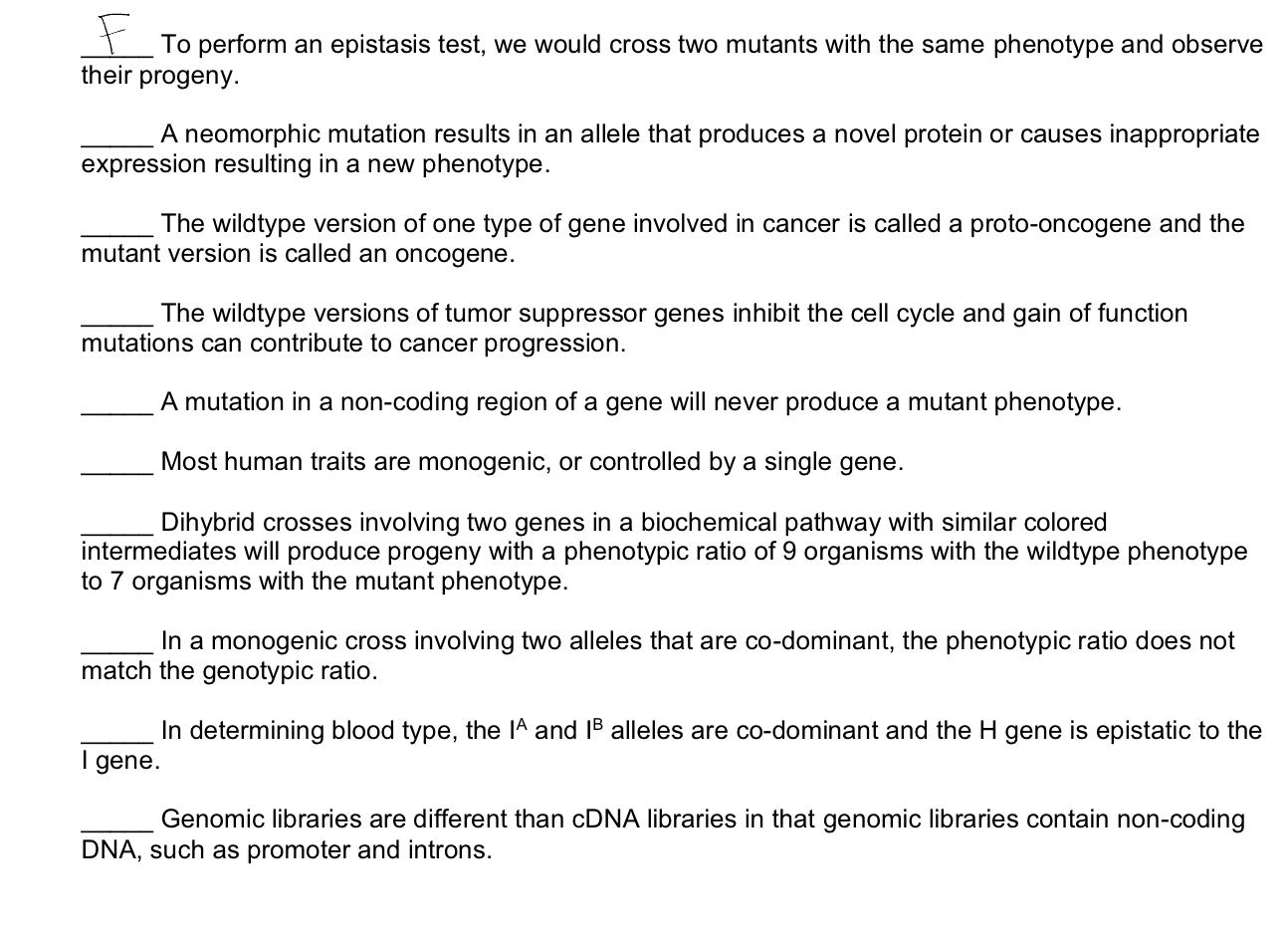
To perform an epistasis test, we would cross two mutants with the same phenotype and observe their progeny.
A neomorphic mutation results in an allele that produces a novel protein or causes inappropriate expression resulting in a new phenotype.
The wildtype version of one type of gene involved in cancer is called a protooncogene and the mutant version is called an oncogene.
The wildtype versions of tumor suppressor genes inhibit the cell cycle and gain of function mutations can contribute to cancer progression.
A mutation in a noncoding region of a gene will never produce a mutant phenotype.
Most human traits are monogenic, or controlled by a single gene.
Dihybrid crosses involving two genes in a biochemical pathway with similar colored intermediates will produce progeny with a phenotypic ratio of organisms with the wildtype phenotype to organisms with the mutant phenotype.
In a monogenic cross involving two alleles that are codominant, the phenotypic ratio does not match the genotypic ratio.
In determining blood type, the and alleles are codominant and the H gene is epistatic to the I gene.
Genomic libraries are different than cDNA libraries in that genomic libraries contain noncoding DNA, such as promoter and introns.
Step by Step Solution
There are 3 Steps involved in it
1 Expert Approved Answer
Step: 1 Unlock

Question Has Been Solved by an Expert!
Get step-by-step solutions from verified subject matter experts
Step: 2 Unlock
Step: 3 Unlock
 Study Help