







Question: To provide proper rounding for floating-point addition, three extra bits are included in right shifts of fractions: guard, round, and sticky. The least-significant of these,
To provide proper rounding for floating-point addition, three extra bits are included in right shifts of fractions: guard, round, and sticky. The least-significant of these, the sticky bit, stays one whenever a 1 bit is shifted through it. In designing the logic for a sticky bit, let the following state transistion table define the actions for R (reset) and I (input) on a D flip-flop.
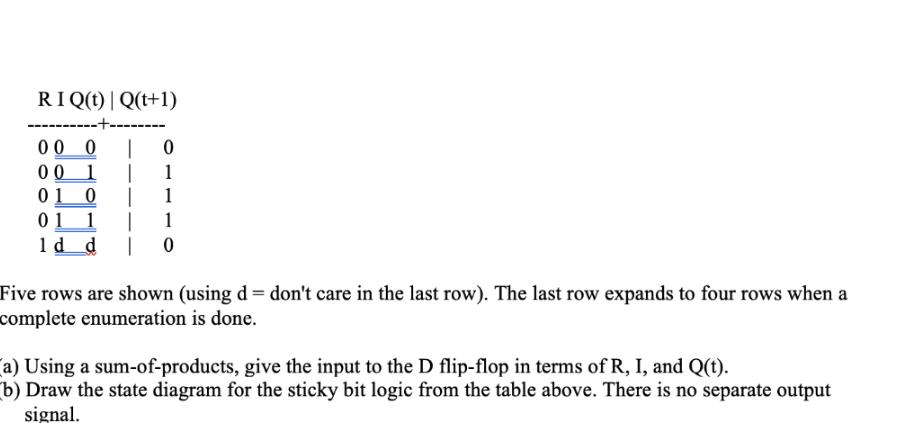
RIQ(t) | Q(t+1) -+-------- 00 0 T 0 00 1 1 1 01 0 1 1 01 1 1 1 ld d |0 Five rows are shown (using d = don't care in the last row). The last row expands to four rows when a complete enumeration is done. (a) Using a sum-of-products, give the input to the D flip-flop in terms of R, I, and Q(t). (b) Draw the state diagram for the sticky bit logic from the table above. There is no separate output signal.
Step by Step Solution
There are 3 Steps involved in it

Get step-by-step solutions from verified subject matter experts
 Study Help