







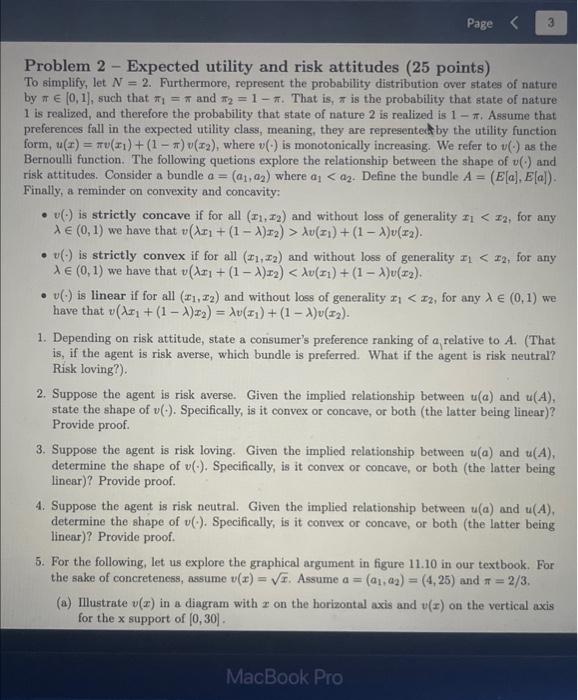
Question: To simplify, let N=2. Furthermore, represent the probability distribution over states of nature by [0,1], such that 1= and 2=1. That is, is the probability
![of nature by [0,1], such that 1= and 2=1. That is, is](https://dsd5zvtm8ll6.cloudfront.net/si.experts.images/questions/2024/10/6702496403834_107670249639e53c.jpg)
To simplify, let N=2. Furthermore, represent the probability distribution over states of nature by [0,1], such that 1= and 2=1. That is, is the probability that state of nature 1 is realized, and therefore the probability that state of nature 2 is realized is 1. Assume that preferences fall in the expected utility class, meaning, they are represented by the utility function form, u(x)=v(x1)+(1)v(x2), where v() is monotonically increasing. We refer to v() as the Bernoulli function. The following quetions explore the relationship between the shape of v() and risk attitudes. Consider a bundle a=(a1,a2) where a1
Step by Step Solution
There are 3 Steps involved in it

Get step-by-step solutions from verified subject matter experts
 Study Help