







Question: To understand how a multiple-server waiting line system with a shared queue compares to a multiple-server waiting line system with a dedicated queue for each
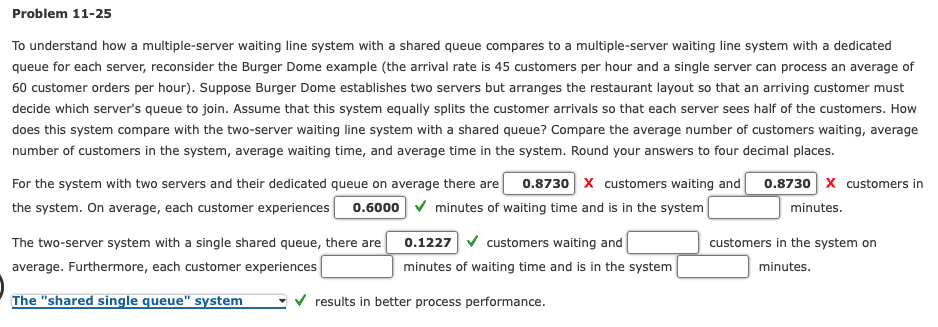
To understand how a multiple-server waiting line system with a shared queue compares to a multiple-server waiting line system with a dedicated queue for each server, reconsider the Burger Dome example (the arrival rate is 45 customers per hour and a single server can process an average of 60 customer orders per hour). Suppose Burger Dome establishes two servers but arranges the restaurant layout so that an arriving customer must decide which server's queue to join. Assume that this system equally splits the customer arrivals so that each server sees half of the customs. How does this system compare with the two-server waiting line system with a shared queue? Compare the average number of customers waiting, average number of customers in the system, average waiting time, and average time in the system. Round your answers to four decimal places. For the system with two servers and their dedicated queue on average there are X customers waiting and X customers in the system. On average, each customer experiences minutes of waiting time and is in the system minutes. The two-server system with a single shared queue, there are customers waiting and average. Furthermore, each customer experiences minutes of waiting time and is in the system customers in the system on minutes. results in better process performance. To understand how a multiple-server waiting line system with a shared queue compares to a multiple-server waiting line system with a dedicated queue for each server, reconsider the Burger Dome example (the arrival rate is 45 customers per hour and a single server can process an average of 60 customer orders per hour). Suppose Burger Dome establishes two servers but arranges the restaurant layout so that an arriving customer must decide which server's queue to join. Assume that this system equally splits the customer arrivals so that each server sees half of the customs. How does this system compare with the two-server waiting line system with a shared queue? Compare the average number of customers waiting, average number of customers in the system, average waiting time, and average time in the system. Round your answers to four decimal places. For the system with two servers and their dedicated queue on average there are X customers waiting and X customers in the system. On average, each customer experiences minutes of waiting time and is in the system minutes. The two-server system with a single shared queue, there are customers waiting and average. Furthermore, each customer experiences minutes of waiting time and is in the system customers in the system on minutes. results in better process performance
Step by Step Solution
There are 3 Steps involved in it

Get step-by-step solutions from verified subject matter experts
 Study Help