







Question: To write an effective and concise executive summary, use only the most important details and supporting statistics or information Omit the details of technical content
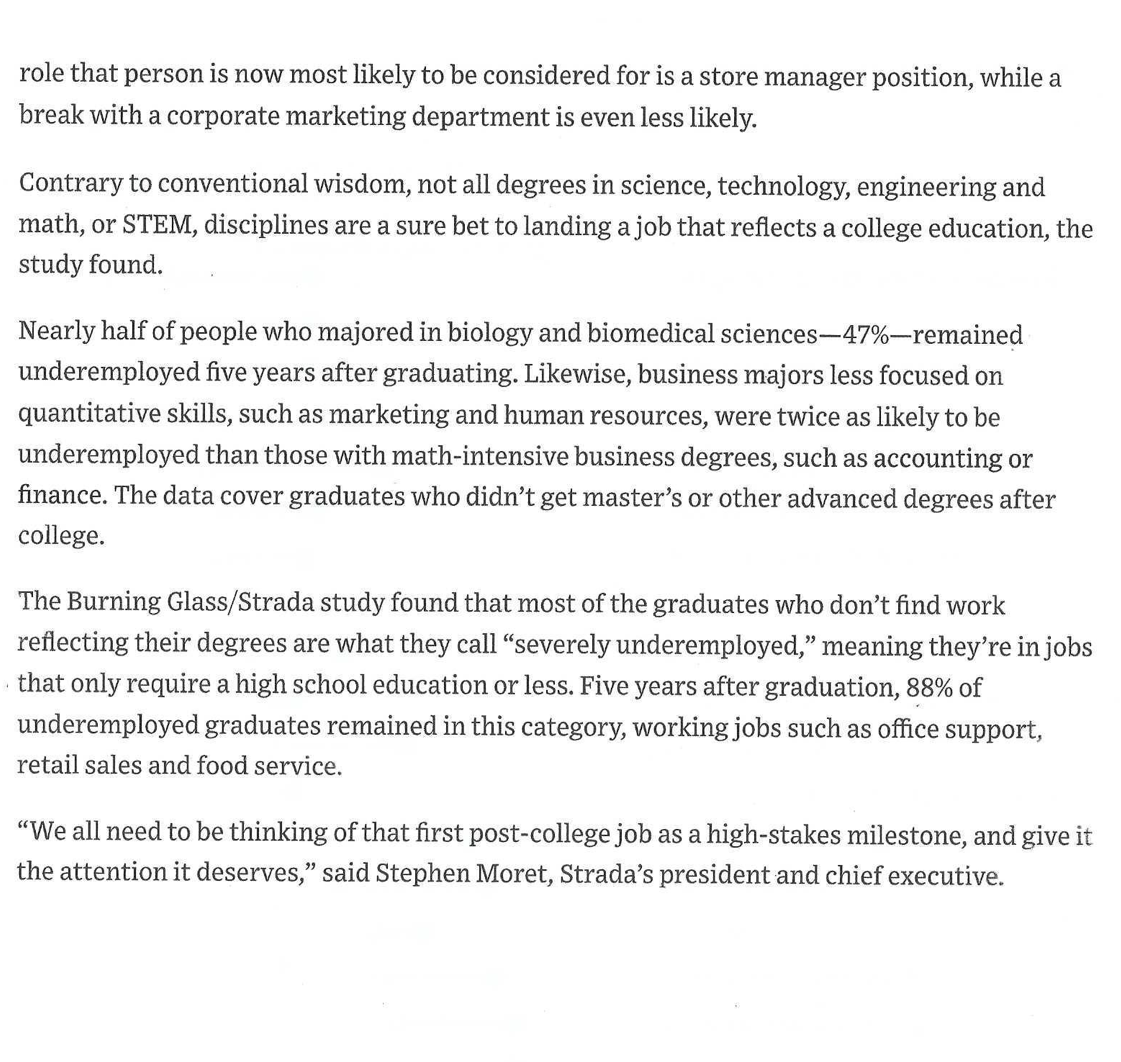
To write an effective and concise executive summary, use only the most important details and supporting statistics or information Omit the details of technical content that readers do not need to know or would be unnecessarily be confused by please one (1) paragraph summary of the the most important points made in the Wall Street Journal Article entitled: "Half of College Grads are Working Jobs that Don't Use Their Degrees". The target audience is first year college students.
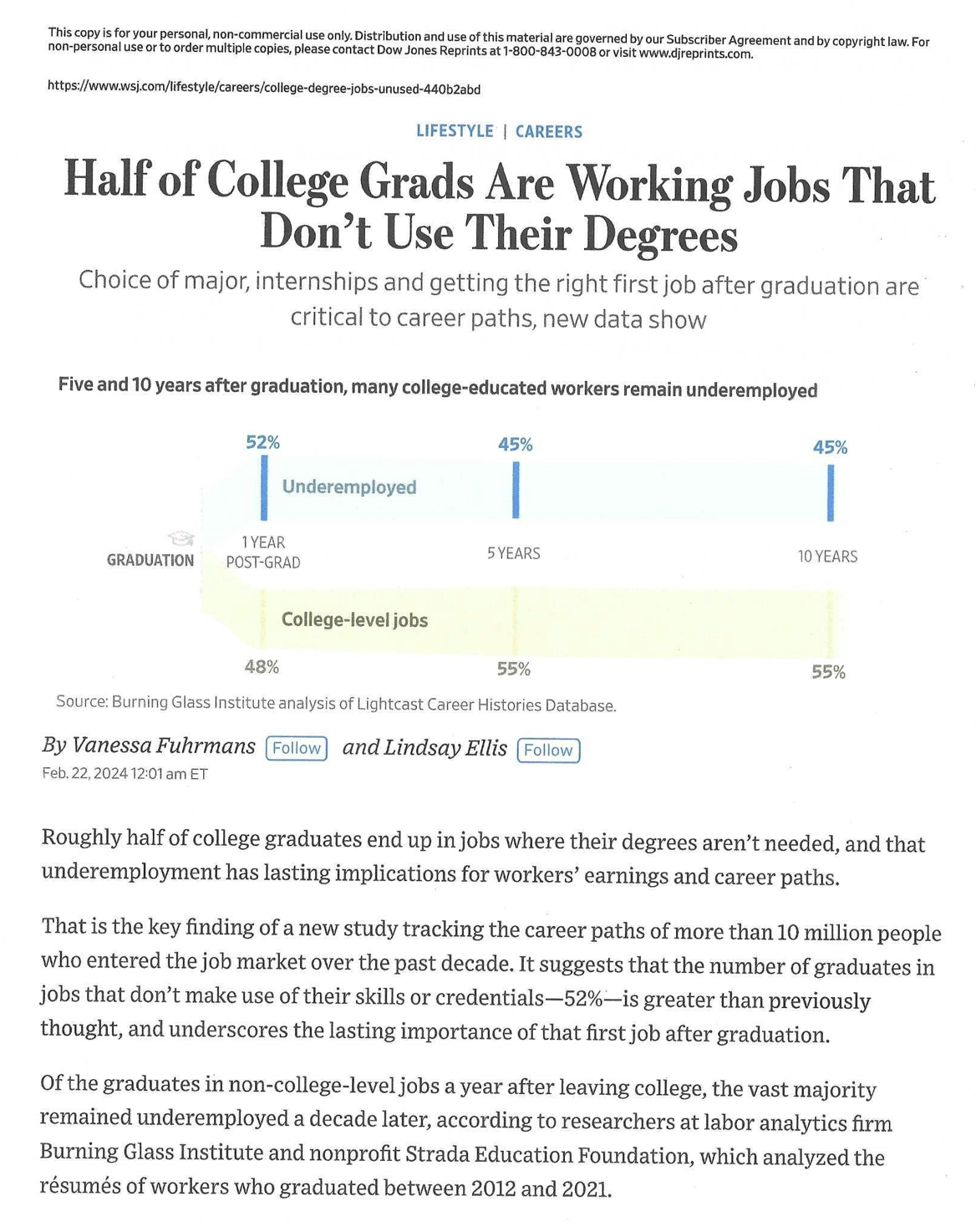
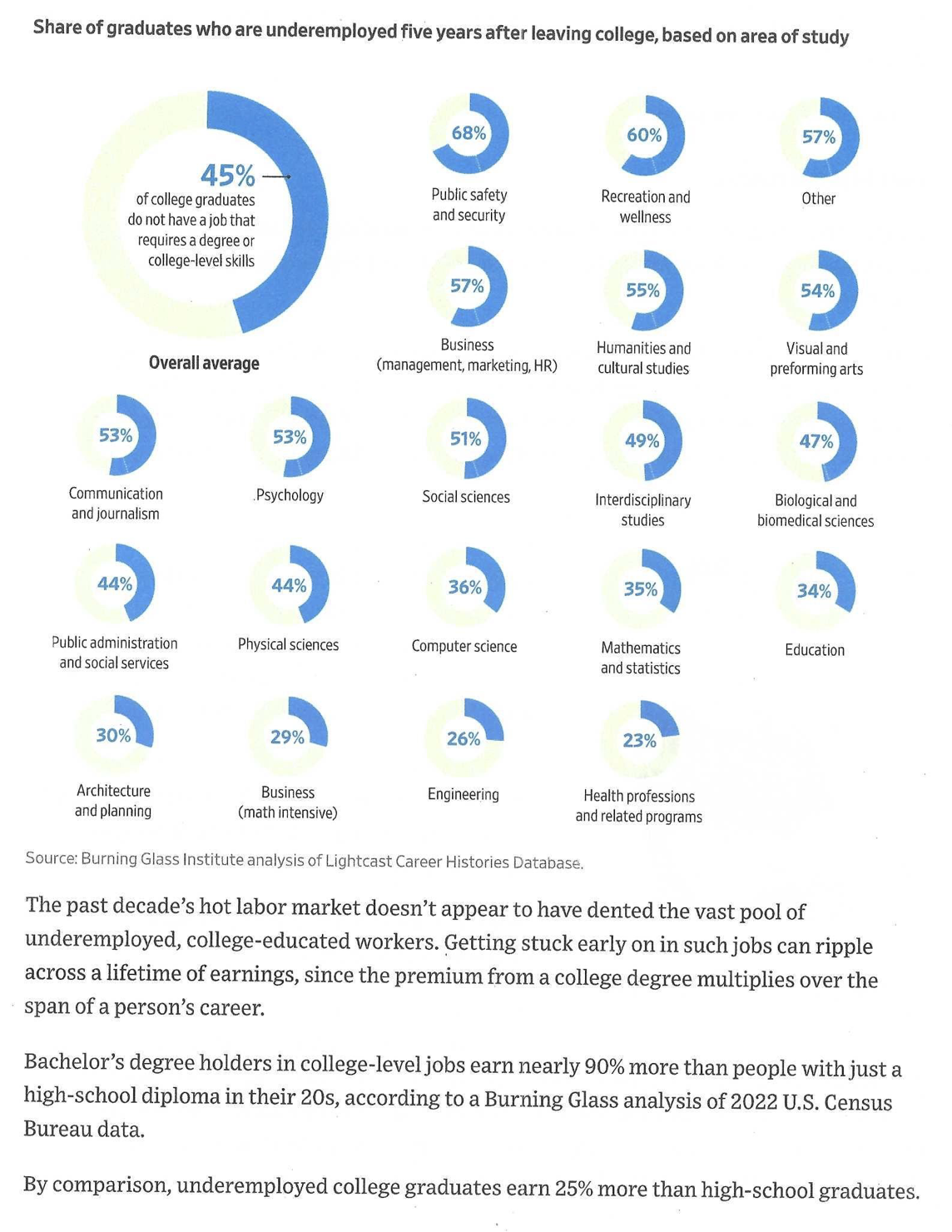
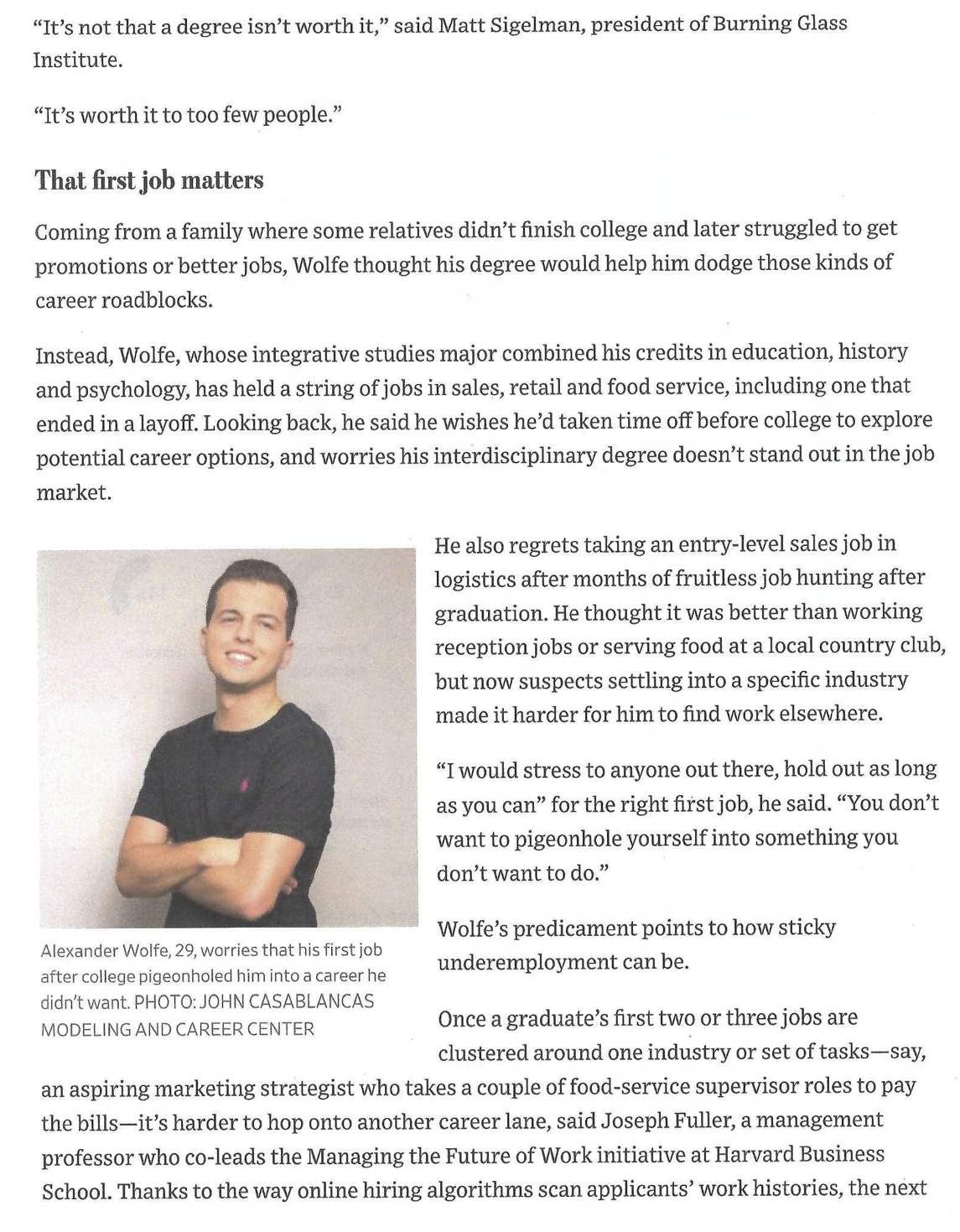
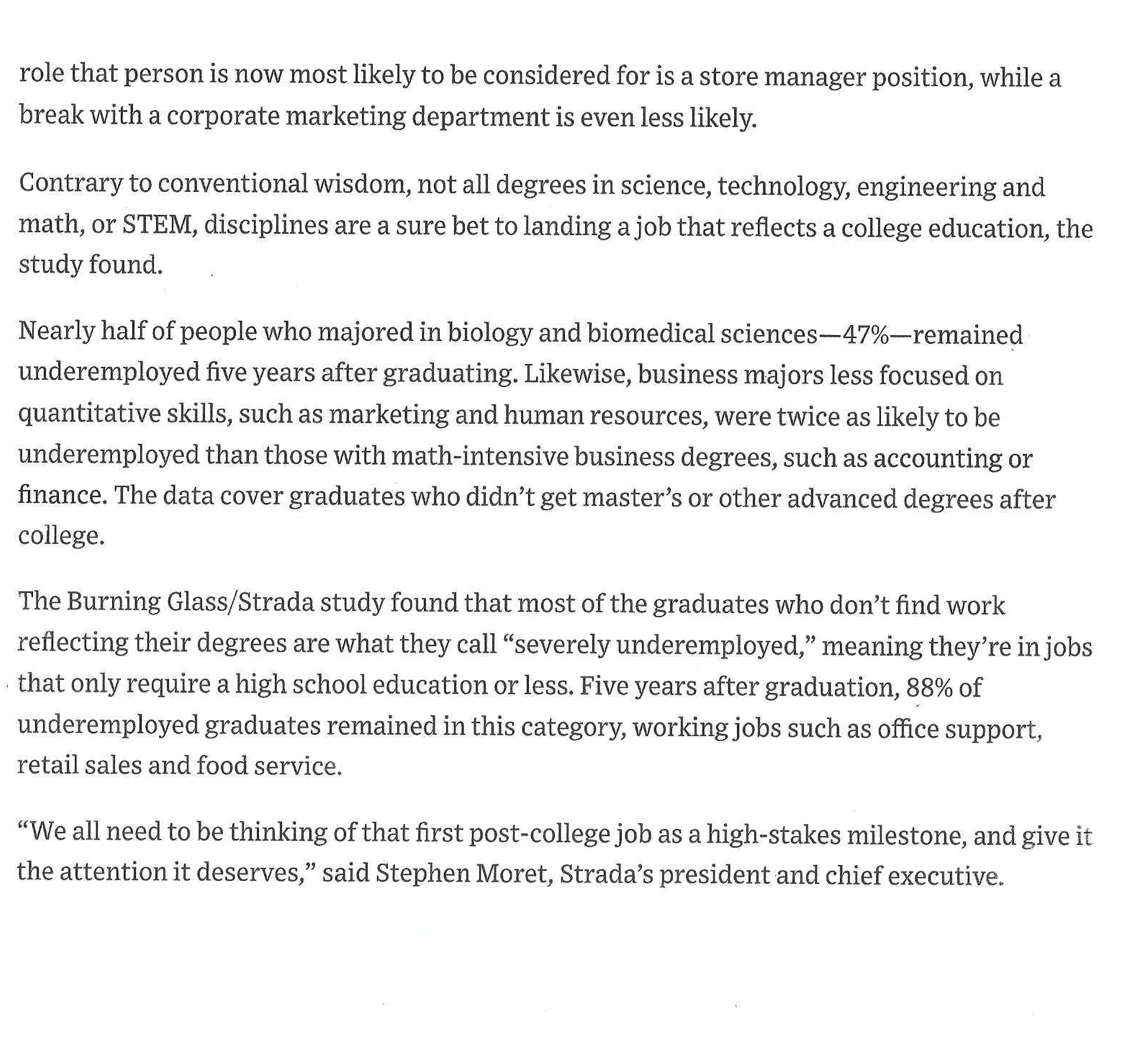
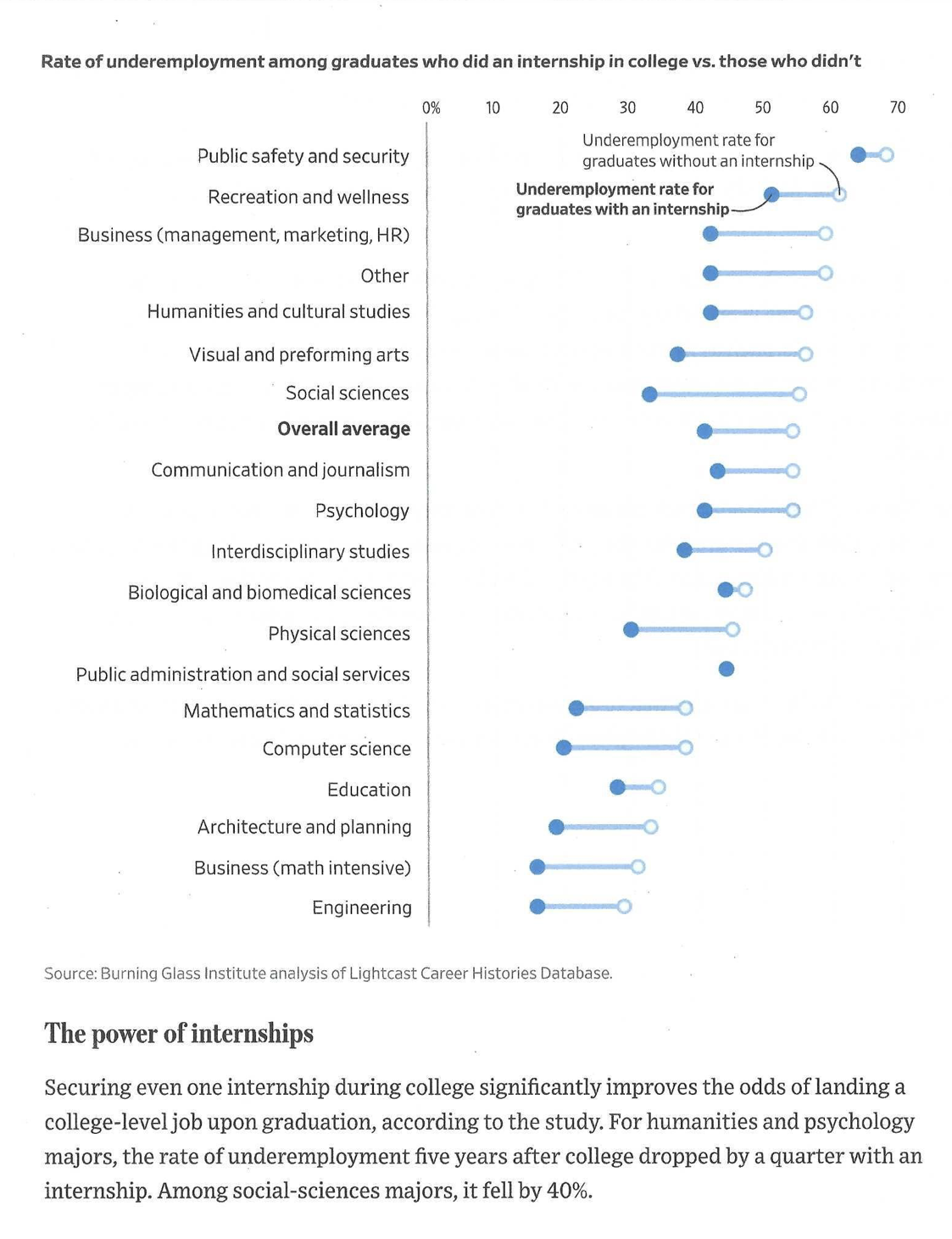
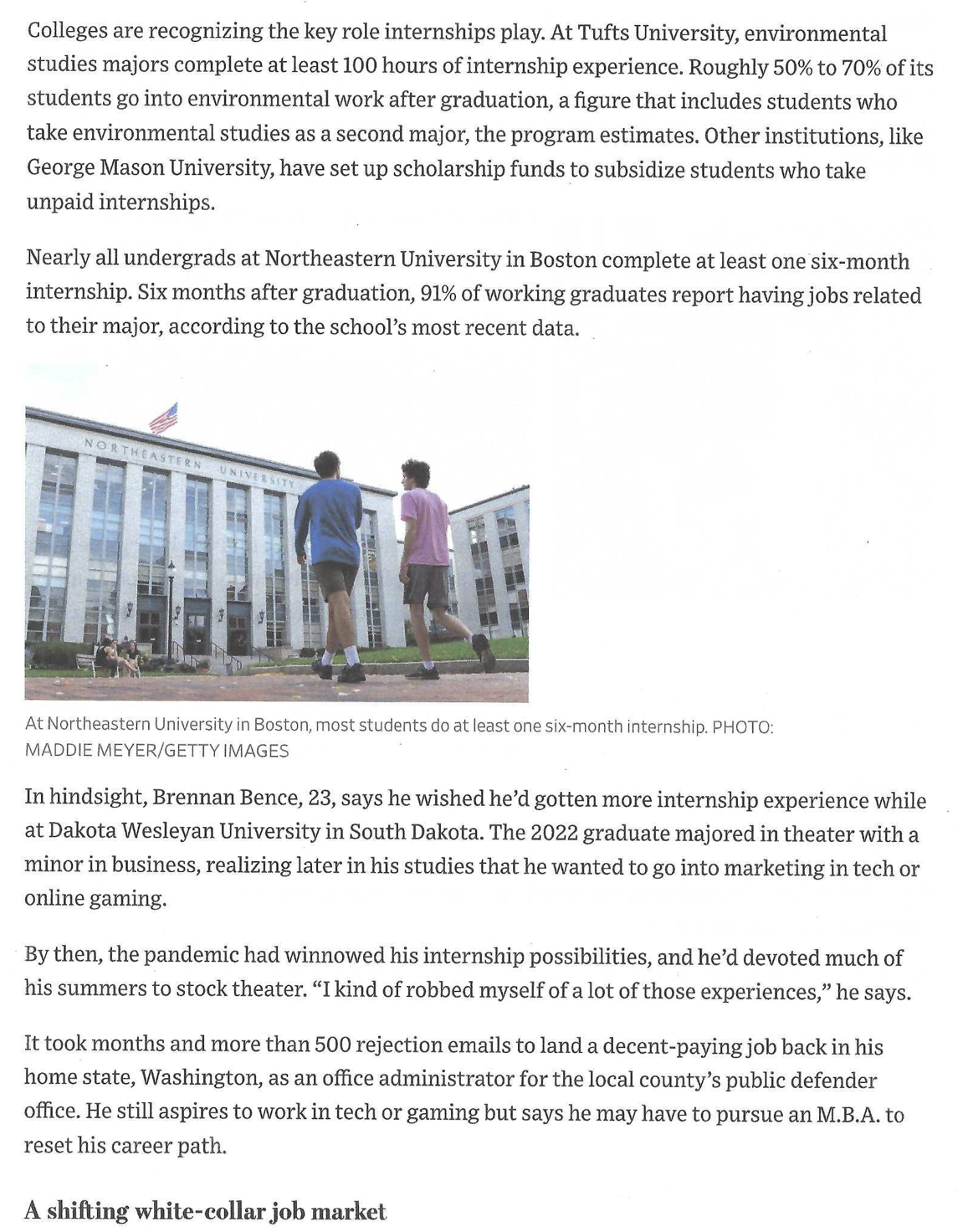
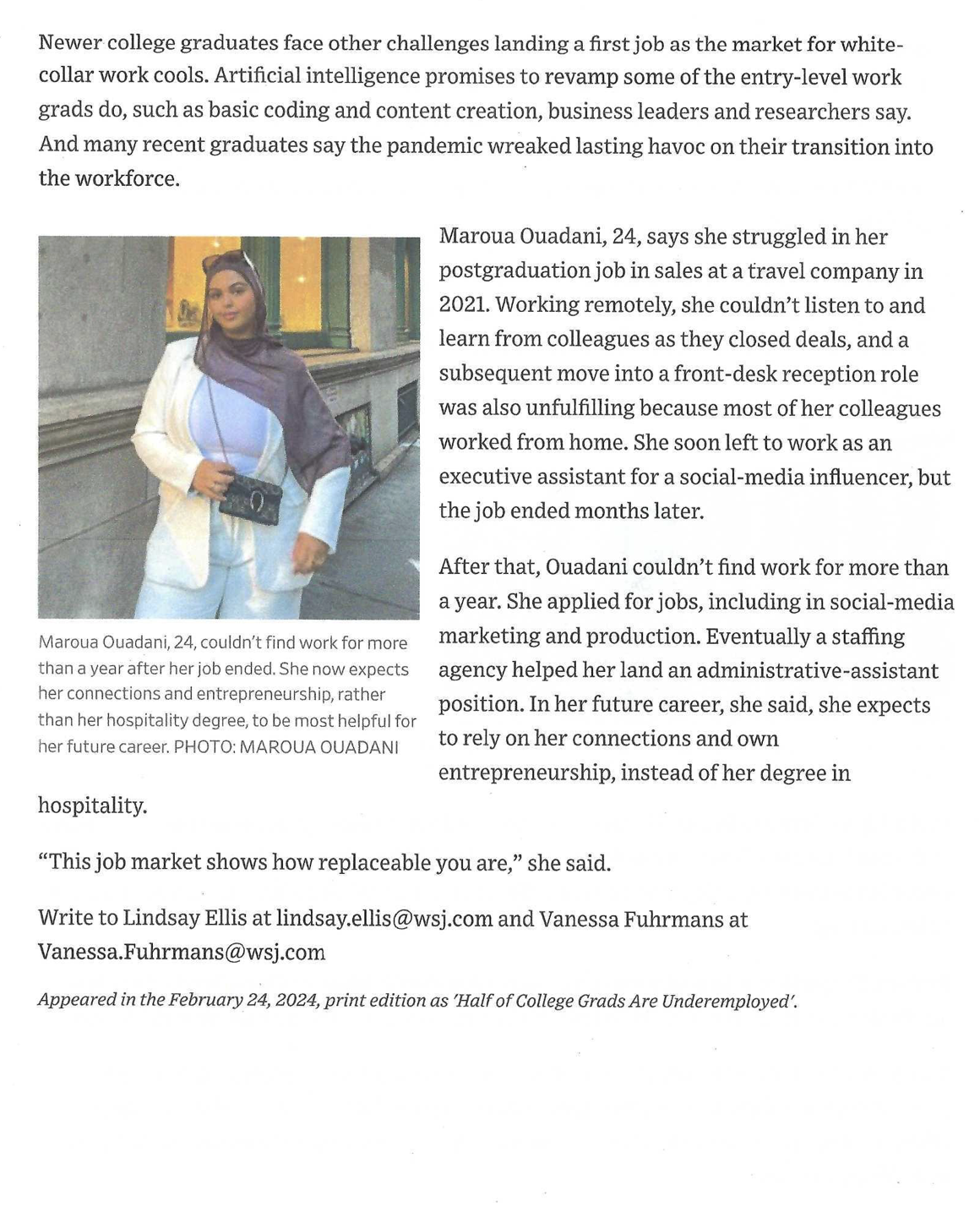
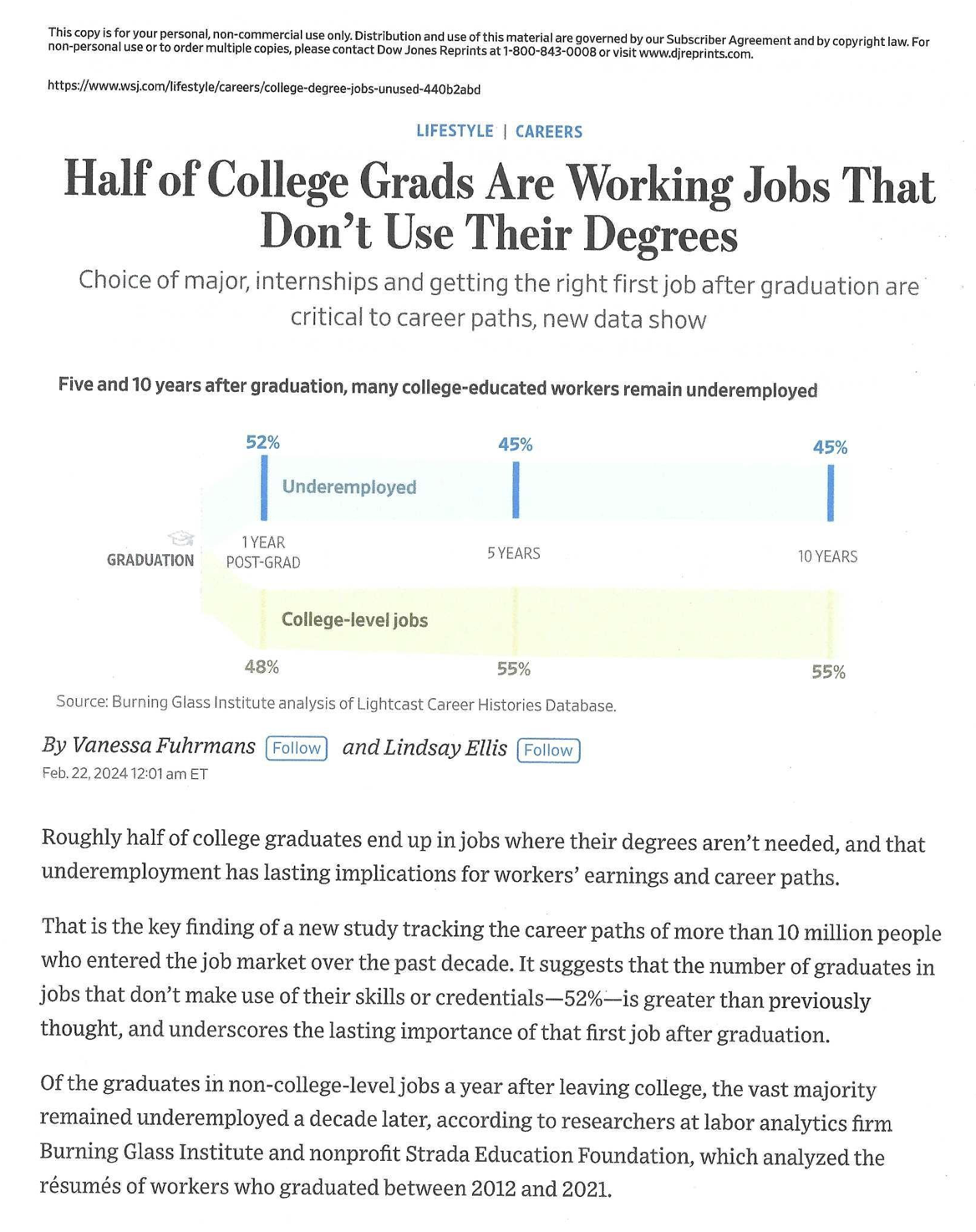
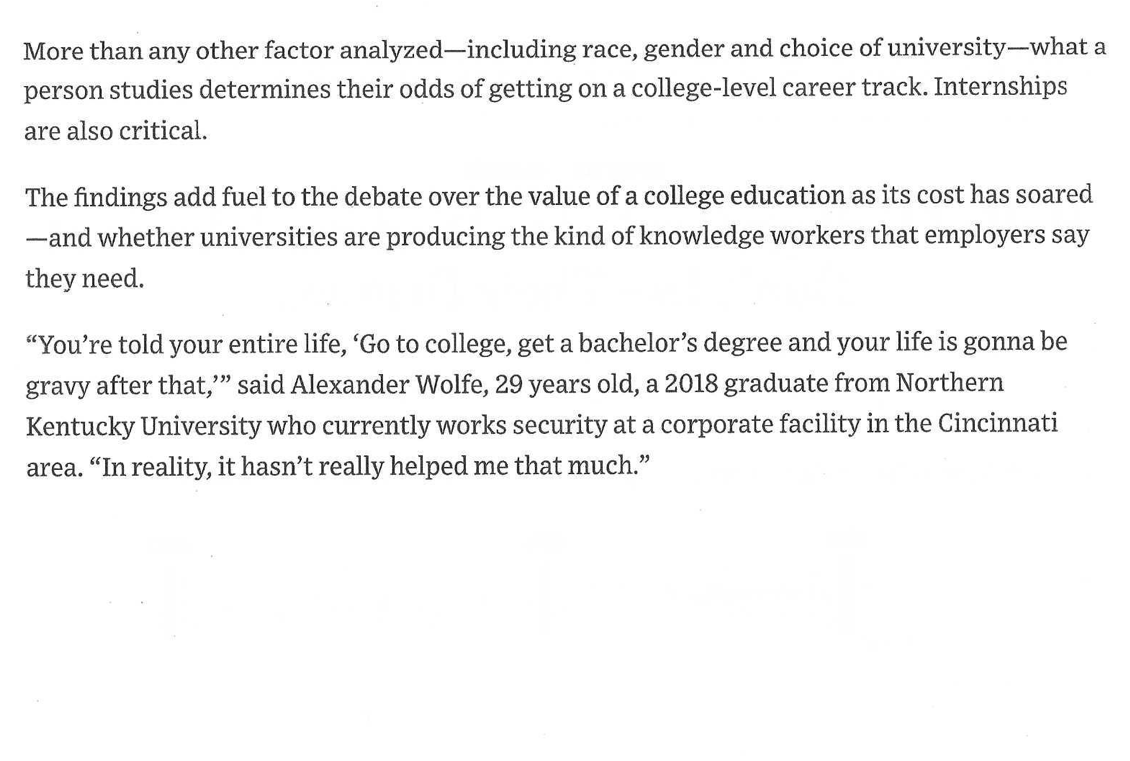
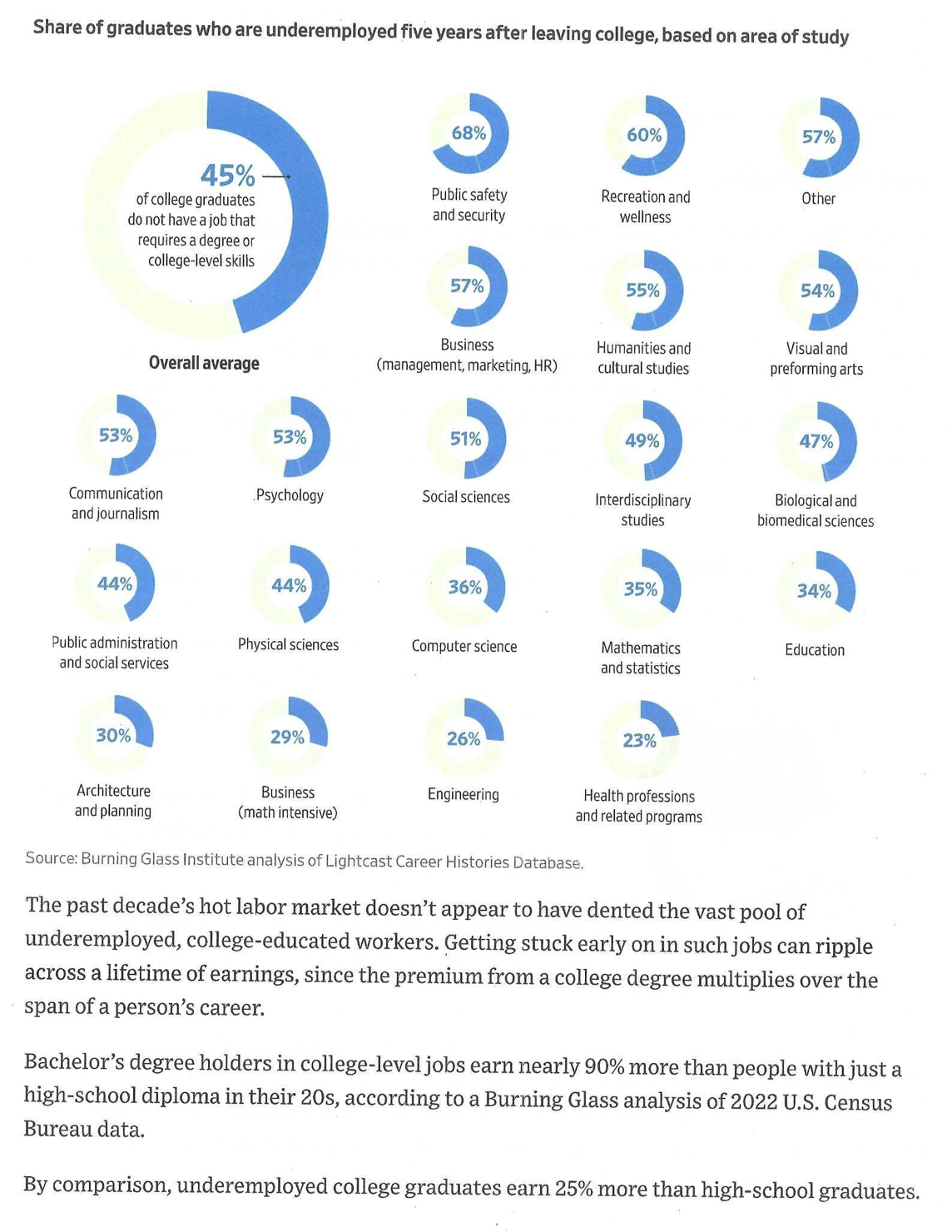
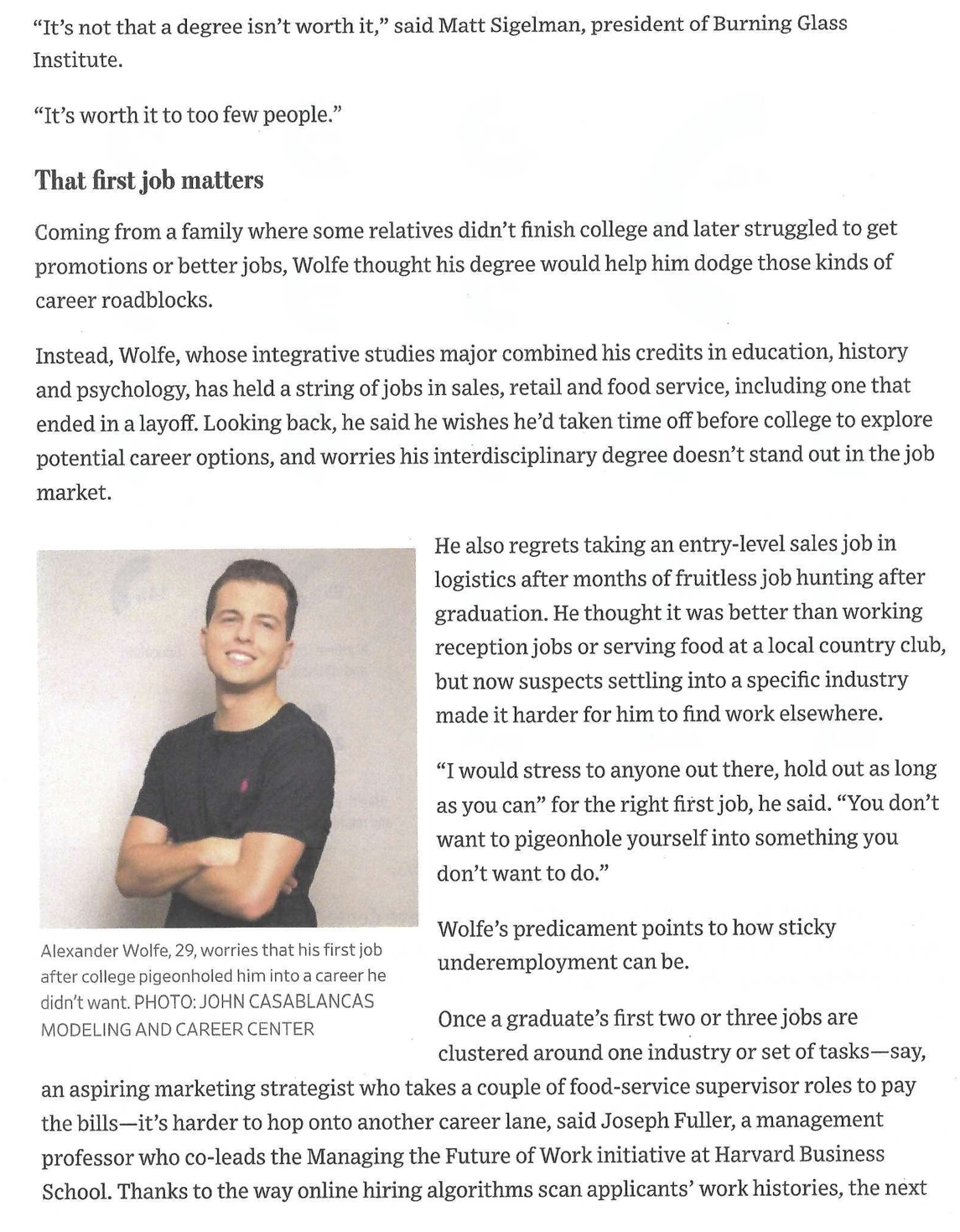
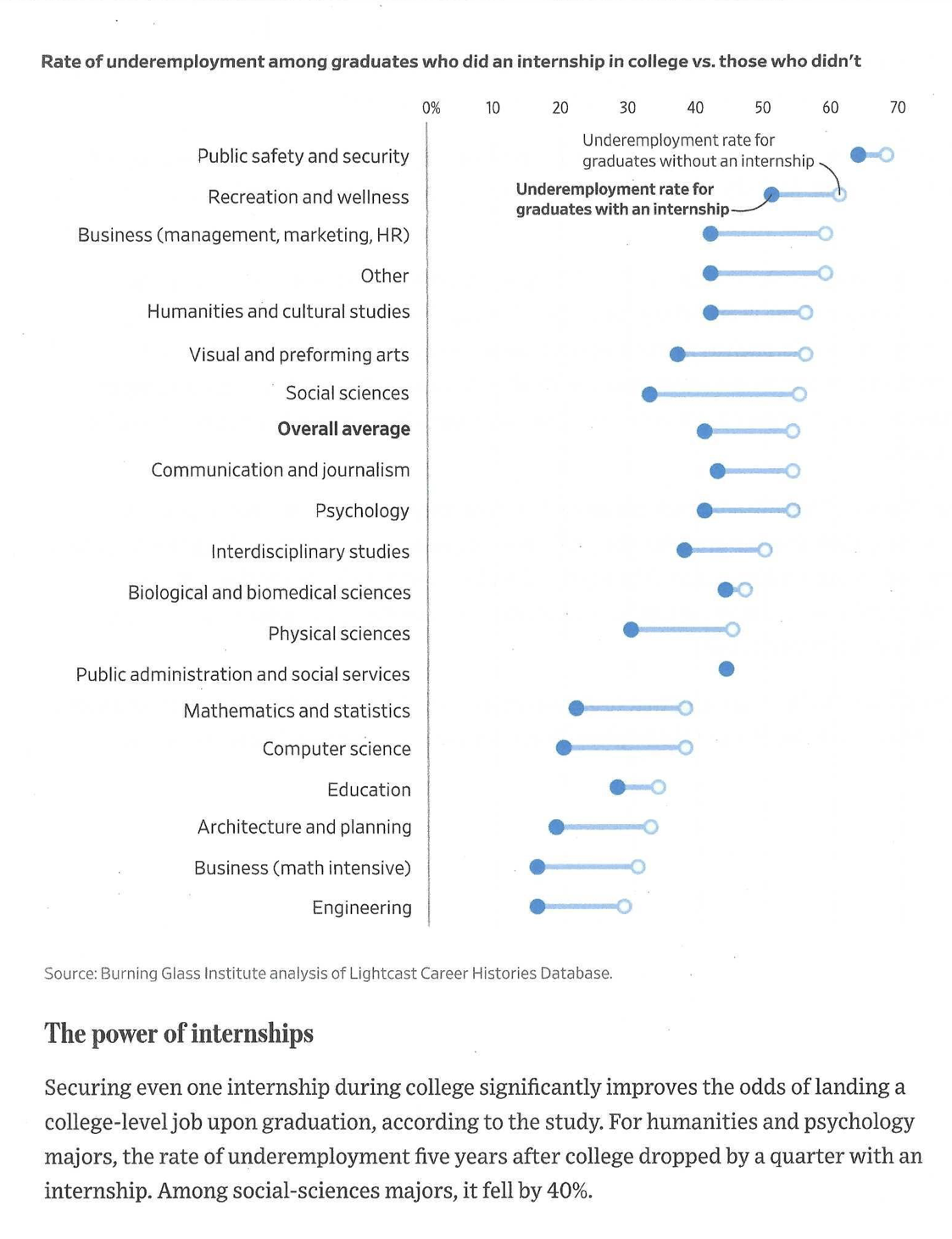
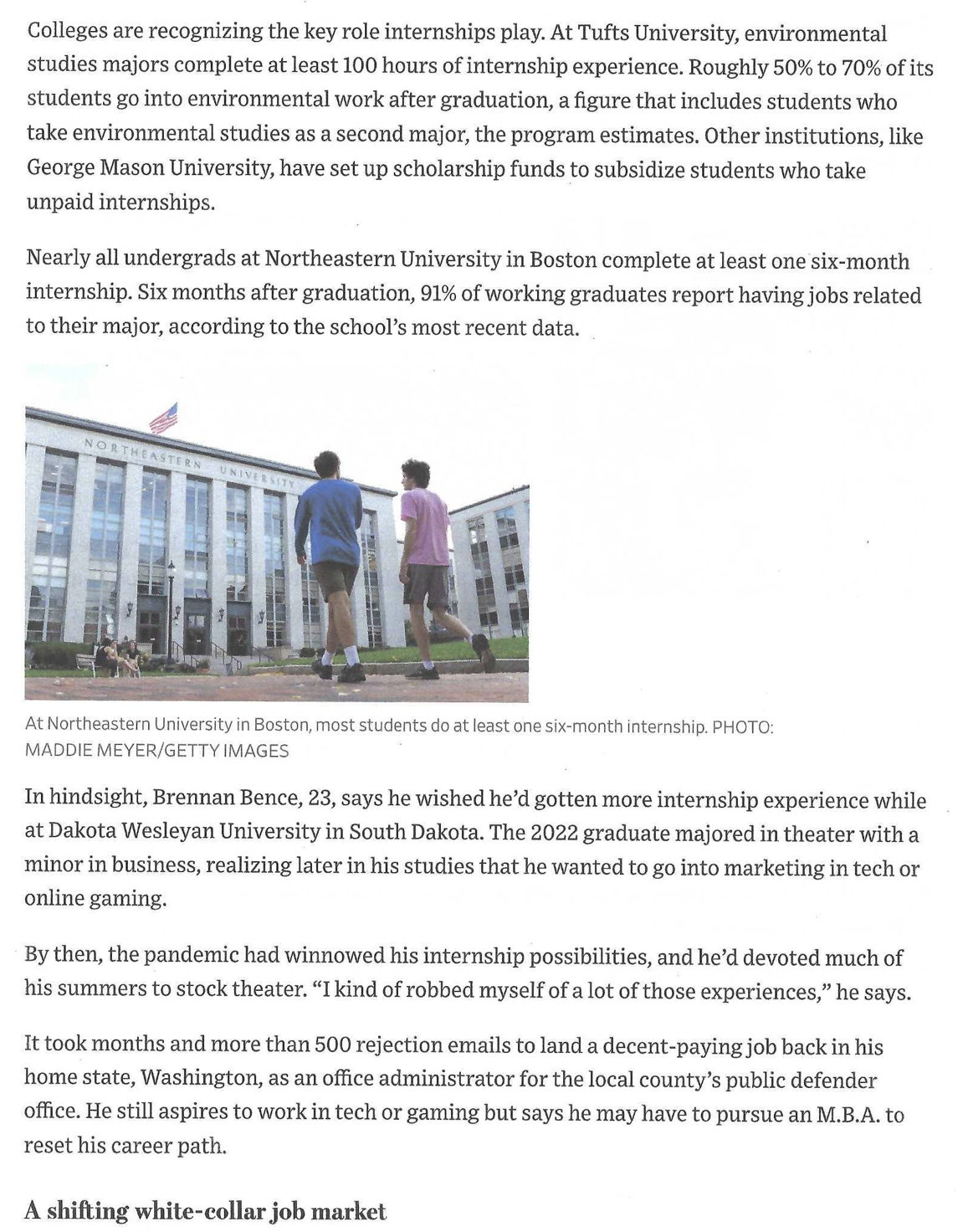
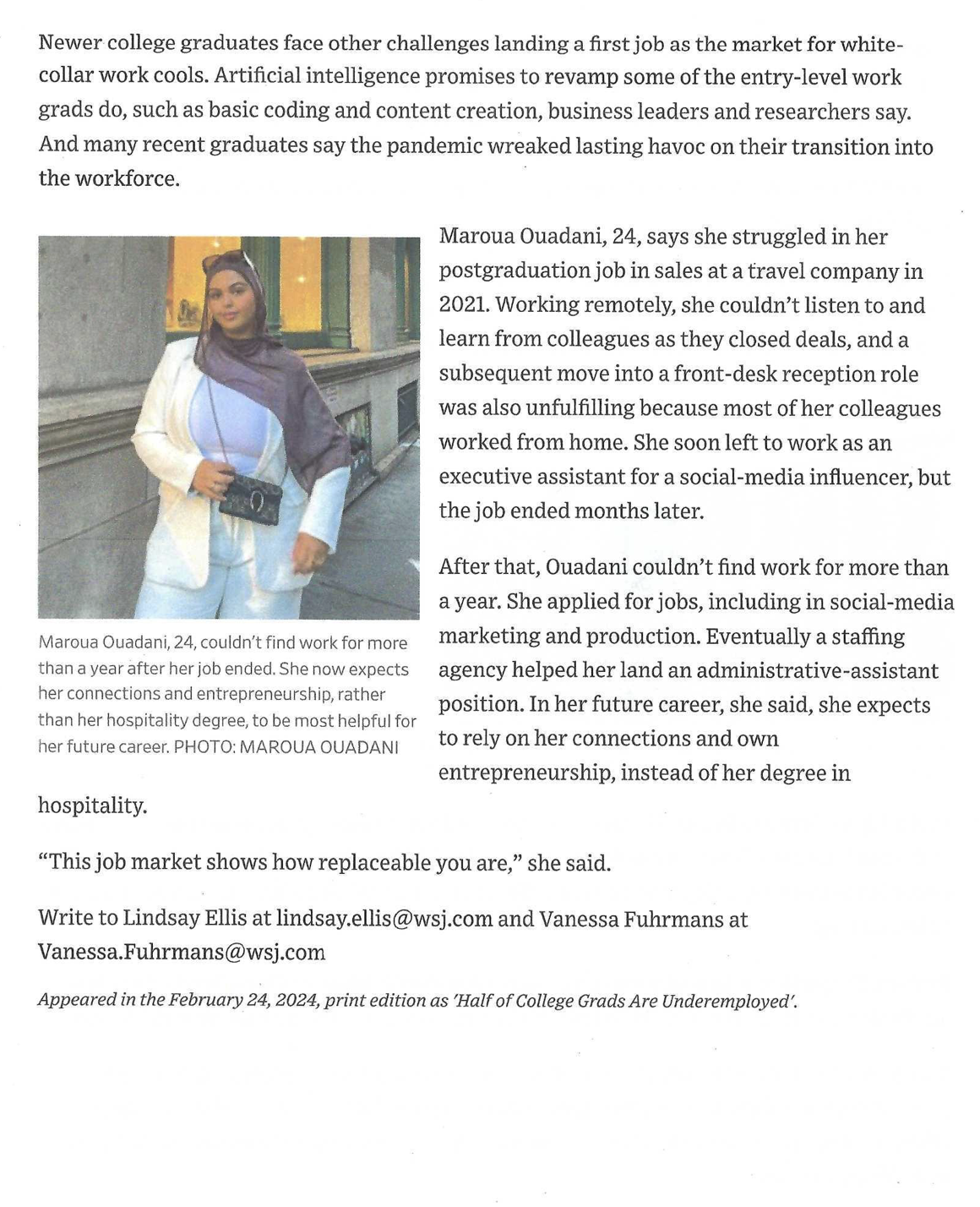
This copy is for your personal, non-commercial use only. Distribution and use of this material are governed by our Subscriber Agreement and by copyright law. For non-personal use or to order multiple copies, please contact Dow Jones Reprints at 1-800-843-0008 or visit www.djreprints.com. https://www.wsj.com/lifestyle/careers/college-degree-jobs-unused-440b2abd LIFESTYLE | CAREERS Half of College Grads Are Working Jobs That Don't Use Their Degrees Choice of major, internships and getting the right first job after graduation are critical to career paths, new data show Five and 10 years after graduation, many college-educated workers remain underemployed 52% 45% 45% Underemplioyed 1YEAR GRADUATION POST-GRAD BRIA 10 YEARS College-level jobs 48% 55% 55% Source: Burning Glass Institute analysis of Lightcast Career Histories Database. By Vanessa Fuhrmans and Lindsay Ellis Feb.22,202412:01amET Roughly half of college graduates end up in jobs where their degrees aren't needed, and that underemployment has lasting implications for workers' earnings and career paths. That is the key finding of a new study tracking the career paths of more than 10 million people who entered the job market over the past decade. It suggests that the number of graduates in jobs that don't make use of their skills or credentials52%is greater than previously thought, and underscores the lasting importance of that first job after graduation. Of the graduates in non-college-level jobs a year after leaving college, the vast majority remained underemployed a decade later, according to researchers at labor analytics firm Burning Glass Institute and nonprofit Strada Education Foundation, which analyzed the rsums of workers who graduated between 2012 and 2021. More than any other factor analyzedincluding race, gender and choice of universitywhat a person studies determines their odds of getting on a college-level career track. Internships are also critical. The findings add fuel to the debate over the value of a college education as its cost has soared and whether universities are producing the kind of knowledge workers that employers say they need. \"You're told your entire life, 'Go to college, get a bachelor's degree and your life is gonna be gravy after that,'\" said Alexander Wolfe, 29 years old, a 2018 graduate from Northern Kentucky University who currently works security at a corporate facility in the Cincinnati area. \"Inreality, it hasn't really helped me that much.\" Share of graduates who are underemployed five years after leaving college, based on area of study 45% of college graduates do not have ajob that requires a degree or college-level skills Overall average 53% 53% Communication .Psychology and journalism 44% 44% Public administration and social services o\\ Architecture and planning Physical sciences i, Business (math intensive) G 68% 60% ' Public safety Recreation and and security wellness 57% ' 55% ' Business Humanities and (management, marketing, HR) cultural studies 51% 493 Social sciences Interdisciplinary ) =4 studies 36% 35% Computer science Mathematics and statistics 26% 23% Engineering Health professions and related programs Source: Burning Glass Institute analysis of Lightcast Career Histories Database. 57% & Other 54% o Visualand preforming arts 47% \\ 4 Biological and biomedical sciences w 8 a2 Education The past decade's hot labor market doesn't appear to have dented the vast pool of underemployed, college-educated workers. Getting stuck early on in such jobs can ripple across a lifetime of earnings, since the premium from a college degree multiplies over the - span of a person's career. Bachelor's degree holders in college-level jobs earn nearly 90% more than people with just a high-school diploma in their 20s, according to a Burning Glass analysis of 2022 U.S. Census Bureau data. By comparison, underemployed college graduates earn 25% more than high-school graduates. \"It's not that a degree isn't worth it,\" said Matt Sigelman, president of Burning Glass Institute. \"It's worth it to too few people.\" That first job matters Coming from a family where some relatives didn't finish college and later struggled to get promotions or better jobs, Wolfe thought his degree would help him dodge those kinds of career roadblocks. Instead, Wolfe, whose integrative studies major combined his credits in education, history and psychology, has held a string of jobs in sales, retail and food service, including one that ended in a layoff. Looking back, he said he wishes he'd taken time off before college to explore potential career options, and worries his interdisciplinary degree doesn't stand out in the job market. He also regrets taking an entry-level sales job in logistics after months of fruitless job hunting after graduation. He thought it was better than working reception jobs or serving food at a local country club, but now suspects settling into a specific industry made it harder for him to find work elsewhere. \"Iwould stress to anyone out there, hold out as long as you can\" for the right first job, he said. \"You don't want to pigeonhole yourself into something you don't want to do.\" Wolfe's predicament points to how sticky Alexander Wolfe, 29, worries that his first job underemployment can be. after college pigeonholed him into a career he didn't want. PHOTO: JOHN CASABLANCAS - MODELING AND CAREER CENTER Once a graduate's first two or three jobs are clustered around one indl.istry or set of taskssay, an aspiring marketing strategist who takes a couple of food-service supervisor roles to pay the billsit's harder to hop onto another career lane, said Joseph Fuller, a management professor who co-leads the Managing the Future of Work initiative at Harvard Business School. Thanks to the way online hiring algorithms scan applicants' work histories, the next role that person is now most likely to be considered for is a store manager position, while a break with a corporate marketing department is even less likely. Contrary to conventional wisdom, not all degrees in science, technology, engineering and math, or STEM, disciplines are a sure bet to landing a job that reflects a college education, the study found. Nearly half of people who majored in biology and biomedical sciences47%remained underemployed five years after graduating. Likewise, business majors less focused on quantitative skills, such as marketing and human resources, were twice as likely to be underemployed than those with math-intensive business degrees, such as accounting or finance. The data cover graduates who didn't get master's or other advanced degrees after college. The Burning Glass/Strada study found that most of the graduates who don't find work reflecting their degrees are what they call \"severely underemployed,\" meaning they're in jobs - that only require a high school education or less. Five years after graduation, 88% of underemployed graduates remained in this category, working jobs such as office support, retail sales and food service. \"We all need to be thinking of that first post-college job as a high-stakes milestone, and give it the attention it deserves,\" said Stephen Moret, Strada's president and chief executive. Rate of underemployment among graduates who did an internship in college vs. those who didn't 0% 10 20 30 40 50 60 70 | Underemployment rate for Public safety and security graduates without an internship Underemployment rate for _/. \\ graduates with an internship Recreation and wellness Business (management, marketing, HR) Other Humanities and cultural studies Visual and preforming arts Social sciences Overall average Communication and journalism Interdisciplinary studies Biological and biomedical sciences Physical sciences Public administ_ration and social services Mathematics and statistics Computer science Education | E | | | & Psychology & E | | 1 | Architecture and planning | 1 | Business (math intensive) Engineering | & Source: Burning Glass Institute analysis of Lightcast Career Histories Database. The power of internships Securing even one internship during college significantly improves the odds of landing a college-level job upon graduation, according to the study. For humanities and psychology majors, the rate of underemployment five years after college dropped by a quarter with an internship. Among social-sciences majors, it fell by 40%. Colleges are recognizing the key role internships play. At Tufts University, environmental studies majors complete at least 100 hours of internship experience. Roughly 50% to 70% of its students go into environmental work after graduation, a figure that includes students who take environmental studies as a second major, the program estimates. Other institutions, like George Mason University, have set up scholarship funds to subsidize students who take unpaid internships. Nearly all undergrads at Northeastern University in Boston complete at least one six-month internship. Six months after graduation, 91% of working graduates report having jobs related to their major, according to the school's most recent data. At Northeastern University in Boston, most students do at least one six-month internship. PHOTO: MADDIE MEYER/GETTY IMAGES ' In hindsight, Brennan Bence, 23, says he wished he'd gotten more internship experience while at Dakota Wesleyan University in South Dakota. The 2022 graduate majored in theater with a minor in business, realizing later in his studies that he wanted to go into marketing in tech or online gaming. By then, the pandemic had winnowed his internship possibilities, and he'd devoted much of his summers to stock theater. \"I'kind of robbed myself of a lot of those experiences,\" he says. It took months and more than 500 rejection emails to land a decent-paying job back in his home state, Washington, as an office administrator for the local county's public defender office. He still aspires to work in tech or gaming but says he may have to pursue an M.B.A. to reset his career path. A shifting white-collar job market Newer college graduates face other challenges landing a first job as the market for white- collar work cools. Artificial intelligence promises to revamp some of the entry-level work grads do, such as basic coding and content creation, business leaders and researchers say. And many recent graduates say the pandemic wreaked lasting havoc on their transition into the workforce. Maroua Quadani, 24, couldn't find work for more than a year after her job ended. She now expects her connections and entrepreneurship, rather than her hospitality degree, to be most helpful for her future career. PHOTO: MAROUA QUADANI hospitality. Maroua Ouadani, 24, says she struggled in her postgraduation job in sales at a travel company in 2021. Working remotely, she couldn't listen to and learn from colleagues as they closed deals, and a subsequent move into a front-desk reception role was also unfulfilling because most of her colleagues worked from home. She soon left to work as an executive assistant for a social-media influencer, but the job ended months later. After that, Ouadani couldn't find work for more than a year. She applied for jobs, including in social-media marketing and production. Eventually a staffing agency helped her land an administrative-assistant position. In her future career, she said, she expects to rely on her connections and own entrepreneurship, instead of her degree in \"This job market shows how replaceable you are,\" she said. Write to Lindsay Ellis at lindsay.ellis@wsj.com and Vanessa Fuhrmans at Vanessa.Fuhrmans@wsj.com Appeared in the February 24, 2024, print edition as 'Half of College Grads Are Underemployed"
Step by Step Solution
There are 3 Steps involved in it

Get step-by-step solutions from verified subject matter experts
 Study Help