







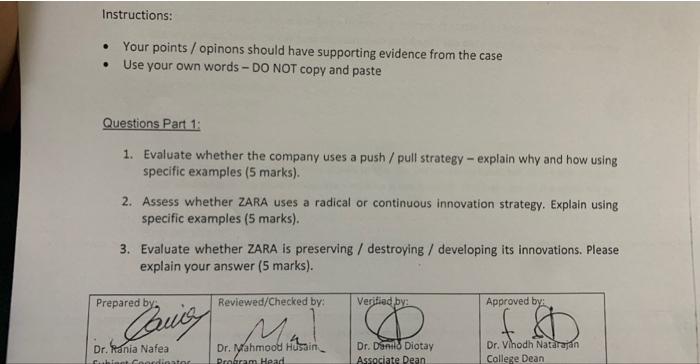
Question: Today this is a global industry embracing design activities, cutting and processing operations, assembly,distribution and sales - all fueled by a huge demand for differentiation
Today this is a global industry embracing design activities, cutting and processing operations, assembly,distribution and sales - all fueled by a huge demand for differentiation and personalization. This is an industry in which price is only one element - non-price factors such as variety, speed, brand, and quality
matter. And it's an industry dominated by the need for high-frequency product innovation - fashion
collections no longer run along the old seasonal track with winter and summer collections. In some cases,
the collection is changed every month and innovation in information and communications technology
means that this cycle is getting shorter still.
One such player was a young man working in a small clothing retailing business in northern Spain.
Frustrated with his career prospects Amancio Ortega Gaona decided to leave the company and start on
his own and in 1963 invested his savings - the princely sum of US$25 - into a small manufacturing
operation making pyjamas and lingerie. He built the business over the next 10 years and then decided to
move into retailing as well, opening his first shop in La Coruna in 1975.
Things have moved on somewhat since then. Industria de Diseno Textil - Inditex - the holding company
which he established - is now worth around US$21 billion, double the sales of less than a decade ago, and
employs over 150,000 people. With over 7,000 stores in nearly 70 countries this textile and clothing
business has 8 key brand groups, each targeted at particular segments or product types - for example,
"Pull and Bear' for children, 'Massimo Dutti' for older men and women or 'Oysho' in lingerie. Best known
of these is 'Zara' - a global brand with a strong design and fashion identity running through both the
clothes and the stores in which they are sold.
Its clothes combine stylish designs with a strong link to current high fashion themes with moderate prices.
'If you want a classic, Italianate look in tune with current styles and at a reasonable price go to Zara.' Zara's
successful growth is not simply a matter of low cost or of standardization but rather of innovation, based
on the idea of 'fast fashion'. The company have become leaders by exploiting some of the key non-price
trends in the industry - for example, variety and product innovation. For example, over 18 000 different
clothing models are created and sold every year - this is most certainly not a case of 'one size fits all' or
of long-lasting product types! Ortega has taken the entire system for creating clothes and built a business
- and originally did so in an area which did not previously have any textile tradition. At an early stage in
the development of the manufacturing business he moved back into textile finishing operations to make
sure that the colors and quality of the material he used to make the clothes were up to quality. Not only
did this give better quality control but it also opened up the road to offering exciting and different fabric
designs and textures. There are now 18 textile-designing and - finishing operations in the group as well as
the clothing manufacturing.
A major part of the company's success comes from a strong commitment to design - they employ over
350 designers and make extensive use of this commitment. It's a theme which doesn't stop with the
clothes themselves but also extends to the presentation of the stores, their window displays, their
catalogues, Internet advertising and so on. Part of the headquarters building in Arteixo La Coruna, Spain
contains 25 full-size shop windows with display platforms and lighting which allow the team to see what
real store windows would look like - not only under normal conditions but also on rainy days, at night and
so on. Another key aspect of Zara's success is the flexibility which comes from having a very different
model for manufacturing. Around 2500 employees work directly in manufacturing operations - but
behind them is a much larger workforce spread across villages and small communities in Spain
Once the new design has been approved the fabric is cut and then distributed to this network of small
workshops - and these represent an outsource capability delivering a high degree of flexibility. Pre-cut
pieces and easy-to-follow instructions are given to workers in what is still largely an informal economy
and their output then flows back into the massive Zara distribution centre. (This is not a small operation
- the centre has around 200 kilometers of moving rails on 5 which the products flow. Highly automated
and with extensive in-line quality checking, the process transfers the incoming pieces into production lots
which are then allocated to a fleet of trucks for fast shipment, mostly by air from the nearby airport at
Santiago de Compostela.) This places significant demands on a highly flexible and innovative coordination
system which Zara have developed in-house. In this way they make use of a model which dates back
hundreds of years (the idea of industrial districts and clusters) but use twenty-first-century technologies
to make it work to give them huge flexibility in both the volume and variety of the things they make.
Where competitors such as H&M and Gap must start planning and producing their new lines three to five
months before goods finally make it to the stores, Zara manages the whole process in less than three
weeks! Their flexibility is also based on rapid response and extensive use of information and
communication technologies. At the end of the day as the customers leave their 950 stores around the
world the sales staff use wireless handsets to communicate inventory levels to the store manager who
then transmits this intelligence back to Spain as a feed into the design order and distribution system. This
gives an up-to-the- minute idea of what is selling - and what isn't, so the stores can be highly responsive
to customer preferences - which colors 'work', which themes are popular, which designs aren't hitting
the spot. But it's not just following the market - Zara also push the game by making sure that no model is
kept on sale for more than four weeks - no matter how well it is selling. This has a strong impact on their
brand - they are seen as very original and design-led - but it puts even more pressure on their ability to
be agile in design and manufacture. For example, an idea for a coat with a high collar and a metal ring to
fasten it was born in Zara's design studio in the small city of Arteixo. Five days later the draft sketches,
themselves a result of feedback from store managers about fashion trends they were seeing, had been
converted into a physical prototype.
A second pattern maker then took over and working with a team of seamstresses and cutters worked the
next 13 days to produce a batch of 8000 coats. Their final 6 days in manufacturing were spent being
ironed, tagged, quality checked and prepared for dispatch, moving from the logistics centre in Zaragoza
to Barcelona airport. By the next day a truck was taking them from J.F. Kennedy airport to downtown New
York to be sold in the Fifth Avenue Zara store, selling at $189. Total cycle time, including transport and
distribution, 25 days. This is not unusual; their fast fashion model has been able to move from idea to
store in as little as 2 weeks! Another is exclusivity; their model is geared around small batch production in
which only a small number - for example, 25,000 of the coats - will be made. Selling out of stock is not a
problem since Zara store managers need to keep making space for newer items which arrive twice a week
from Spain. As one analyst commented, 'think of Zara not as a brand but as a very speedy chameleon that
Step by Step Solution
There are 3 Steps involved in it

Get step-by-step solutions from verified subject matter experts
 Study Help