





Question: Top question just select a,b,c or d. For the middle question select: Def or ABC select: DEF or GHJ Select:can or cannot. For the final

Top question just select a,b,c or d. For the middle question select: Def or ABC select: DEF or GHJ Select:can or cannot. For the final and last question fill in blanks and select: have the same angle, are the same length, Select: dilation, vertical translation, reflection over x axis or a rotation of 90 degrees.
Top question just select a,b,c or d. For the
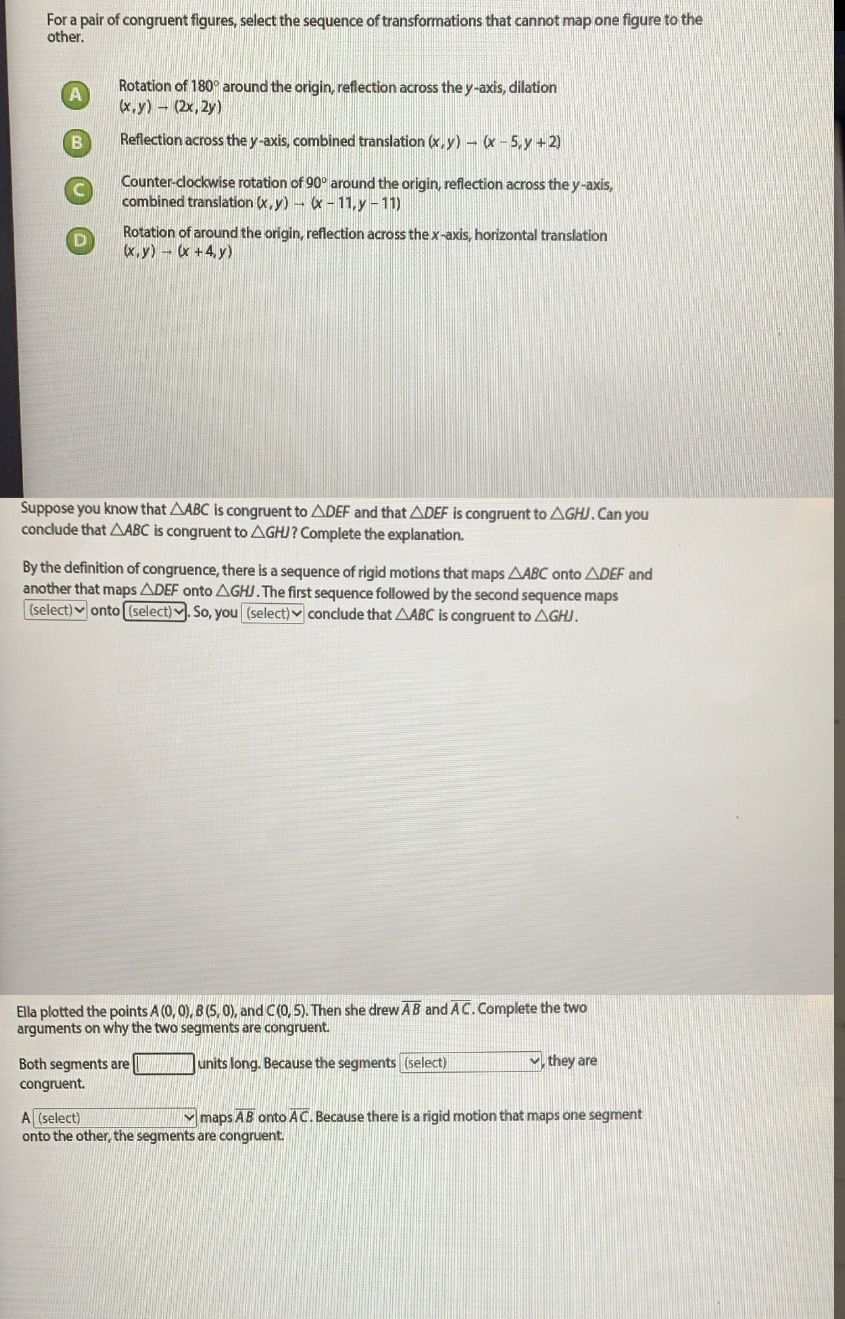
For a pair of congruent figures, select the sequence of transformations that cannot map one figure to the other. Rotation of 180 around the origin, reflection across the y-axis, dilation (x,y) - (2x, 2y) Reflection across the y-axis, combined translation (x , y) - (x -5,y +2) Counter-clockwise rotation of 90 around the origin, reflection across the y-axis, combined translation (x, y) - (x - 17,y -11) D Rotation of around the origin, reflection across the x-axis, horizontal translation (x , y ) - (x + 4. ) ) Suppose you know that \\ABC is congruent to ADEF and that ADEF is congruent to AGHJ. Can you conclude that AABC is congruent to AGH/? Complete the explanation. By the definition of congruence, there is a sequence of rigid motions that maps AABC onto ADEF and another that maps ADEF onto AGHJ. The first sequence followed by the second sequence maps (select) v onto [(select) v). So, you (select) v conclude that \\ABC is congruent to AGHJ. Ella plotted the points A (0, 0), B (5, 0), and C(0, 5). Then she drew AB and AC. Complete the two arguments on why the two segments are congruent. Both segments are | units long. Because the segments (select) they are congruent. A (select) I'Mmaps AB onto AC. Because there is a rigid motion that maps one segment onto the other, the segments are congruent

Step by Step Solution

There are 3 Steps involved in it

1 Expert Approved Answer
Step: 1 Unlock blur-text-image

Question Has Been Solved by an Expert!

Get step-by-step solutions from verified subject matter experts

Step: 2 Unlock
Step: 3 Unlock

Students Have Also Explored These Related Mathematics Questions!