







Question: Topic: (Callister, Chapter 3; Ashby, Teach Yourself Crystallography) 1. Fill in the missing information in the following stereograms as dictated by the indicated symmetry
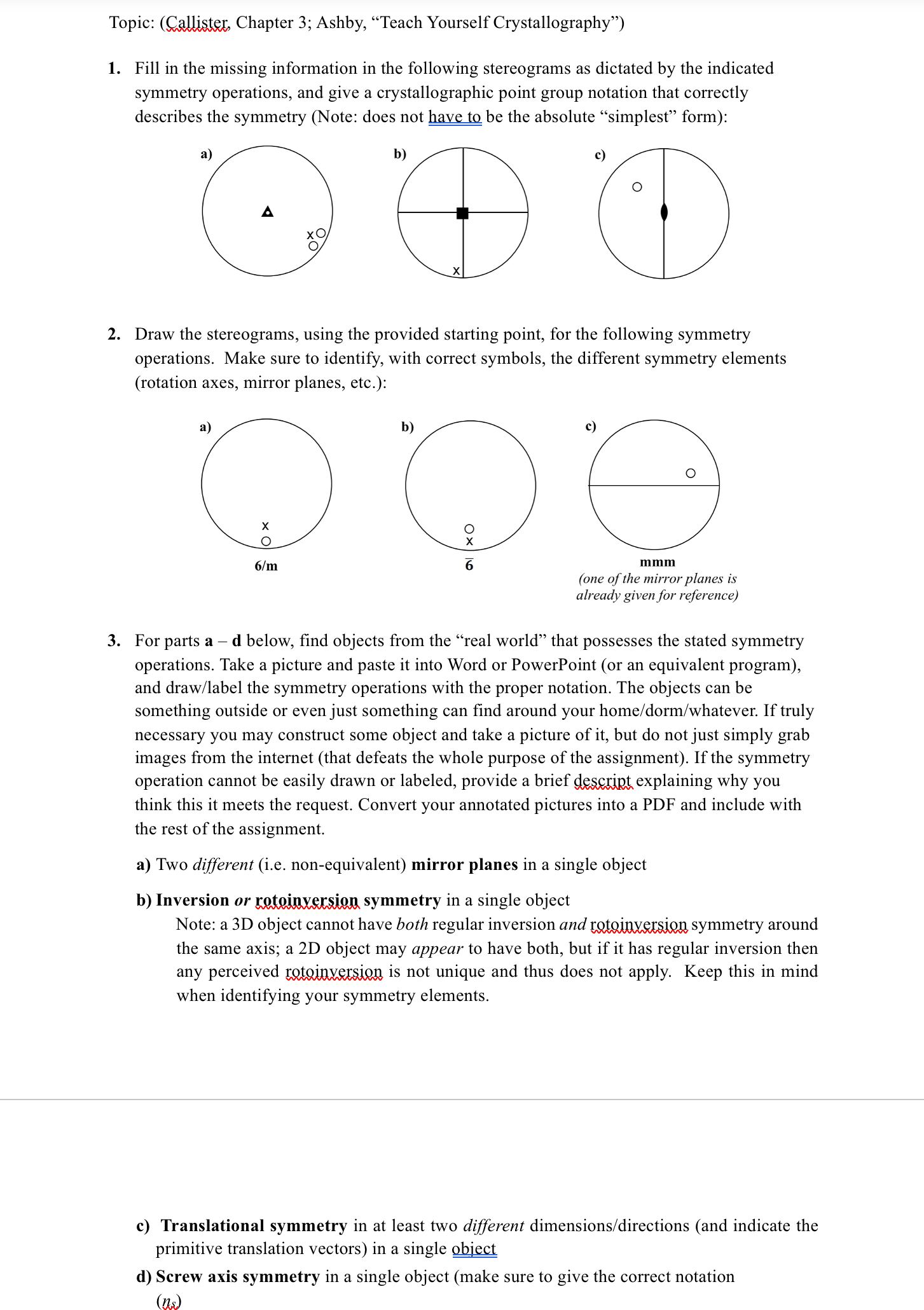
Topic: (Callister, Chapter 3; Ashby, "Teach Yourself Crystallography") 1. Fill in the missing information in the following stereograms as dictated by the indicated symmetry operations, and give a crystallographic point group notation that correctly describes the symmetry (Note: does not have to be the absolute simplest" form): a) b) c) 2. Draw the stereograms, using the provided starting point, for the following symmetry operations. Make sure to identify, with correct symbols, the different symmetry elements (rotation axes, mirror planes, etc.): a) X 6/m b) OX 6 c) mmm (one of the mirror planes is already given for reference) 3. For parts a d below, find objects from the "real world" that possesses the stated symmetry operations. Take a picture and paste it into Word or PowerPoint (or an equivalent program), and draw/label the symmetry operations with the proper notation. The objects can be something outside or even just something can find around your home/dorm/whatever. If truly necessary you may construct some object and take a picture of it, but do not just simply grab images from the internet (that defeats the whole purpose of the assignment). If the symmetry operation cannot be easily drawn or labeled, provide a brief descript explaining why you think this it meets the request. Convert your annotated pictures into a PDF and include with the rest of the assignment. a) Two different (i.e. non-equivalent) mirror planes in a single object b) Inversion or rotoinversion symmetry in a single object Note: a 3D object cannot have both regular inversion and rotoinversion symmetry around the same axis; a 2D object may appear to have both, but if it has regular inversion then any perceived rotoinversion is not unique and thus does not apply. Keep this in mind when identifying your symmetry elements. c) Translational symmetry in at least two different dimensions/directions (and indicate the primitive translation vectors) in a single object d) Screw axis symmetry in a single object (make sure to give the correct notation (ns)
Step by Step Solution
There are 3 Steps involved in it

Get step-by-step solutions from verified subject matter experts
 Study Help