







Question: Topic: Linear System of Equations -(a) Gaussian Elimination method with Matlab programming (b) Jacobi iterative method with Matlab programming (c) Gauss-Seidel Iterative Method (d) Numerical
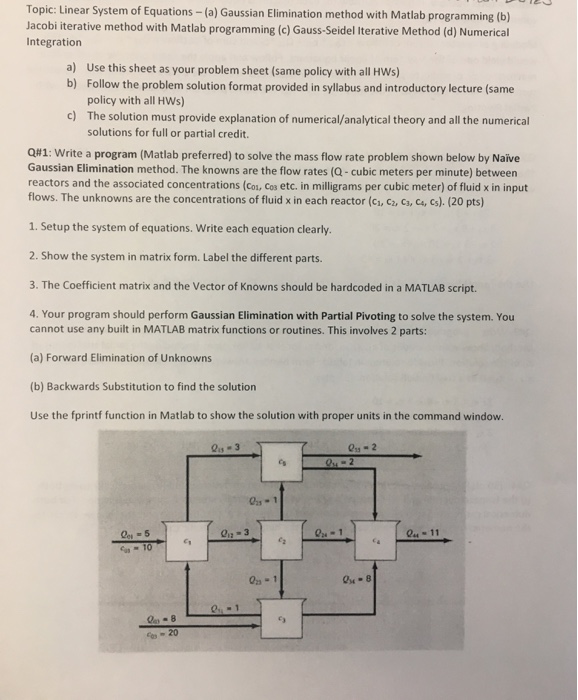
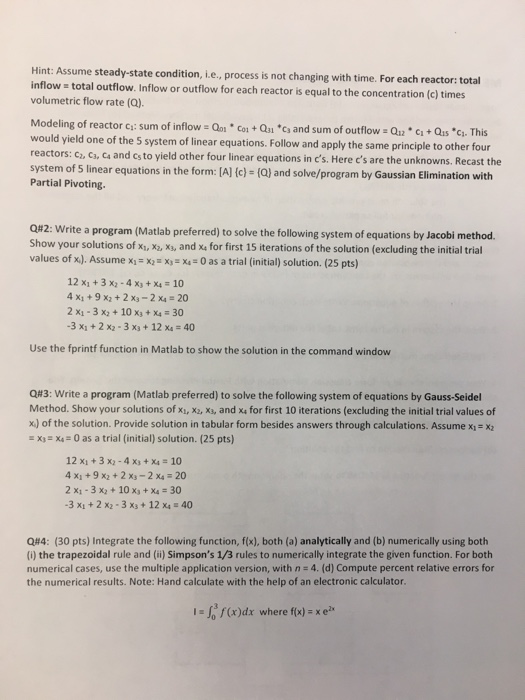
Topic: Linear System of Equations -(a) Gaussian Elimination method with Matlab programming (b) Jacobi iterative method with Matlab programming (c) Gauss-Seidel Iterative Method (d) Numerical Integratiorn Use this sheet as your problem sheet (same policy with all HWs) Follow the problem solution format provided in syllabus and introductory lecture (same policy with all HWs) The solution must provide explanation of numerical/analytical theory and all the numerical solutions for full or partial credit a) b) c) Q#1: write a program (Matlab preferred) to solve the mass flow rate problem shown below by Naive Gaussian Elimination method. The knowns are the flow rates (Q-cubic meters per minute) between reactors and the associated concentrations (Cos, Cos etc. in milligrams per cubic meter) of fluid x in input flows. The unknowns are the concentrations of fluid x in each reactor (c1, C2, C3, Ca, cs). (20 pts) 1. Setup the system of equations. Write each equation clearly. 2. Show the system in matrix form. Label the different parts. 3. The Coefficient matrix and the Vector of Knowns should be hardcoded in a MATLAB script. 4. Your program should perform Gaussian Elimination with Partial Pivoting to solve the system. You cannot use any built in MATLAB matrix functions or routines. This involves 2 parts: (a) Forward Elimination of Unknowns (b) Backwards Substitution to find the solution Use the fprintf function in Matlab to show the solution with proper units in the command window. 5 02 3 Qu 11 0n-1 - 20
Step by Step Solution
There are 3 Steps involved in it

Get step-by-step solutions from verified subject matter experts
 Study Help