Question: TOPIC: Obstacles facing the development of forensic accounting Obstacles Facing the Development of Forensic Accounting Curricula within the Australian Universities: Exploring Perspectives of Practitioners and
TOPIC: Obstacles facing the development of forensic accounting
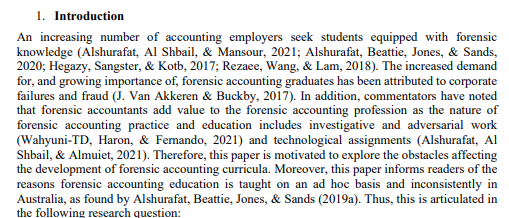
Obstacles Facing the Development of Forensic Accounting Curricula within the Australian Universities: Exploring Perspectives of Practitioners and Educators Hashem Al-Shurafat', John Sands, Gregory Jones and Claire Beattie* Abstract Forensic accounting education has become an increasingly significant issue in recent years. In Australia, universities have acknowledged the industry's growing relevance, and there have been attempts to address gaps in the provision of forensic aceounting education. Despite these efforts, forensic accounting education is frequently omitted in university programs. This paper secks to identify the obstacles that influence the transformation of forensic accounting knowledge into university programs. To do so, this study explores the perspectives of two groups: forensic accounting practitioners and university academics. Simi-structured interviews were conducted with the two groups to gather their perception. The findings show that the interdisciplinary nature of forensic accounting, the educator's relevant experience, and some other factors (e.g. university timetabling, calendar, venue arrangements, lack of forensic accounting instructional material, and professional and educational accreditations) are all obstacles facing the development process of forensic accounting. It is recommended for schools that do not have the required resources or are facing many obstacles in integrating forensic accounting education to offer an introductory elective course in the curriculum or utilize appropriately qualified puest speakers. The findings in this qualitative study could help educators in the development process of forensic accounting curricula. Keywords: Forensic Accounting, Curricula Development, Australia JEL: G30, M42, M49 SDG: SDGE, Target 8.2 1. Introduction An increasing number of accounting employers seek students equipped with forensic knowledge (Alshurafat, Al Shbail, & Mansour, 2021; Alshurafat, Beattie, Jones, & Sands, 2020; Hegazy, Sangster, & Kotb, 2017; Rezace, Wang, & Lam, 2018). The increased demand for, and growing importance of, forensic accounting graduates has been attributed to corporate failures and fraud (J. Van Akkeren & Buckby, 2017). In addition, commentators have noted that forensic accountants add value to the forensic accounting profession as the nature of forensic accounting practice and education includes investigative and adversarial work (Wahyuni-TD. Haron, & Femando, 2021) and technological assignments (Alshurafat, Al Shbail, & Almuiet, 2021). Therefore, this paper is motivated to explore the obstacles affecting the development of forensic accounting curricula. Moreover, this paper informs readers of the reasons forensic accounting education is taught on an ad hoc basis and inconsistently in Australia, as found by Alshurafat, Beattie, Jones, & Sands (2019a). Thus, this is articulated in the following research
Step by Step Solution
There are 3 Steps involved in it
1 Expert Approved Answer
Step: 1 Unlock
Question Has Been Solved by an Expert!
Get step-by-step solutions from verified subject matter experts
Step: 2 Unlock
Step: 3 Unlock
Students Have Also Explored These Related Accounting Questions!









 Study Help