







Question: Topic of Counting: double counting, k-to-1 functions, permutations & combinations, binomial & multinomial coefficients, counting poker hands 2. Let K5 denote the complete graph on
Topic of Counting: double counting, k-to-1 functions, permutations & combinations, binomial & multinomial coefficients, counting poker hands
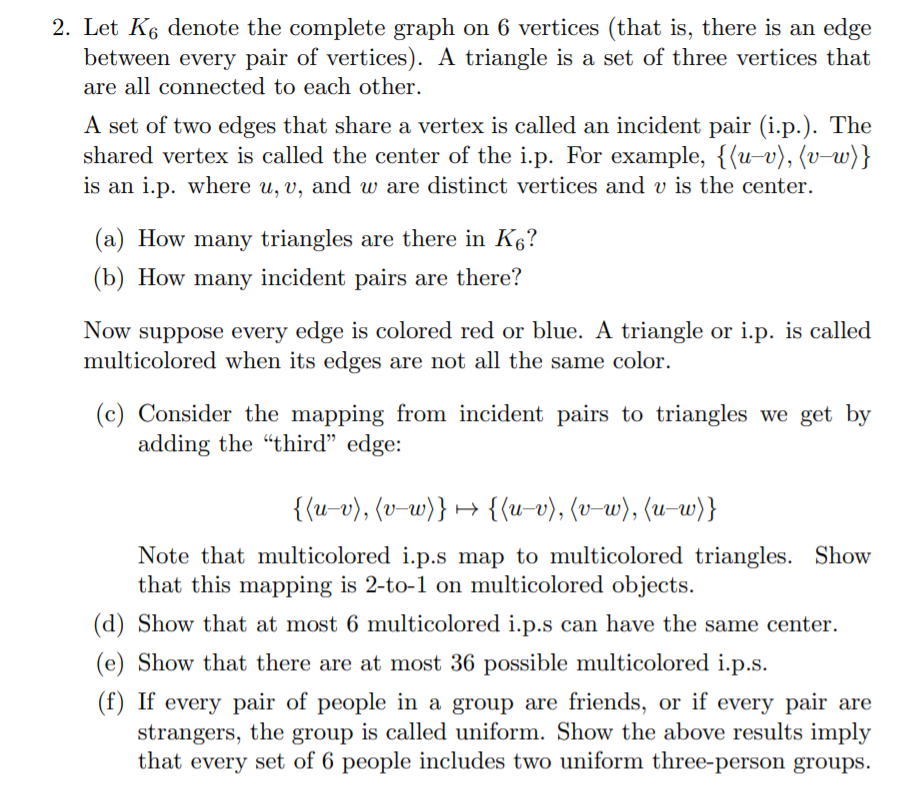
2. Let K5 denote the complete graph on 6 vertices (that is, there is an edge between every pair of vertices). A triangle is a set of three vertices that are all connected to each other. A set of two edges that share a vertex is called an incident pair (i.p.). The shared vertex is called the center of the i.p. For example, {(uv), (sw)} is an i.p. where 1.3.1:, and w are distinct vertices and 'v is the center. (a) How many triangles are there in K5? (b) How many incident pairs are there? Now suppose every edge is colored red or blue. A triangle or i.p. is called multicolored when its edges are not all the same color. (c) Consider the mapping from incident pairs to triangles we get by adding the \"third\" edge: {(urvls (we'll '-> {(urvla {vow}: (\"*M} Note that multicolored i.p.s map to multicolored triangles. Show that this mapping is 2to1 on multicolored objects. (d) Show that at most 6 multicolored i.p.s can have the same center. (e) Show that there are at most 36 possible multicolored i.p.s. (f) If every pair of people in a group are friends, or if every pair are strangers, the group is called uniform. Show the above results imply that every set of 6 people includes two uniform threeperson groups
Step by Step Solution
There are 3 Steps involved in it

Get step-by-step solutions from verified subject matter experts
 Study Help