







Question: Topic: Physics: Statistical Mechanics. Instructions: Answer the Problems below and Show Complete Solution. Introductory Statistical Mechanics The Ideal Gas and Kinetic Molecular Theory Problem Sets
Topic: Physics: Statistical Mechanics.
Instructions: Answer the Problems below and Show Complete Solution.
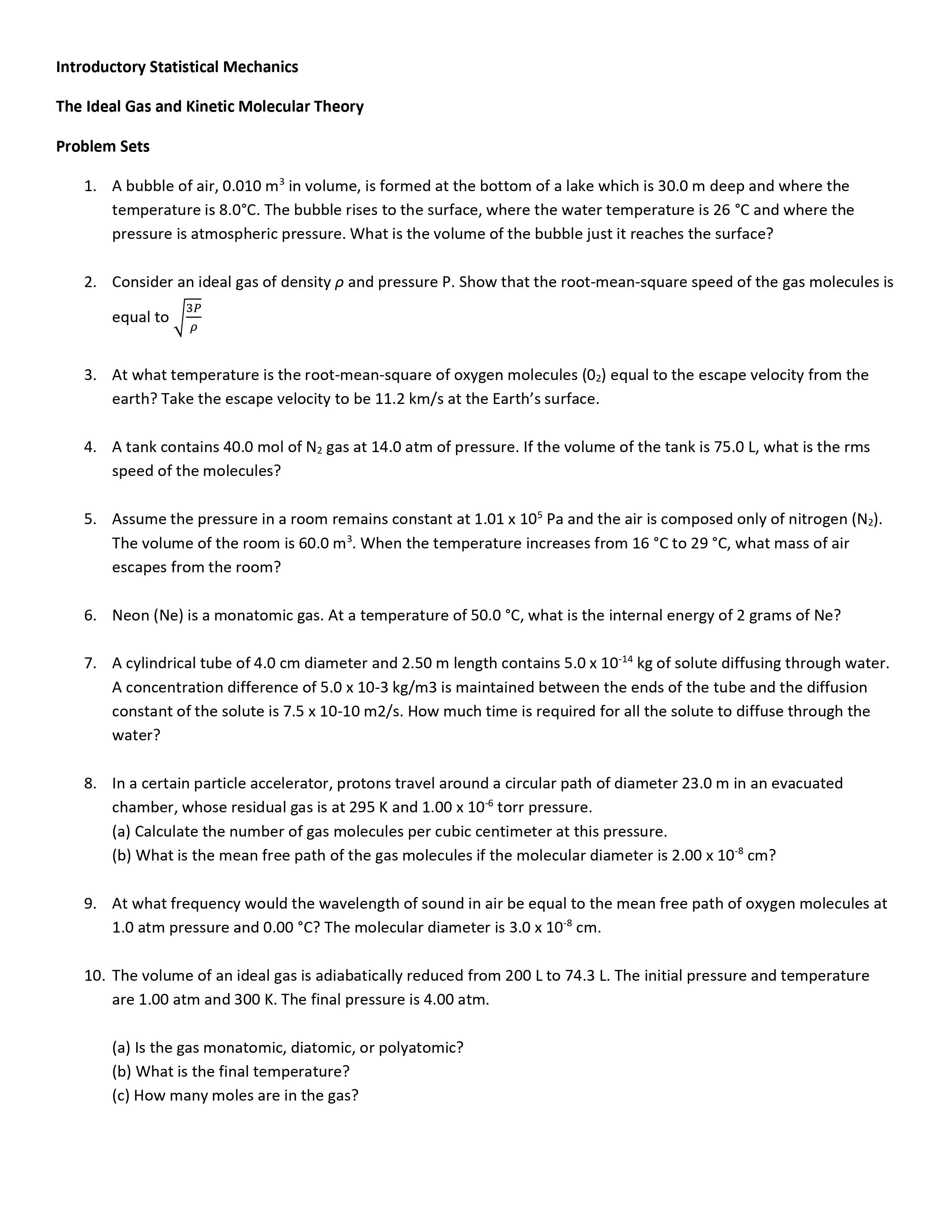
Introductory Statistical Mechanics The Ideal Gas and Kinetic Molecular Theory Problem Sets 10. A bubble of air, 0.010 m3 in volume, is formed at the bottom of a lake which is 30.0 m deep and where the temperature is 8.0C. The bubble rises to the surface, where the water temperature is 26 C and where the pressure is atmospheric pressure. What is the volume of the bubble just it reaches the surface? Consider an ideal gas of density p and pressure P. Show that the root-mean-square speed of the gas molecules is 3P e ual to q \\l p At what temperature is the rootmeansquare of oxygen molecules (02) equal to the escape velocity from the earth? Take the escape velocity to be 11.2 km/s at the Earth's surface. A tank contains 40.0 mol of N2 gas at 14.0 atm of pressure. lfthe volume ofthe tank is 75.0 L, what is the rms speed of the molecules? Assume the pressure in a room remains constant at 1.01 x 10⁵ Pa and the air is composed only of nitrogen (N2). The volume ofthe room is 60.0 m3. When the temperature increases from 16 C to 29 C, what mass of air escapes from the room? Neon (Ne) is a monatomic gas. At a temperature of 50.0 C, what is the internal energy of 2 grams of Ne? A cylindrical tube of 4.0 cm diameter and 2.50 m length contains 5.0 x 10']4 kg of solute diffusing through water. A concentration difference of 5.0 x 10⁻³ kg/m3 is maintained between the ends of the tube and the diffusion constant ofthe solute is 7.5 x 10⁻¹⁰ m2/s. How much time is required for all the solute to diffuse through the water? In a certain particle accelerator, protons travel around a circular path of diameter 23.0 m in an evacuated chamber, whose residual gas is at 295 K and 1.00 x 10'6 torr pressure. (3) Calculate the number of gas molecules per cubic centimeter at this pressure. (b) What is the mean free path ofthe gas molecules if the molecular diameter is 2.00 x 10'8 cm? At what frequency would the wavelength of sound in air be equal to the mean free path of oxygen molecules at 1.0 atm pressure and 0.00 C? The molecular diameter is 3.0 x 10'8 cm. The volume of an ideal gas is adiabatically reduced from 200 L to 74.3 L. The initial pressure and temperature are 1.00 atm and 300 K. The final pressure is 4.00 atm. (a) Is the gas monatomic, diatomic, or polyatomic? (b) What is the final temperature? (c) How many moles are in the gas
Step by Step Solution
There are 3 Steps involved in it

Get step-by-step solutions from verified subject matter experts
 Study Help