







Question: Total points: 20 Instructions: The assignment must be typed and submitted online (Times New Roman, font 12, spacing 1.5) The table below shows the price
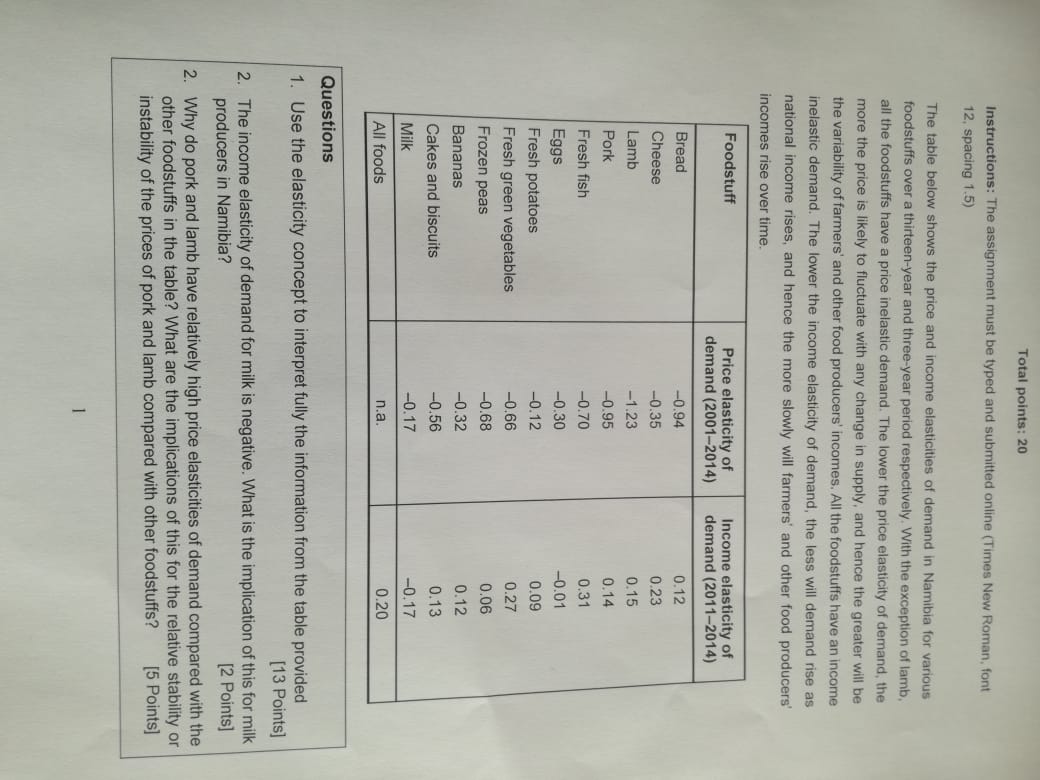
Total points: 20 Instructions: The assignment must be typed and submitted online (Times New Roman, font 12, spacing 1.5) The table below shows the price and income elasticities of demand in Namibia for various foodstuffs over a thirteen-year and three-year period respectively. With the exception of lamb, all the foodstuffs have a price inelastic demand. The lower the price elasticity of demand, the more the price is likely to fluctuate with any change in supply, and hence the greater will be the variability of farmers' and other food producers' incomes. All the foodstuffs have an income inelastic demand. The lower the income elasticity of demand, the less will demand rise as national income rises, and hence the more slowly will farmers and other food producers' incomes rise over time. Foodstuff Price elasticity of Income elasticity of demand (2001-2014) demand (2011-2014) Bread -0.94 0.12 Cheese -0.35 0.23 Lamb -1.23 0. 15 Pork -0.95 0.14 Fresh fish -0.70 0.31 Eggs -0.30 -0.01 Fresh potatoes -0.12 0.09 Fresh green vegetables -0.66 0.27 Frozen peas -0.68 0.06 Bananas -0.32 0.12 Cakes and biscuits -0.56 0.13 Milk -0.17 -0.17 All foods n.a. 0.20 Questions 1. Use the elasticity concept to interpret fully the information from the table provided [13 Points] 2. The income elasticity of demand for milk is negative. What is the implication of this for milk producers in Namibia? [2 Points] 2. Why do pork and lamb have relatively high price elasticities of demand compared with the other foodstuffs in the table? What are the implications of this for the relative stability or instability of the prices of pork and lamb compared with other foodstuffs? [5 Points]
Step by Step Solution
There are 3 Steps involved in it

Get step-by-step solutions from verified subject matter experts
 Study Help