







Question: TQM implementation and policy deployment at ST Microelectronics Company background and TQM ST Microelectronics (formerly SGS-Thomson Microelectronics) is a global, independent semiconductor company which designs,
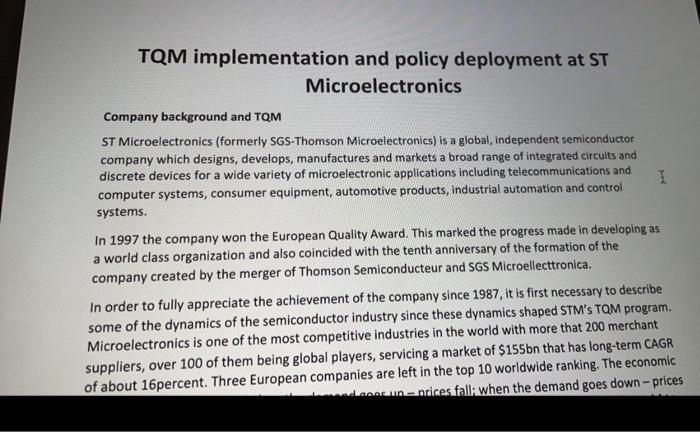
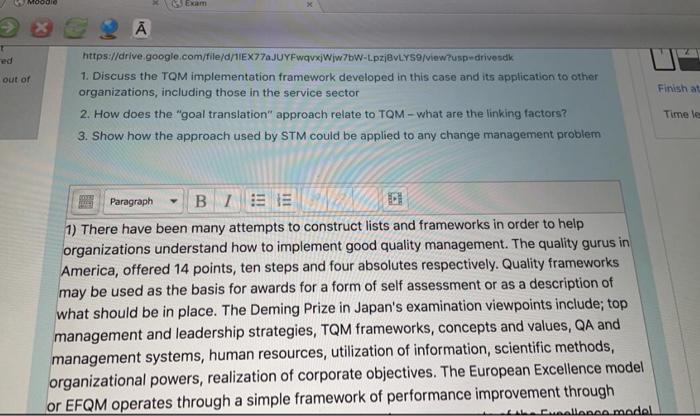
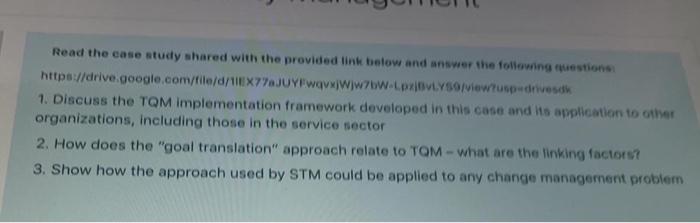
TQM implementation and policy deployment at ST Microelectronics Company background and TQM ST Microelectronics (formerly SGS-Thomson Microelectronics) is a global, independent semiconductor company which designs, develops, manufactures and markets a broad range of integrated circuits and discrete devices for a wide variety of microelectronic applications including telecommunications and 1 computer systems, consumer equipment, automotive products, industrial automation and control systems. In 1997 the company won the European Quality Award. This marked the progress made in developing as a world class organization and also coincided with the tenth anniversary of the formation of the company created by the merger of Thomson Semiconducteur and SGS Microellecttronica. In order to fully appreciate the achievement of the company since 1987, it is first necessary to describe some of the dynamics of the semiconductor industry since these dynamics shaped STM's TQM program. Microelectronics is one of the most competitive industries in the world with more that 200 merchant suppliers, over 100 of them being global players, servicing a market of $155bn that has long-term CAGR of about 16 percent. Three European companies are left in the top 10 worldwide ranking. The economic LACIN rices falls when the demand goes down - prices 1 ed out of Finish at https://drive.google.com/file/d/1EX77JUYEwqvxjWjw7bW-LpzjavlYs/view?uspwdrivesdk 1. Discuss the TQM implementation framework developed in this case and its application to other organizations, including those in the service sector 2. How does the "goal translation" approach relate to TOM - what are the linking factors? 3. Show how the approach used by STM could be applied to any change management problem Time le Paragraph BI SE 1) There have been many attempts to construct lists and frameworks in order to help organizations understand how to implement good quality management. The quality gurus in America, offered 14 points, ten steps and four absolutes respectively. Quality frameworks may be used as the basis for awards for a form of self assessment or as a description of what should be in place. The Deming Prize in Japan's examination viewpoints include; top management and leadership strategies, TQM frameworks, concepts and values, QA and management systems, human resources, utilization of information, scientific methods, organizational powers, realization of corporate objectives. The European Excellence model or EFQM operates through a simple framework of performance improvement through Lunallanna model Read the case study shared with the provided link below and answer the following cuestions https://drive.google.com/file/d/118X77JUYFWQvWw7WW-LELYS/View?uspedrivesdk 1. Discuss the TQM implementation framework developed in this case and its application to other organizations, including those in the service sector 2. How does the "goal translation" approach relate to TOM - what are the linking factors? 3. Show how the approach used by STM could be applied to any change management problem TQM implementation and policy deployment at ST Microelectronics Company background and TQM ST Microelectronics (formerly SGS-Thomson Microelectronics) is a global, independent semiconductor company which designs, develops, manufactures and markets a broad range of integrated circuits and discrete devices for a wide variety of microelectronic applications including telecommunications and 1 computer systems, consumer equipment, automotive products, industrial automation and control systems. In 1997 the company won the European Quality Award. This marked the progress made in developing as a world class organization and also coincided with the tenth anniversary of the formation of the company created by the merger of Thomson Semiconducteur and SGS Microellecttronica. In order to fully appreciate the achievement of the company since 1987, it is first necessary to describe some of the dynamics of the semiconductor industry since these dynamics shaped STM's TQM program. Microelectronics is one of the most competitive industries in the world with more that 200 merchant suppliers, over 100 of them being global players, servicing a market of $155bn that has long-term CAGR of about 16 percent. Three European companies are left in the top 10 worldwide ranking. The economic LACIN rices falls when the demand goes down - prices 1 ed out of Finish at https://drive.google.com/file/d/1EX77JUYEwqvxjWjw7bW-LpzjavlYs/view?uspwdrivesdk 1. Discuss the TQM implementation framework developed in this case and its application to other organizations, including those in the service sector 2. How does the "goal translation" approach relate to TOM - what are the linking factors? 3. Show how the approach used by STM could be applied to any change management problem Time le Paragraph BI SE 1) There have been many attempts to construct lists and frameworks in order to help organizations understand how to implement good quality management. The quality gurus in America, offered 14 points, ten steps and four absolutes respectively. Quality frameworks may be used as the basis for awards for a form of self assessment or as a description of what should be in place. The Deming Prize in Japan's examination viewpoints include; top management and leadership strategies, TQM frameworks, concepts and values, QA and management systems, human resources, utilization of information, scientific methods, organizational powers, realization of corporate objectives. The European Excellence model or EFQM operates through a simple framework of performance improvement through Lunallanna model Read the case study shared with the provided link below and answer the following cuestions https://drive.google.com/file/d/118X77JUYFWQvWw7WW-LELYS/View?uspedrivesdk 1. Discuss the TQM implementation framework developed in this case and its application to other organizations, including those in the service sector 2. How does the "goal translation" approach relate to TOM - what are the linking factors? 3. Show how the approach used by STM could be applied to any change management
Step by Step Solution
There are 3 Steps involved in it

Get step-by-step solutions from verified subject matter experts
 Study Help