


Question: TR IER R, LG T [ @ Questioning O Planning @ Analyzing @ Hypothesizing @ Conducting @ Evaluating @ Predicting @ Recording O Communicating Reflex
TR IER R, LG T [ @ Questioning O Planning @TR IER R, LG T [ @ Questioning O Planning @
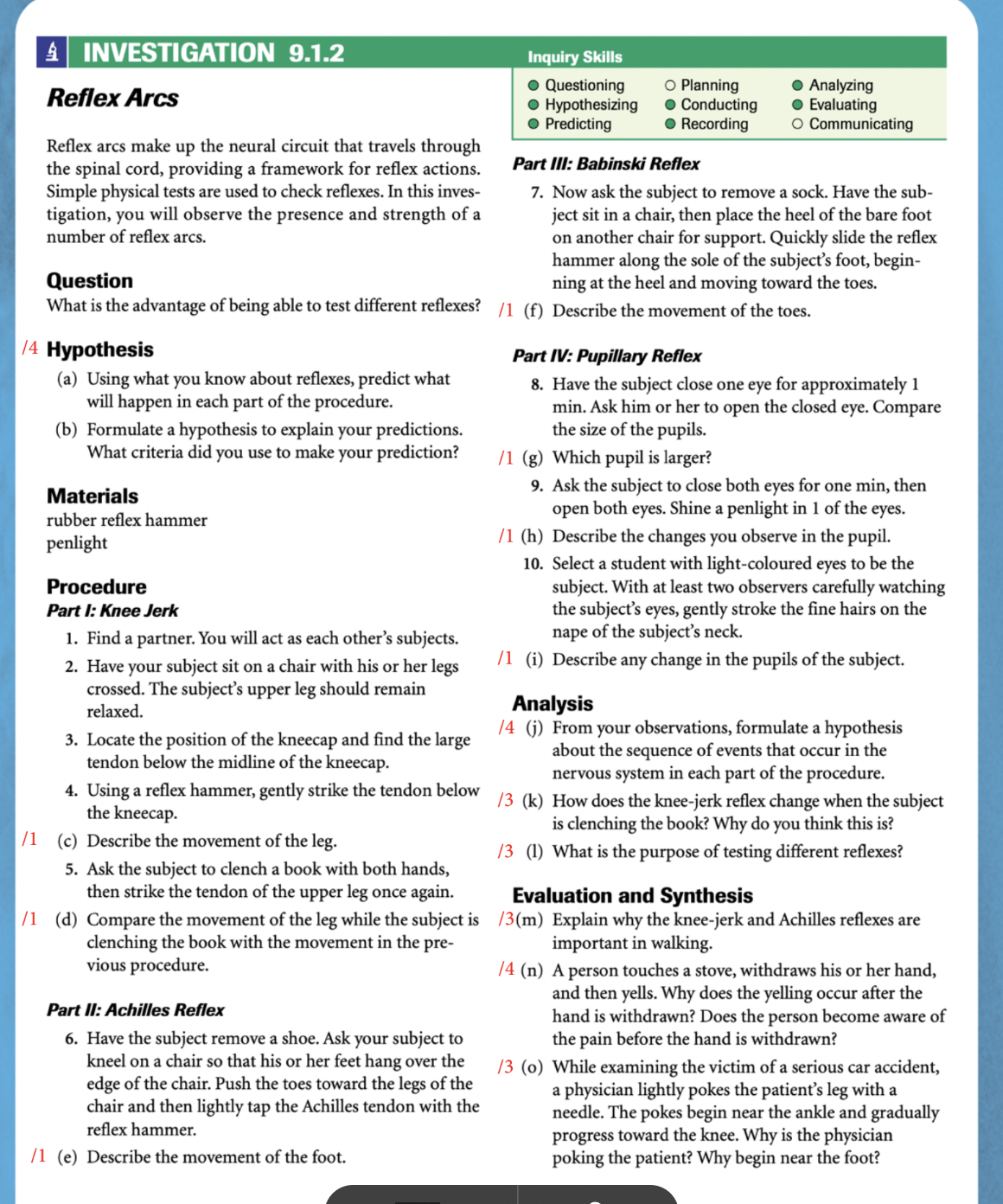
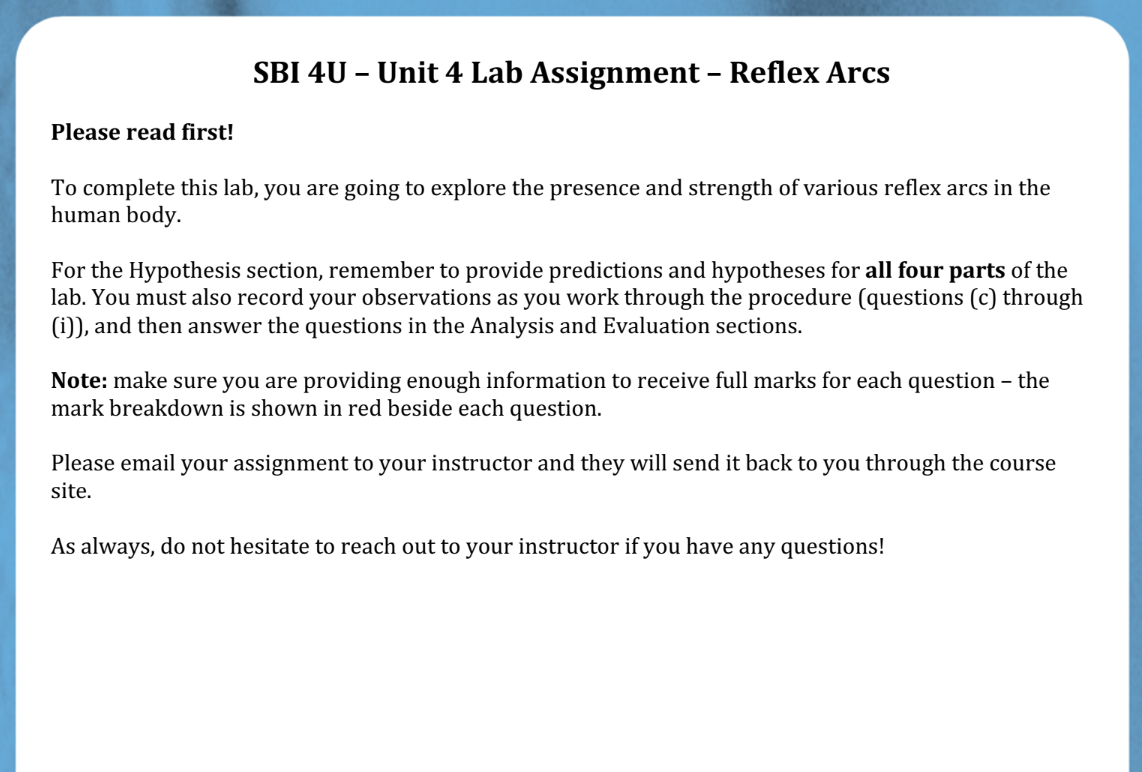
TR IER R, LG T [ @ Questioning O Planning @ Analyzing @ Hypothesizing @ Conducting @ Evaluating @ Predicting @ Recording O Communicating Reflex Arcs Reflex arcs make up the neural circuit that travels through the spinal cord, providing a framework for reflex actions. Part lll: Babinski Reflex Simple physical tests are used to check reflexes. In this inves- 7. Now ask the subject to remove a sock. Have the sub- tigation, you will observe the presence and strength of a ject sit in a chair, then place the heel of the bare foot number of reflex arcs. on another chair for support. Quickly slide the reflex hammer along the sole of the subject's foot, begin- Question ning at the heel and moving toward the toes. What is the advantage of being able to test different reflexes? /1 (f) Describe the movement of the toes. /4 Hypothesis Part IV: Pupillary Reflex /1 (a) Using what you know about reflexes, predict what 8. Have the subject close one eye for approximately 1 will happen in each part of the procedure. min. Ask him or her to open the closed eye. Compare (b) Formulate a hypothesis to explain your predictions. the size of the pupils. What criteria did you use to make your prediction? /1 (g) Which pupil is larger? 9. Ask the subject to close both eyes for one min, then ::;:':;II; fassases open both eyes. Shine a penlight in 1 of the eyes. penlight /1 (h) Describe the changes you observe in the pupil. 10. Select a student with light-coloured eyes to be the Procedure subject. With at least two observers carefully watching Part I: Knee Jerk the subject's eyes, gently stroke the fine hairs on the 1. Find a partner. You will act as each other's subjects. nape of the subject's neck. 2. Have your subject sit on a chair with his or her legs /1 (i) Describe any change in the pupils of the subject. crossed. The subject's upper leg should remain . relaxed. Analysis 3. Locate the position of the kneecap and find the large /4 G) :;?,Eyt;:r Ob::c:t:)t}n:'::z;mt;::t;caczpi:zt':ls tendon below the midline of the kneecap. e ) ) nervous system in each part of the procedure. A ;smkia ekl R ety vicke the sendon below /3 (k) How does the knee-jerk reflex change when the subject AR is clenching the book? Why do you think this is? (c) Describe the movement of the leg. /3 (1) What is the purpose of testing different reflexes? 5. Ask the subject to clench a book with both hands, then strike the tendon of the upper leg once again. Evaluation and Synthesis (d) Compare the movement of the leg while the subjectis /3(m) Explain why the knee-jerk and Achilles reflexes are clenching the book with the movement in the pre- important in walking. vious procedure. /4 (n) A person touches a stove, withdraws his or her hand, and then yells. Why does the yelling occur after the Part lI: Achilles Reflex hand is withdrawn? Does the person become aware of 6. Have the subject remove a shoe. Ask your subject to the pain before the hand is withdrawn? kneel on a chair so that his or her feet hang over the edge of the chair. Push the toes toward the legs of the chair and then lightly tap the Achilles tendon with the reflex hammer. /3 (o) While examining the victim of a serious car accident, a physician lightly pokes the patient's leg with a needle. The pokes begin near the ankle and gradually progress toward the knee. Why is the physician /1 (e) Describe the movement of the foot. poking the patient? Why begin near the foot? SBI 4U - Unit 4 Lab Assignment - Reflex Arcs Please read first! To complete this lab, you are going to explore the presence and strength of various reflex arcs in the human body. For the Hypothesis section, remember to provide predictions and hypotheses for all four parts of the lab. You must also record your observations as you work through the procedure (questions (c) through (i)), and then answer the questions in the Analysis and Evaluation sections. Note: make sure you are providing enough information to receive full marks for each question - the mark breakdown is shown in red beside each question. Please email your assignment to your instructor and they will send it back to you through the course site. As always, do not hesitate to reach out to your instructor if you have any questions

Step by Step Solution

There are 3 Steps involved in it

1 Expert Approved Answer
Step: 1 Unlock blur-text-image
Question Has Been Solved by an Expert!

Get step-by-step solutions from verified subject matter experts

Step: 2 Unlock
Step: 3 Unlock

Students Have Also Explored These Related Law Questions!