







Question: Trade Patterns: Select a country and characterize its trading patterns to identify the nature of its comparative advantage. The only two countries you may not
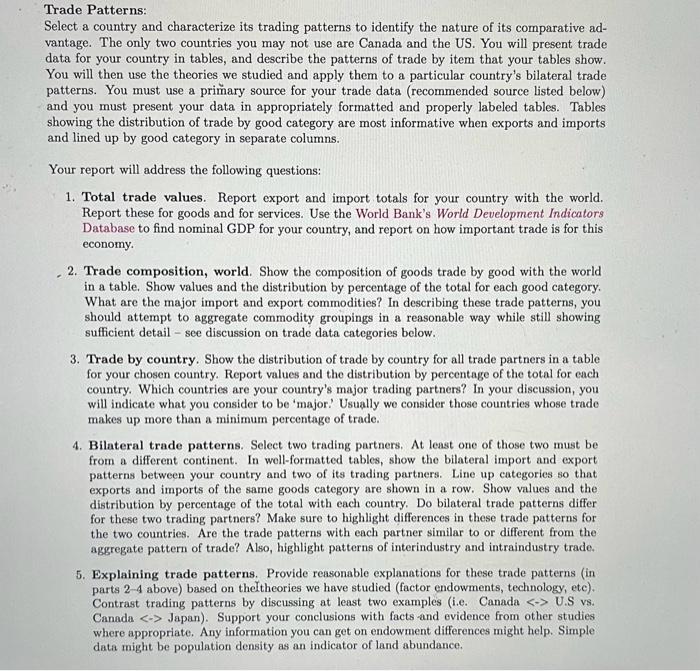
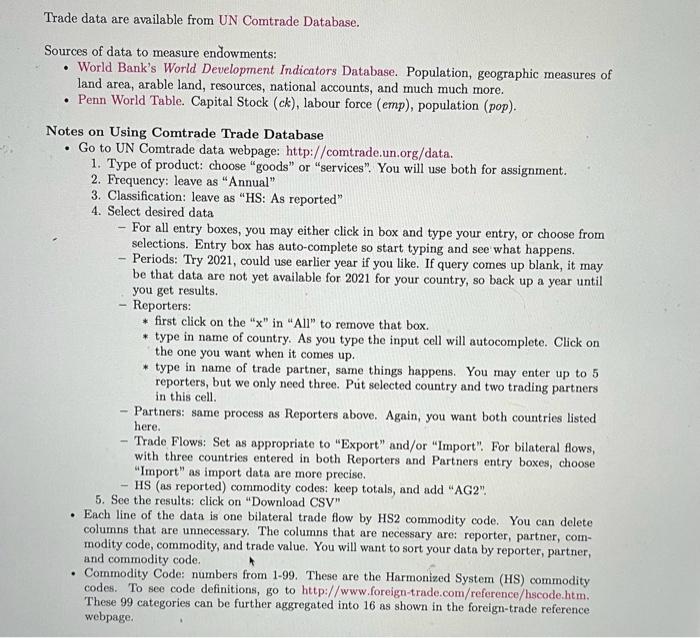
Trade Patterns: Select a country and characterize its trading patterns to identify the nature of its comparative advantage. The only two countries you may not use are Canada and the US. You will present trade data for your country in tables, and describe the patterns of trade by item that your tables show. You will then use the theories we studied and apply them to a particular country's bilateral trade patterns. You must use a primary source for your trade data (recommended source listed below) and you must present your data in appropriately formatted and properly labeled tables. Tables showing the distribution of trade by good category are most informative when exports and imports and lined up by good category in separate columns. Your report will address the following questions: 1. Total trade values. Report export and import totals for your country with the world. Report these for goods and for services. Use the World Bank's World Development Indicators Database to find nominal GDP for your country, and report on how important trade is for this economy. 2. Trade composition, world. Show the composition of goods trade by good with the world in a table. Show values and the distribution by percentage of the total for each good category. What are the major import and export commodities? In describing these trade patterns, you should attempt to aggregate commodity groupings in a reasonable way while still showing sufficient detail - see discussion on trade data categories below. 3. Trade by country. Show the distribution of trade by country for all trade partners in a table for your chosen country. Report values and the distribution by percentage of the total for each country. Which countries are your country's major trading partners? In your discussion, you will indicate what you consider to be 'major.' Usually we consider those countries whose trade makes up more than a minimum percentage of trade. 4. Bilateral trade patterns. Select two trading partners. At least one of those two must be from a different continent. In woll-formatted tables, show the bilateral import and export patterns between your country and two of its trading partners. Line up categories so that exports and imports of the same goods category are shown in a row. Show values and the distribution by percentage of the total with each country. Do bilateral trade patterns differ for these two trading partners? Make sure to highlight differences in these trade patterns for the two countries. Are the trade patterns with each partner similar to or different from the aggregate pattern of trade? Also, highlight patterns of interindustry and intraindustry trade. 5. Explaining trade patterns. Provide reasonable explanations for these trade patterns (in parts 2-4 above) based on theltheories we have studied (factor endowments, technology, etc). Contrast trading patterns by discussing at least two examples (i.e. Canada U.S vs. Canada > Japan). Support your conclusions with facts and evidence from other studies where appropriate. Any information you can get on endowment differences might help. Simple data might be population density as an indicator of land abundance. Trade data are available from UN Comtrade Database. Sources of data to measure endowments: - World Bank's World Development Indicators Database. Population, geographic measures of land area, arable land, resources, national accounts, and much much more. - Penn World Table. Capital Stock ( ck ), labour force (emp), population (pop). Notes on Using Comtrade Trade Database - Go to UN Comtrade data webpage: http://comtrade.un.org/data. 1. Type of product: choose "goods" or "services". You will use both for assignment. 2. Frequency: leave as "Annual" 3. Classification: leave as "HS: As reported" 4. Select desired data - For all entry boxes, you may either click in box and type your entry, or choose from selections. Entry box has auto-complete so start typing and see what happens. - Periods: Try 2021, could use earlier year if you like. If query comes up blank, it may be that data are not yet available for 2021 for your country, so back up a year until you get results. - Reporters: * first click on the " x " in "All" to remove that box. * type in name of country. As you type the input cell will autocomplete. Click on the one you want when it comes up. * type in name of trade partner, same things happens. You may enter up to 5 reporters, but we only need three. Put selected country and two trading partners in this cell. - Partners: same process as Reporters above. Again, you want both countries listed here. - Trade Flows: Set as appropriate to "Export" and/or "Import". For bilateral flows, with three countries entered in both Reporters and Partners entry boxes, choose "Import" as import data are more precise. - HS (as reported) commodity codes: keep totals, and add "AG2". 5. See the results: click on "Download CSV" - Each line of the data is one bilateral trade flow by HS2 commodity code. You can delete columns that are unnecessary. The columns that are necessary are: reporter, partner, commodity code, commodity, and trade value. You will want to sort your data by reporter, partner, and commodity code. - Commodity Code: numbers from 1-99. These are the Harmonized System (HS) commodity codes. To see code definitions, go to http://www.foreign-trade.com/reference/hscode.htm. These 99 categories can be further aggregated into 16 as shown in the foreign-trade reference webpage. Trade Patterns: Select a country and characterize its trading patterns to identify the nature of its comparative advantage. The only two countries you may not use are Canada and the US. You will present trade data for your country in tables, and describe the patterns of trade by item that your tables show. You will then use the theories we studied and apply them to a particular country's bilateral trade patterns. You must use a primary source for your trade data (recommended source listed below) and you must present your data in appropriately formatted and properly labeled tables. Tables showing the distribution of trade by good category are most informative when exports and imports and lined up by good category in separate columns. Your report will address the following questions: 1. Total trade values. Report export and import totals for your country with the world. Report these for goods and for services. Use the World Bank's World Development Indicators Database to find nominal GDP for your country, and report on how important trade is for this economy. 2. Trade composition, world. Show the composition of goods trade by good with the world in a table. Show values and the distribution by percentage of the total for each good category. What are the major import and export commodities? In describing these trade patterns, you should attempt to aggregate commodity groupings in a reasonable way while still showing sufficient detail - see discussion on trade data categories below. 3. Trade by country. Show the distribution of trade by country for all trade partners in a table for your chosen country. Report values and the distribution by percentage of the total for each country. Which countries are your country's major trading partners? In your discussion, you will indicate what you consider to be 'major.' Usually we consider those countries whose trade makes up more than a minimum percentage of trade. 4. Bilateral trade patterns. Select two trading partners. At least one of those two must be from a different continent. In woll-formatted tables, show the bilateral import and export patterns between your country and two of its trading partners. Line up categories so that exports and imports of the same goods category are shown in a row. Show values and the distribution by percentage of the total with each country. Do bilateral trade patterns differ for these two trading partners? Make sure to highlight differences in these trade patterns for the two countries. Are the trade patterns with each partner similar to or different from the aggregate pattern of trade? Also, highlight patterns of interindustry and intraindustry trade. 5. Explaining trade patterns. Provide reasonable explanations for these trade patterns (in parts 2-4 above) based on theltheories we have studied (factor endowments, technology, etc). Contrast trading patterns by discussing at least two examples (i.e. Canada U.S vs. Canada > Japan). Support your conclusions with facts and evidence from other studies where appropriate. Any information you can get on endowment differences might help. Simple data might be population density as an indicator of land abundance. Trade data are available from UN Comtrade Database. Sources of data to measure endowments: - World Bank's World Development Indicators Database. Population, geographic measures of land area, arable land, resources, national accounts, and much much more. - Penn World Table. Capital Stock ( ck ), labour force (emp), population (pop). Notes on Using Comtrade Trade Database - Go to UN Comtrade data webpage: http://comtrade.un.org/data. 1. Type of product: choose "goods" or "services". You will use both for assignment. 2. Frequency: leave as "Annual" 3. Classification: leave as "HS: As reported" 4. Select desired data - For all entry boxes, you may either click in box and type your entry, or choose from selections. Entry box has auto-complete so start typing and see what happens. - Periods: Try 2021, could use earlier year if you like. If query comes up blank, it may be that data are not yet available for 2021 for your country, so back up a year until you get results. - Reporters: * first click on the " x " in "All" to remove that box. * type in name of country. As you type the input cell will autocomplete. Click on the one you want when it comes up. * type in name of trade partner, same things happens. You may enter up to 5 reporters, but we only need three. Put selected country and two trading partners in this cell. - Partners: same process as Reporters above. Again, you want both countries listed here. - Trade Flows: Set as appropriate to "Export" and/or "Import". For bilateral flows, with three countries entered in both Reporters and Partners entry boxes, choose "Import" as import data are more precise. - HS (as reported) commodity codes: keep totals, and add "AG2". 5. See the results: click on "Download CSV" - Each line of the data is one bilateral trade flow by HS2 commodity code. You can delete columns that are unnecessary. The columns that are necessary are: reporter, partner, commodity code, commodity, and trade value. You will want to sort your data by reporter, partner, and commodity code. - Commodity Code: numbers from 1-99. These are the Harmonized System (HS) commodity codes. To see code definitions, go to http://www.foreign-trade.com/reference/hscode.htm. These 99 categories can be further aggregated into 16 as shown in the foreign-trade reference webpage
Step by Step Solution
There are 3 Steps involved in it

Get step-by-step solutions from verified subject matter experts
 Study Help