







Question: Traditionally, companies respond to competitive pressure using the different elements of the marketing mix. The Four Ps of marketing are product, price, place, and
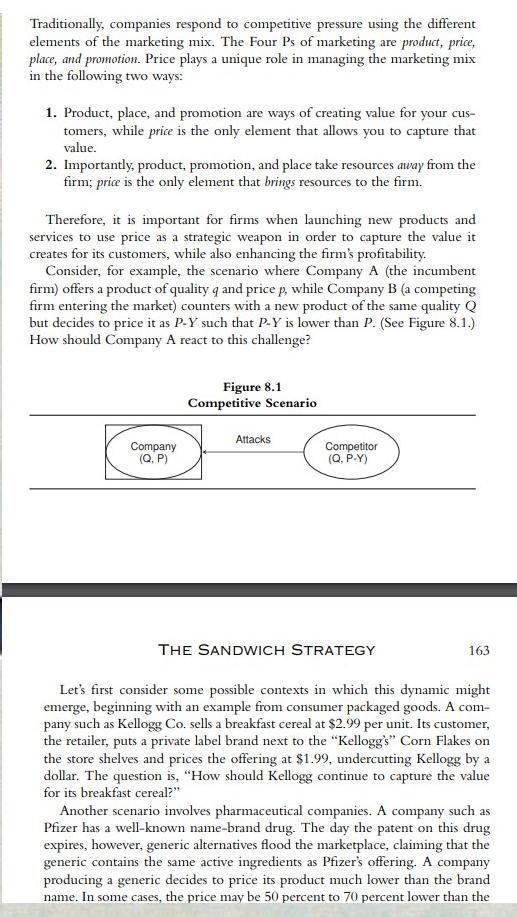
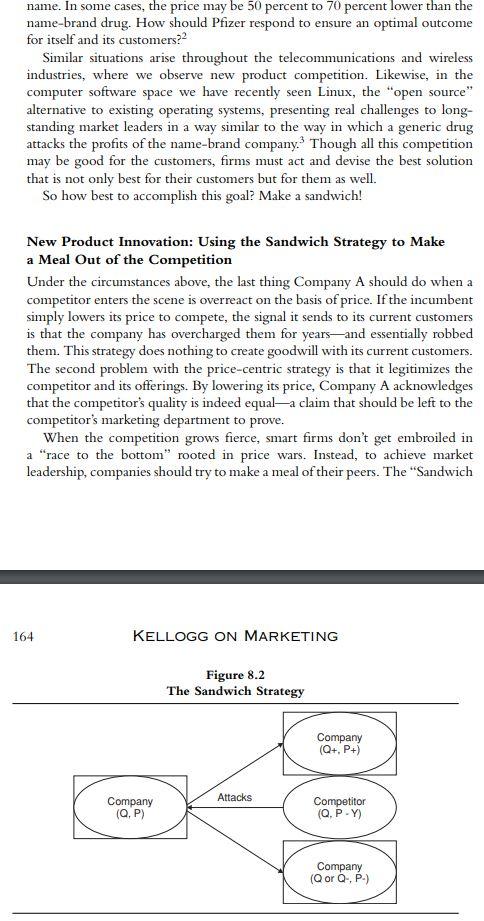
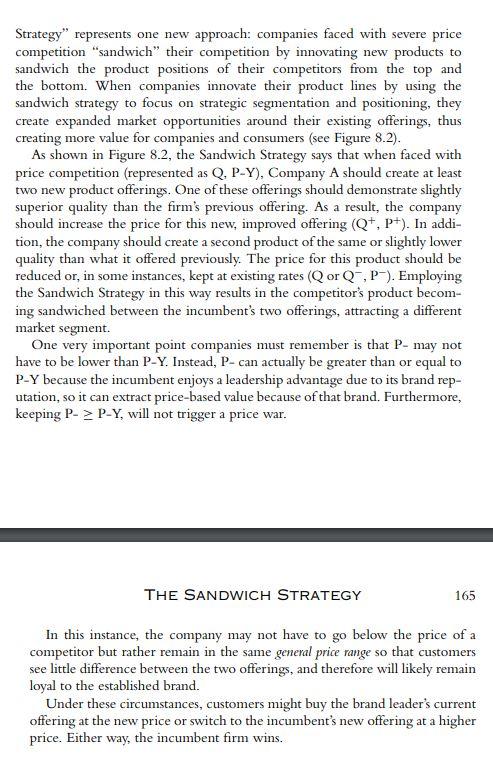
Traditionally, companies respond to competitive pressure using the different elements of the marketing mix. The Four Ps of marketing are product, price, place, and promotion. Price plays a unique role in managing the marketing mix in the following two ways: 1. Product, place, and promotion are ways of creating value for your cus- tomers, while price is the only element that allows you to capture that value. 2. Importantly, product, promotion, and place take resources away from the firm; price is the only element that brings resources to the firm. Therefore, it is important for firms when launching new products and services to use price as a strategic weapon in order to capture the value it creates for its customers, while also enhancing the firm's profitability. Consider, for example, the scenario where Company A (the incumbent firm) offers a product of quality q and price p, while Company B (a competing firm entering the market) counters with a new product of the same quality Q but decides to price it as P-Y such that P-Y is lower than P. (See Figure 8.1.) How should Company A react to this challenge? Figure 8.1 Competitive Scenario Attacks Company (Q, P) Competitor (Q, P-Y) THE SANDWICH STRATEGY 163 Let's first consider some possible contexts in which this dynamic might emerge, beginning with an example from consumer packaged goods. A com- pany such as Kellogg Co. sells a breakfast cereal at $2.99 per unit. Its customer, the retailer, puts a private label brand next to the "Kellogg's" Corn Flakes on the store shelves and prices the offering at $1.99, undercutting Kellogg by a dollar. The question is, "How should Kellogg continue to capture the value for its breakfast cereal?" Another scenario involves pharmaceutical companies. A company such as Pfizer has a well-known name-brand drug. The day the patent on this drug expires, however, generic alternatives flood the marketplace, claiming that the generic contains the same active ingredients as Pfizer's offering. A company producing a generic decides to price its product much lower than the brand name. In some cases, the price may be 50 percent to 70 percent lower than the name. In some cases, the price may be 50 percent to 70 percent lower than the name-brand drug. How should Pfizer respond to ensure an optimal outcome for itself and its customers?? Similar situations arise throughout the telecommunications and wireless industries, where we observe new product competition. Likewise, in the computer software space we have recently seen Linux, the "open source" alternative to existing operating systems, presenting real challenges to long- standing market leaders in a way similar to the way in which a generic drug attacks the profits of the name-brand company. Though all this competition may be good for the customers, firms must act and devise the best solution that is not only best for their customers but for them as well. So how best to accomplish this goal? Make a sandwich! New Product Innovation: Using the Sandwich Strategy to Make a Meal Out of the Competition Under the circumstances above, the last thing Company A should do when a competitor enters the scene is overreact on the basis of price. If the incumbent simply lowers its price to compete, the signal it sends to its current customers is that the company has overcharged them for years and essentially robbed them. This strategy does nothing to create goodwill with its current customers. The second problem with the price-centric strategy is that it legitimizes the competitor and its offerings. By lowering its price, Company A acknowledges that the competitor's quality is indeed equal-a claim that should be left to the competitor's marketing department to prove. When the competition grows fierce, smart firms don't get embroiled in a "race to the bottom" rooted in price wars. Instead, to achieve market leadership, companies should try to make a meal of their peers. The "Sandwich 49 164 KELLOGG ON MARKETING Figure 8.2 The Sandwich Strategy Company (Q+, P+) Company (Q, P) Attacks Competitor (Q, P-Y) Company (Q or Q-, P-) Strategy" represents one new approach: companies faced with severe price competition "sandwich" their competition by innovating new products to sandwich the product positions of their competitors from the top and the bottom. When companies innovate their product lines by using the sandwich strategy to focus on strategic segmentation and positioning, they create expanded market opportunities around their existing offerings, thus creating more value for companies and consumers (see Figure 8.2). As shown in Figure 8.2, the Sandwich Strategy says that when faced with price competition (represented as Q, P-Y), Company A should create at least two new product offerings. One of these offerings should demonstrate slightly superior quality than the firm's previous offering. As a result, the company should increase the price for this new, improved offering (Q+, P+). In addi- tion, the company should create a second product of the same or slightly lower quality than what it offered previously. The price for this product should be reduced or, in some instances, kept at existing rates (Q or Q, P). Employing the Sandwich Strategy in this way results in the competitor's product becom- ing sandwiched between the incumbent's two offerings, attracting a different market segment. One very important point companies must remember is that P- may not have to be lower than P-Y. Instead, P- can actually be greater than or equal to P-Y because the incumbent enjoys a leadership advantage due to its brand rep- utation, so it can extract price-based value because of that brand. Furthermore, keeping P-P-Y, will not trigger a price war. THE SANDWICH STRATEGY 165 In this instance, the company may not have to go below the price of a competitor but rather remain in the same general price range so that customers see little difference between the two offerings, and therefore will likely remain loyal to the established brand. Under these circumstances, customers might buy the brand leader's current offering at the new price or switch to the incumbent's new offering at a higher price. Either way, the incumbent firm wins.
Step by Step Solution
There are 3 Steps involved in it

Get step-by-step solutions from verified subject matter experts
 Study Help