



Question: 2. (Helpman, Melitz, Yeaple (2004)) There are 2 countries and 2 sectors. One sec- tor produces a freely traded homogeneous good with constant returns to
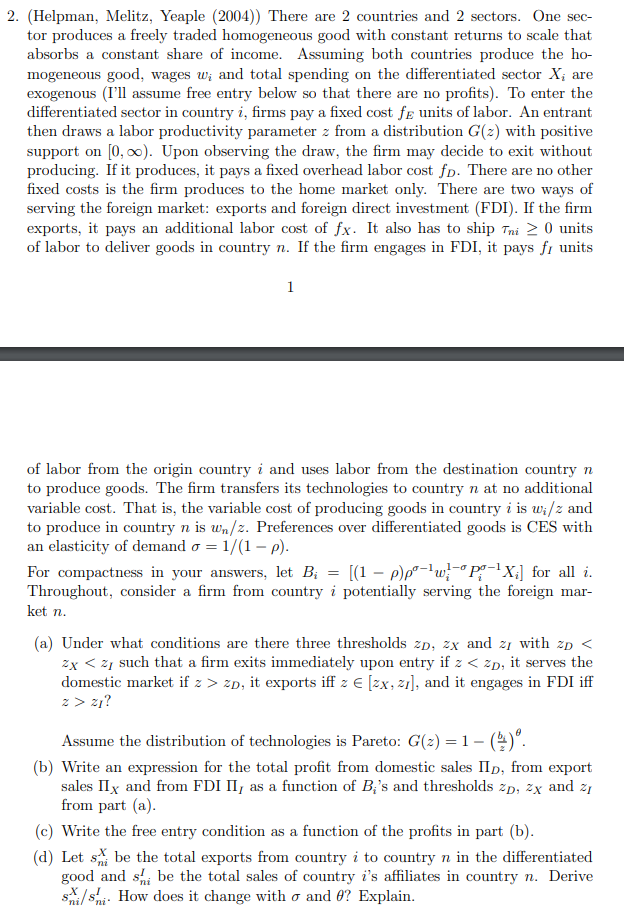
2. (Helpman, Melitz, Yeaple (2004)) There are 2 countries and 2 sectors. One sec- tor produces a freely traded homogeneous good with constant returns to scale that absorbs a constant share of income. Assuming both countries produce the ho- mogeneous good, wages w; and total spending on the differentiated sector X; are exogenous (I'll assume free entry below so that there are no profits). To enter the differentiated sector in country i, firms pay a fixed cost fe units of labor. An entrant then draws a labor productivity parameter 2 from a distribution G(2) with positive support on [0,). Upon observing the draw, the firm may decide to exit without producing. If it produces, it pays a fixed overhead labor cost fo. There are no other fixed costs is the firm produces to the home market only. There are two ways of serving the foreign market: exports and foreign direct investment (FDI). If the firm exports, it pays an additional labor cost of fx. It also has to ship Tni > 0 units of labor to deliver goods in country n. If the firm engages in FDI, it pays fi units 1 of labor from the origin country i and uses labor from the destination country n to produce goods. The firm transfers its technologies to country n at no additional variable cost. That is, the variable cost of producing goods in country i is wi/z and to produce in country n is wn/2. Preferences over differentiated goods is CES with an elasticity of demand o = 1/(1-P). For compactness in your answers, let B; = [(1 p)po-?w-PO-X;] for all i. Throughout, consider a firm from country i potentially serving the foreign mar- ket n. (a) Under what conditions are there three thresholds zd, zx and z, with zp zd, it exports iff z [zx,z1], and it engages in FDI iff z > 21? Assume the distribution of technologies is Pareto: G(2) = 1-0). (b) Write an expression for the total profit from domestic sales IID, from export sales IIx and from FDI II, as a function of B;'s and thresholds 2d, 2x and zi from part (a). (c) Write the free entry condition as a function of the profits in part (b). (d) Lets be the total exports from country i to country n in the differentiated good and shi be the total sales of country i's affiliates in country n. Derive smi/shi. How does it change with o and e? Explain. 2. (Helpman, Melitz, Yeaple (2004)) There are 2 countries and 2 sectors. One sec- tor produces a freely traded homogeneous good with constant returns to scale that absorbs a constant share of income. Assuming both countries produce the ho- mogeneous good, wages w; and total spending on the differentiated sector X; are exogenous (I'll assume free entry below so that there are no profits). To enter the differentiated sector in country i, firms pay a fixed cost fe units of labor. An entrant then draws a labor productivity parameter 2 from a distribution G(2) with positive support on [0,). Upon observing the draw, the firm may decide to exit without producing. If it produces, it pays a fixed overhead labor cost fo. There are no other fixed costs is the firm produces to the home market only. There are two ways of serving the foreign market: exports and foreign direct investment (FDI). If the firm exports, it pays an additional labor cost of fx. It also has to ship Tni > 0 units of labor to deliver goods in country n. If the firm engages in FDI, it pays fi units 1 of labor from the origin country i and uses labor from the destination country n to produce goods. The firm transfers its technologies to country n at no additional variable cost. That is, the variable cost of producing goods in country i is wi/z and to produce in country n is wn/2. Preferences over differentiated goods is CES with an elasticity of demand o = 1/(1-P). For compactness in your answers, let B; = [(1 p)po-?w-PO-X;] for all i. Throughout, consider a firm from country i potentially serving the foreign mar- ket n. (a) Under what conditions are there three thresholds zd, zx and z, with zp zd, it exports iff z [zx,z1], and it engages in FDI iff z > 21? Assume the distribution of technologies is Pareto: G(2) = 1-0). (b) Write an expression for the total profit from domestic sales IID, from export sales IIx and from FDI II, as a function of B;'s and thresholds 2d, 2x and zi from part (a). (c) Write the free entry condition as a function of the profits in part (b). (d) Lets be the total exports from country i to country n in the differentiated good and shi be the total sales of country i's affiliates in country n. Derive smi/shi. How does it change with o and e? Explain
Step by Step Solution
There are 3 Steps involved in it

Get step-by-step solutions from verified subject matter experts