



Question: Expected Return Standard Derivation Portfolio Industry Weight Stock W (50%) Financial 16%p.a. 30%p.a. Stock X (30%) Real Estate 18% p.a. 25%p.a. Stock Y (10%) Hospitality
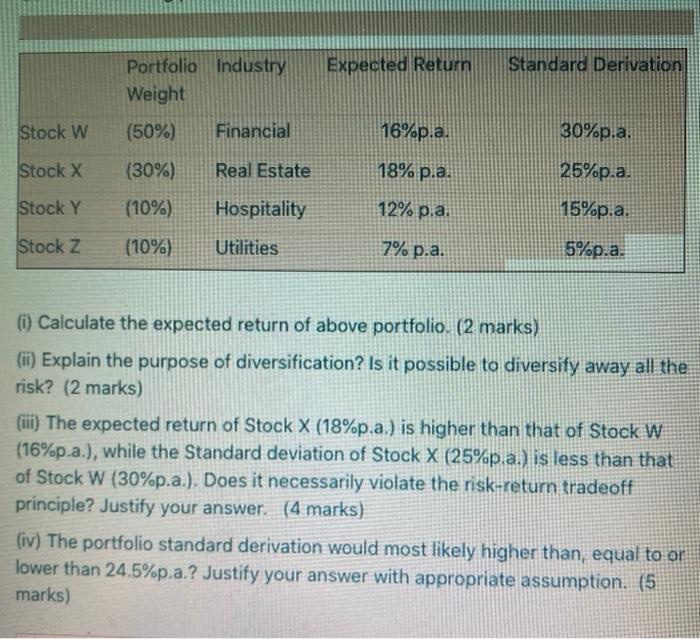
Expected Return Standard Derivation Portfolio Industry Weight Stock W (50%) Financial 16%p.a. 30%p.a. Stock X (30%) Real Estate 18% p.a. 25%p.a. Stock Y (10%) Hospitality 12% p.a. 15%p.a. Stock z (10%) Utilities 7% p.a. 5%p.a. (i) Calculate the expected return of above portfolio. (2 marks) (ii) Explain the purpose of diversification? Is it possible to diversity away all the risk? (2 marks) (ii) The expected return of Stock X (18%p.a) is higher than that of Stock W (16%p.a.), while the Standard deviation of Stock X (25%p.a.) is less than that of Stock W (30%p.a.). Does it necessarily violate the risk-return tradeoff principle? Justify your answer. (4 marks) (iv) The portfolio standard derivation would most likely higher than, equal to on lower than 24.5%p.a.? Justify your answer with appropriate assumption. (5 marks) Expected Return Standard Derivation Portfolio Industry Weight Stock W (50%) Financial 16%p.a. 30%p.a. Stock X (30%) Real Estate 18% p.a. 25%p.a. Stock Y (10%) Hospitality 12% p.a. 15%p.a. Stock z (10%) Utilities 7% p.a. 5%p.a. (i) Calculate the expected return of above portfolio. (2 marks) (ii) Explain the purpose of diversification? Is it possible to diversity away all the risk? (2 marks) (ii) The expected return of Stock X (18%p.a) is higher than that of Stock W (16%p.a.), while the Standard deviation of Stock X (25%p.a.) is less than that of Stock W (30%p.a.). Does it necessarily violate the risk-return tradeoff principle? Justify your answer. (4 marks) (iv) The portfolio standard derivation would most likely higher than, equal to on lower than 24.5%p.a.? Justify your answer with appropriate assumption
Step by Step Solution
There are 3 Steps involved in it

Get step-by-step solutions from verified subject matter experts