



Question: QUESTION 3 (25 marks) You are given the following cost information: Per unit Historic purchase price Current purchase price Scrap value Contract requirements Product A
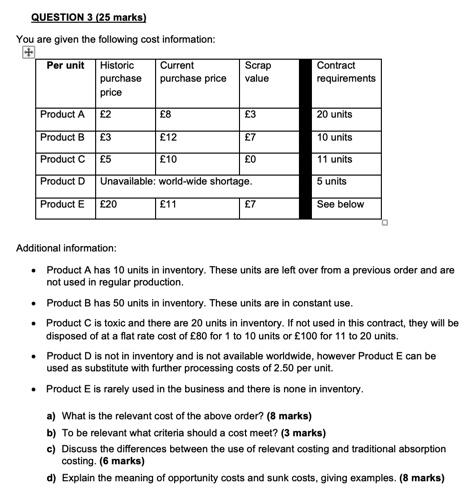
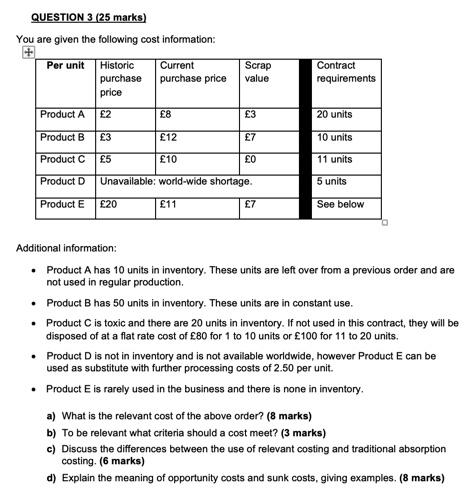
QUESTION 3 (25 marks) You are given the following cost information: Per unit Historic purchase price Current purchase price Scrap value Contract requirements Product A 2 8 3 20 units Product B 3 12 7 10 units Product C 5 10 0 11 units Product D Unavailable: world-wide shortage. 5 units Product E 20 11 7 See below Additional information: Product A has 10 units in inventory. These units are left over from a previous order and are not used in regular production. Product B has 50 units in inventory. These units are in constant use. Product C is toxic and there are 20 units in inventory. If not used in this contract, they will be disposed of at a flat rate cost of 80 for 1 to 10 units or 100 for 11 to 20 units. Product Dis not in inventory and is not available worldwide, however Product E can be used as substitute with further processing costs of 2.50 per unit. Product E is rarely used in the business and there is none in inventory. a) What is the relevant cost of the above order? (8 marks) b) To be relevant what criteria should a cost meet? (3 marks) c) Discuss the differences between the use of relevant costing and traditional absorption costing. (6 marks) d) Explain the meaning of opportunity costs and sunk costs, giving examples. (8 marks)
Step by Step Solution
There are 3 Steps involved in it

Get step-by-step solutions from verified subject matter experts