







Question: TranscribedText: Part A Learning Goal: To understand how to construct a free-body diagram for an object that can be treated as a particle. As shown,
TranscribedText:
Part A Learning Goal:
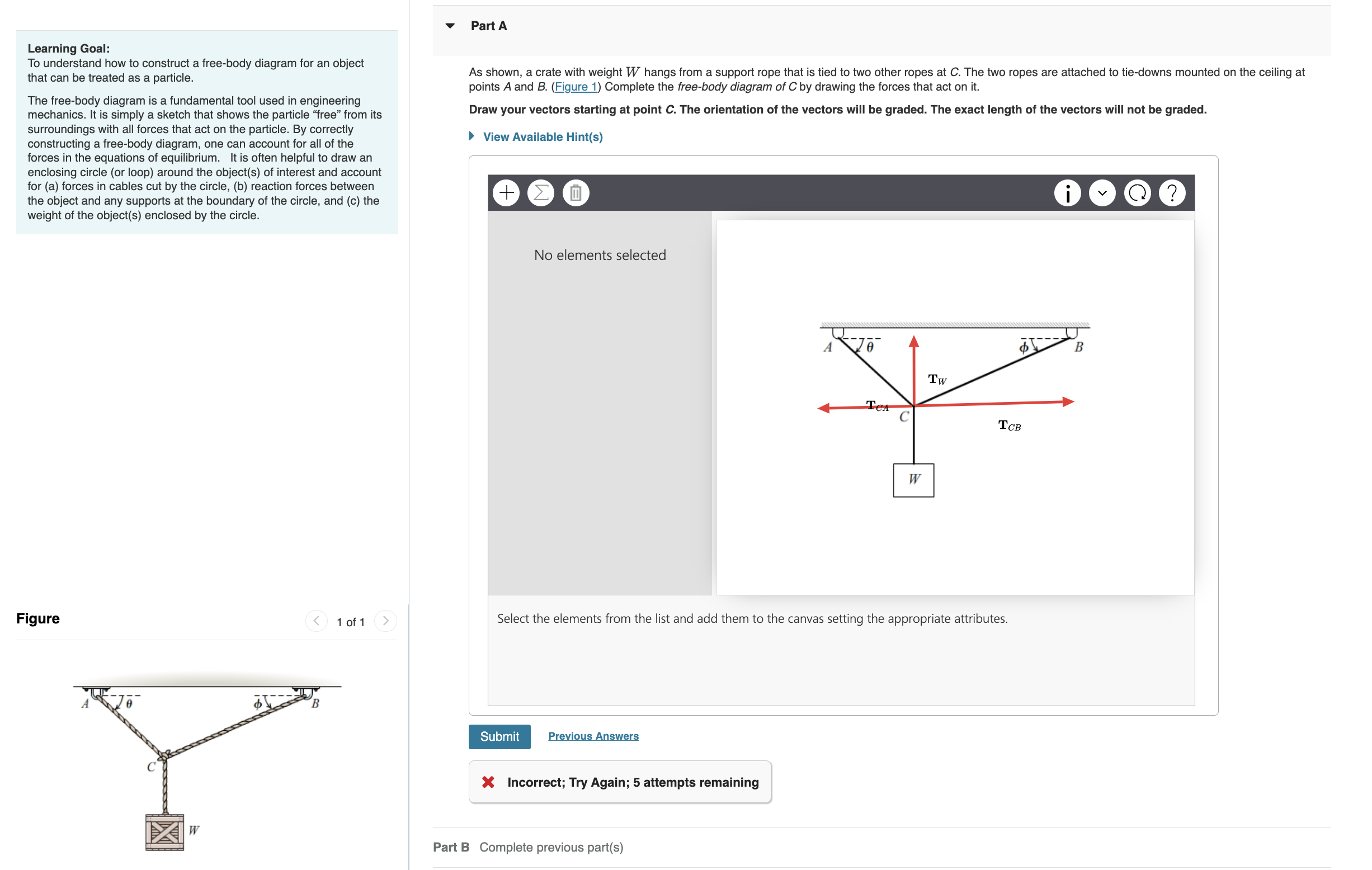
To understand how to construct a free-body diagram for an object that can be treated as a particle. As shown, a crate with weight W hangs from a support rope that is tied to two other ropes at C. The two ropes are attached to tie-downs mounted on the ceiling at points A and B.
(Figure 1) Complete the free-body diagram of C by drawing the forces that act on it. The free-body diagram is a fundamental tool used in engineering mechanics. It is simply a sketch that shows the particle "free" from its Draw your vectors starting at point C.
The orientation of the vectors will be graded. The exact length of the vectors will not be graded. surroundings with all forces that act on the particle. By correctly constructing a free-body diagram, one can account for all of the View Available Hint(s) forces in the equations of equilibrium.
It is often helpful to draw an enclosing circle (or loop) around the object(s) of interest and account for (a) forces in cables cut by the circle, (b) reaction forces between the object and any supports at the boundary of the circle, and (c) the + weight of the object(s) enclosed by the circle.
No elements selected B TW TeA TCB W Figure Select the elements from the list and add them to the canvas setting the appropriate attributes. B Submit Previous Answers X Incorrect; Try Again; 5 attempts remaining W Part B Complete previous part(s.)
Part A Learning Goal: To understand how to construct a free-body diagram for an object that can be treated as a particle. The free-body diagram is a fundamental tool used in engineering mechanics. It is simply a sketch that shows the particle "free" from its surroundings with all forces that act on the particle. By correctly constructing a free-body diagram, one can account for all of the forces in the equations of equilibrium. It is often helpful to draw an enclosing circle (or loop) around the object(s) of interest and account for (a) forces in cables cut by the circle, (b) reaction forces between the object and any supports at the boundary of the circle, and (c) the weight of the object(s) enclosed by the circle. As shown, a crate with weight W hangs from a support rope that is tied to two other ropes at C. The two ropes are attached to tie-downs mounted on the ceiling at points A and B. (Figure 1) Complete the free-body diagram of C by drawing the forces that act on it. Draw your vectors starting at point C. The orientation of the vectors will be graded. The exact length of the vectors will not be graded. View Available Hint(s) + ? Figure 1 of 1 B No elements selected A 10 TCA W Tw TCB Select the elements from the list and add them to the canvas setting the appropriate attributes. Submit Previous Answers Incorrect; Try Again; 5 attempts remaining W Part B Complete previous part(s) B
Step by Step Solution
There are 3 Steps involved in it

Get step-by-step solutions from verified subject matter experts
 Study Help