







Question: TRANSFER FUNCTION (2) Benefits - Once TF is known, the output response to various given inputs can be obtained easily. y(t)=L1{Y(s)}=L1{G(s)U(s)}=L1{G(s)}L1{U(s)} - Interconnected system can
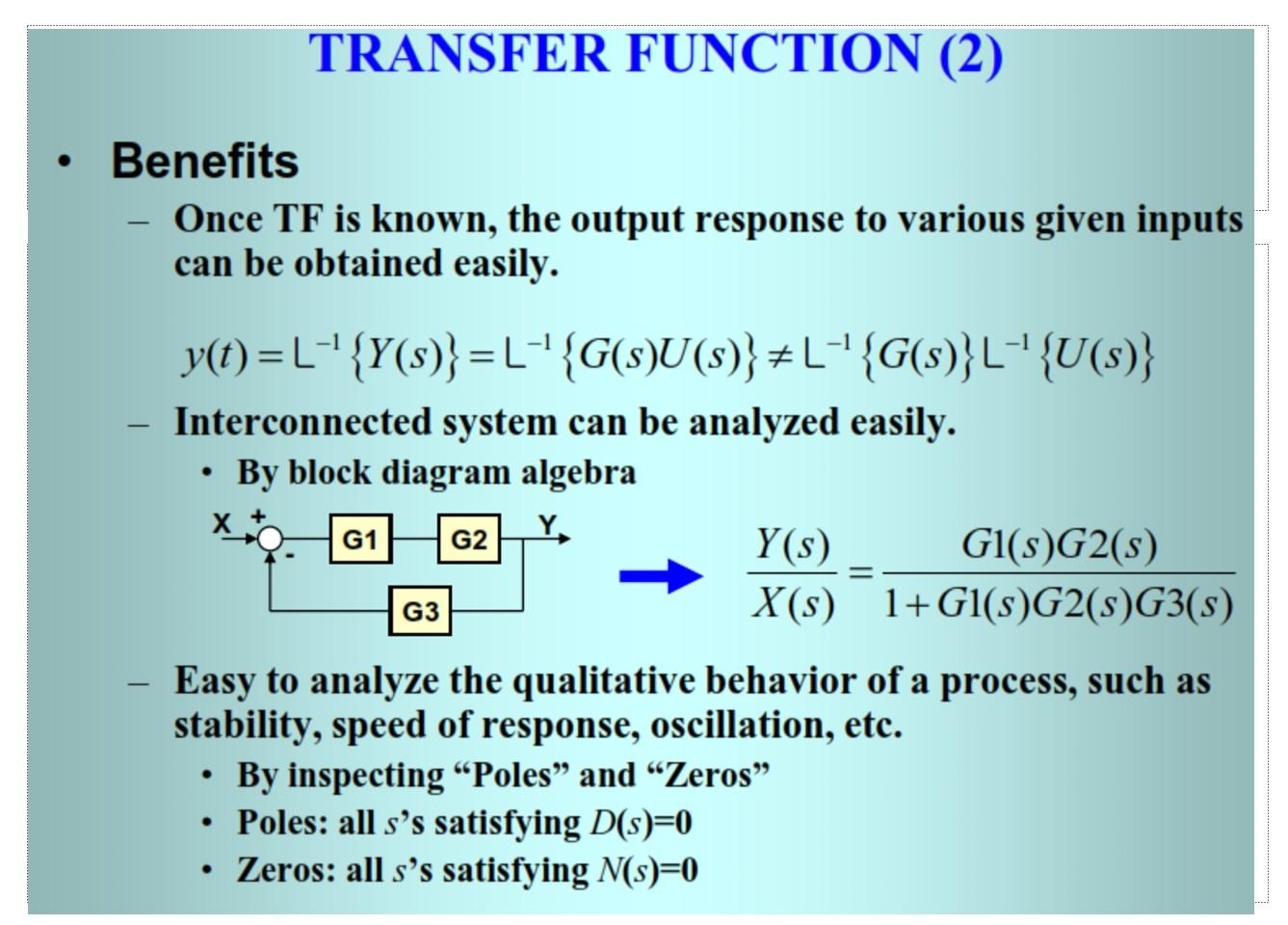
TRANSFER FUNCTION (2) Benefits - Once TF is known, the output response to various given inputs can be obtained easily. y(t)=L1{Y(s)}=L1{G(s)U(s)}=L1{G(s)}L1{U(s)} - Interconnected system can be analyzed easily. - By block diagram algebra XYX(s)Y(s)=1+G1(s)G2(s)G3(s)G1(s)G2(s) - Easy to analyze the qualitative behavior of a process, such as stability, speed of response, oscillation, etc. - By inspecting "Poles" and "Zeros" - Poles: all s 's satisfying D(s)=0 - Zeros: all s 's satisfying N(s)=0 TRANSFER FUNCTION (2) Benefits - Once TF is known, the output response to various given inputs can be obtained easily. y(t)=L1{Y(s)}=L1{G(s)U(s)}=L1{G(s)}L1{U(s)} - Interconnected system can be analyzed easily. - By block diagram algebra XYX(s)Y(s)=1+G1(s)G2(s)G3(s)G1(s)G2(s) - Easy to analyze the qualitative behavior of a process, such as stability, speed of response, oscillation, etc. - By inspecting "Poles" and "Zeros" - Poles: all s 's satisfying D(s)=0 - Zeros: all s 's satisfying N(s)=0
Step by Step Solution
There are 3 Steps involved in it

Get step-by-step solutions from verified subject matter experts
 Study Help