



Question: Transitions exercise V A This, Then, First, Second, For example, A further. They. The final, Indeed, Finally, Rather L. A child may leave home for
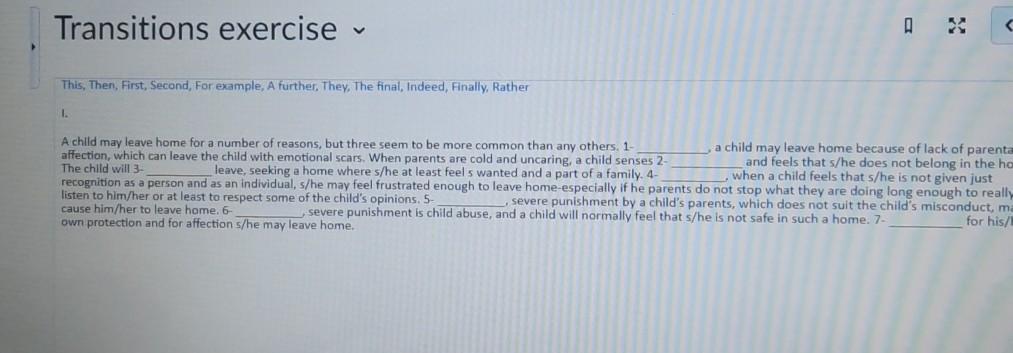
Transitions exercise V A This, Then, First, Second, For example, A further. They. The final, Indeed, Finally, Rather L. A child may leave home for a number of reasons, but three seem to be more common than any others. 1 a child may leave home because of lack of parenta affection, which can leave the child with emotional scars. When parents are cold and uncaring, a child senses 2 and feels that s/he does not belong in the ho The child will 3 leave, seeking a home where s/he at least feels wanted and a part of a family. 4- when a child feels that she is not given just recognition as a person and as an individual, s/he may feel frustrated enough to leave home-especially if he parents do not stop what they are doing long enough to really- listen to him/her or at least to respect some of the child's opinions. 5- severe punishment by a child's parents, which does not suit the child's misconduct, ma cause him/her to leave home, 6- severe punishment is child abuse, and a child will normally feel that s/he is not safe in such a home. 7- for his/ own protection and for affection s/he may leave home
Step by Step Solution
There are 3 Steps involved in it
1 Expert Approved Answer
Step: 1 Unlock

Question Has Been Solved by an Expert!
Get step-by-step solutions from verified subject matter experts
Step: 2 Unlock
Step: 3 Unlock