Question: Translate the given argument into symbolic form then construct a formal proof of its validity. Justin, a student in this class, knows how to write

Translate the given argument into symbolic formTranslate the given argument into symbolic formTranslate the given argument into symbolic formTranslate the given argument into symbolic form
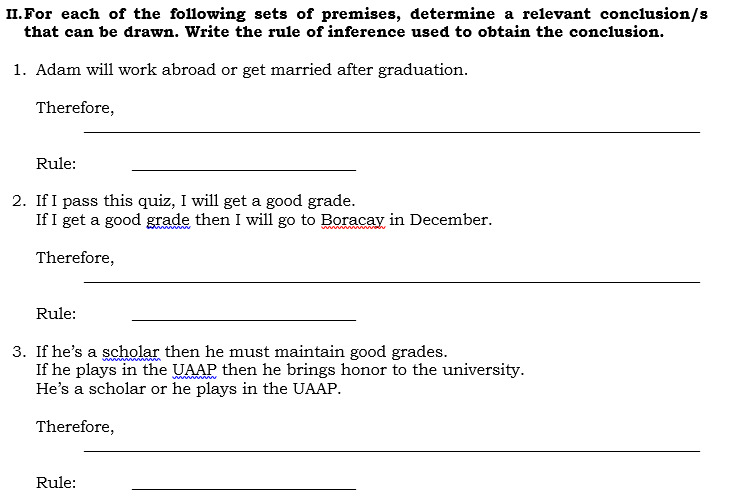
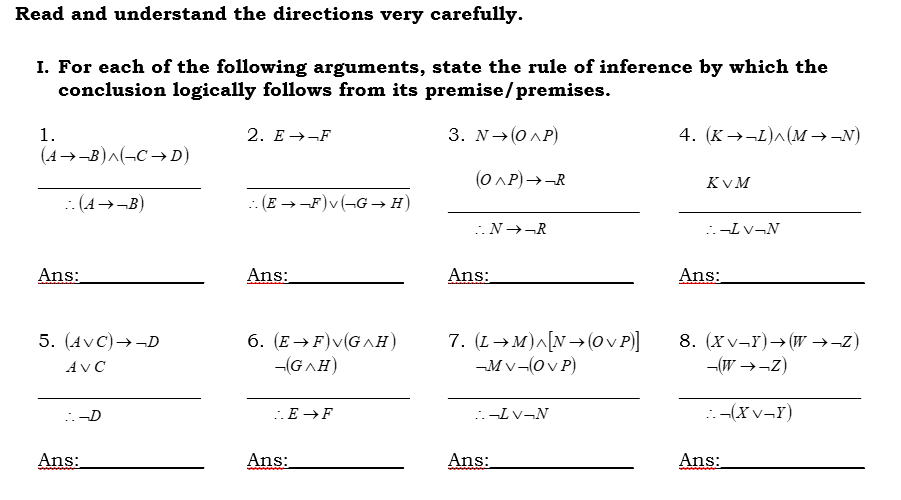
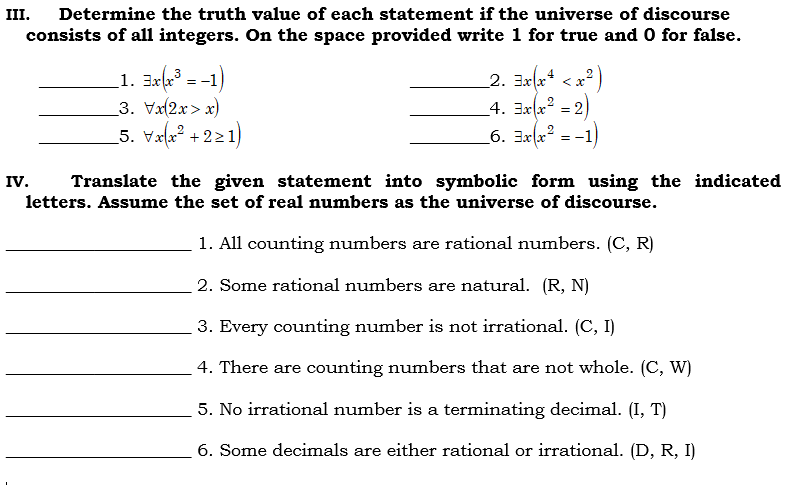
Translate the given argument into symbolic form then construct a formal proof of its validity. Justin, a student in this class, knows how to write programs in JAVA. Everyone who knows how to write programs in JAVA can get a highpaying job. Therefore, someone in this class can get a highpaymg job. (P, H} Read and understand the directions very carefully. I. For each of the following arguments, state the rule of inference by which the conclusion logically follows from its premise/premises. 1. 2. E- -F 3. N- (0AP) 4. ( K - -L)A(M - - N) ( A - -B ) A(-C- D) (OAP) - -R KVM (A- - B) : ( E - - F) V(-G- H) :. N- -R :LV-N Ans: Ans: Ans: Ans: 5. (AVC) - -D 6. (E- F)V(GAH) 7. (L-M)AN - (0VP)] 8. ( X V - Y ) - (W - -z) AVC -(GAH) -MV-(0VP) -(W - -Z) : -D RE-F :-LV-N : (XV-Y) Ans: Ans: Ans: Ans:III. Determine the truth value of each statement if the universe of discourse consists of all integers. On the space provided write 1 for true and {I for false. 1. EI:::[.'I:3 = l) 2. Elx[x4
Step by Step Solution

There are 3 Steps involved in it

1 Expert Approved Answer
Step: 1 Unlock blur-text-image

Question Has Been Solved by an Expert!

Get step-by-step solutions from verified subject matter experts

Step: 2 Unlock
Step: 3 Unlock

Students Have Also Explored These Related Mathematics Questions!