







Question: Trapezoid Rule for Approximating Define Integrals Read about the Trapezoid Rule is your textbook and/or other sources. In your ebook, this is located in section
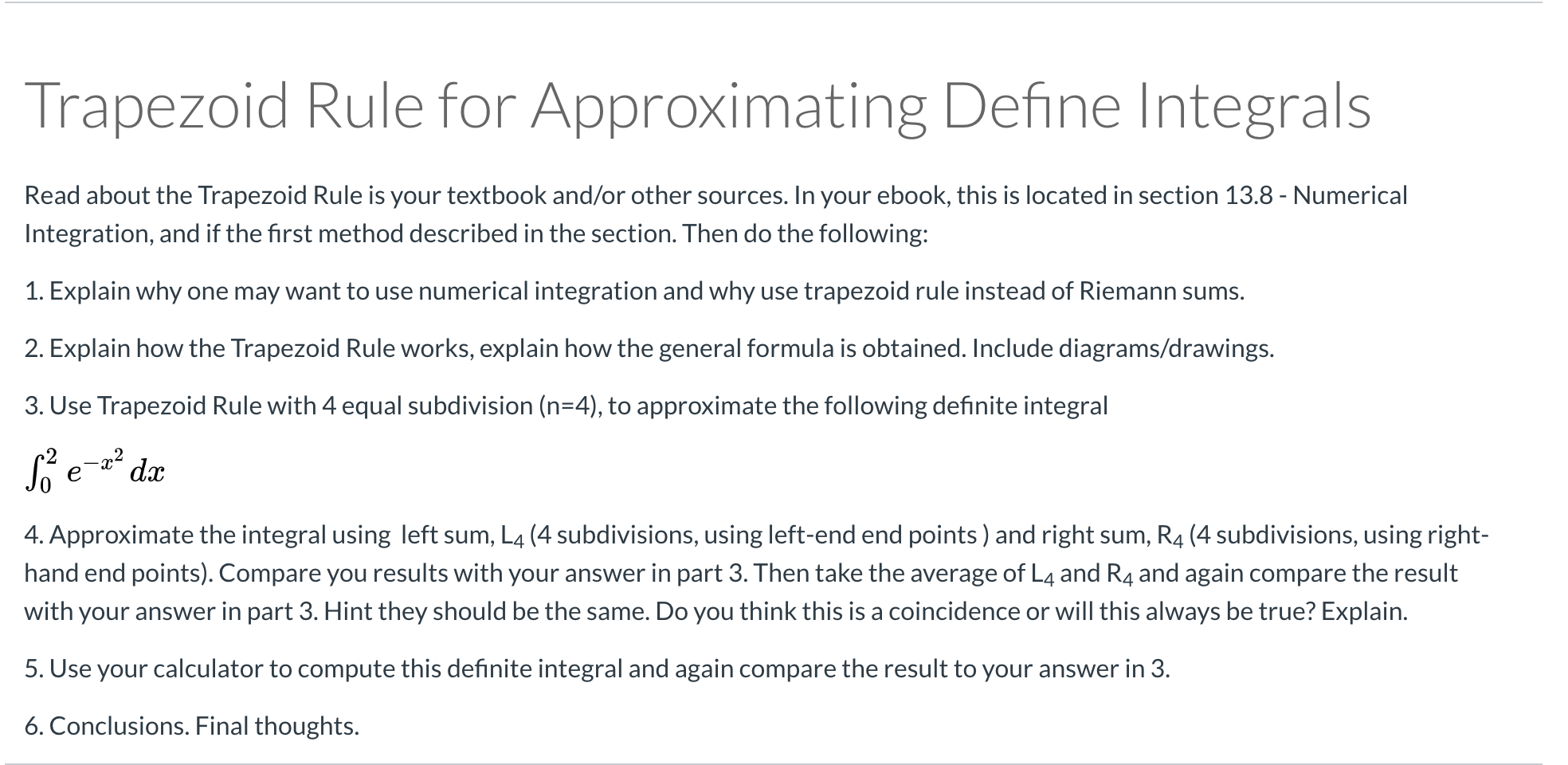
Trapezoid Rule for Approximating Define Integrals Read about the Trapezoid Rule is your textbook and/or other sources. In your ebook, this is located in section 13.8 - Numerical Integration, and if the first method described in the section. Then do the following: 1. Explain why one may want to use numerical integration and why use trapezoid rule instead of Riemann sums. 2. Explain how the Trapezoid Rule works, explain how the general formula is obtained. Include diagrams/drawings. 3. Use Trapezoid Rule with 4 equal subdivision (n=4), to approximate the following definite integral So e 2 dx 4. Approximate the integral using left sum, L4 (4 subdivisions, using left-end end points ) and right sum, R4 (4 subdivisions, using right- hand end points). Compare you results with your answer in part 3. Then take the average of L4 and R4 and again compare the result with your answer in part 3. Hint they should be the same. Do you think this is a coincidence or will this always be true? Explain. 5. Use your calculator to compute this definite integral and again compare the result to your answer in 3. 6. Conclusions. Final thoughts. Trapezoid Rule for Approximating Define Integrals Read about the Trapezoid Rule is your textbook and/or other sources. In your ebook, this is located in section 13.8 - Numerical Integration, and if the first method described in the section. Then do the following: 1. Explain why one may want to use numerical integration and why use trapezoid rule instead of Riemann sums. 2. Explain how the Trapezoid Rule works, explain how the general formula is obtained. Include diagrams/drawings. 3. Use Trapezoid Rule with 4 equal subdivision (n=4), to approximate the following definite integral So e 2 dx 4. Approximate the integral using left sum, L4 (4 subdivisions, using left-end end points ) and right sum, R4 (4 subdivisions, using right- hand end points). Compare you results with your answer in part 3. Then take the average of L4 and R4 and again compare the result with your answer in part 3. Hint they should be the same. Do you think this is a coincidence or will this always be true? Explain. 5. Use your calculator to compute this definite integral and again compare the result to your answer in 3. 6. Conclusions. Final thoughts
Step by Step Solution
There are 3 Steps involved in it

Get step-by-step solutions from verified subject matter experts
 Study Help