







Question: TRASLATION: PART I. JACOBI METHOD Using the C ++ programming language, implement an algorithm that executes the Jacobi iterative method. The algorithm must execute the
TRASLATION:
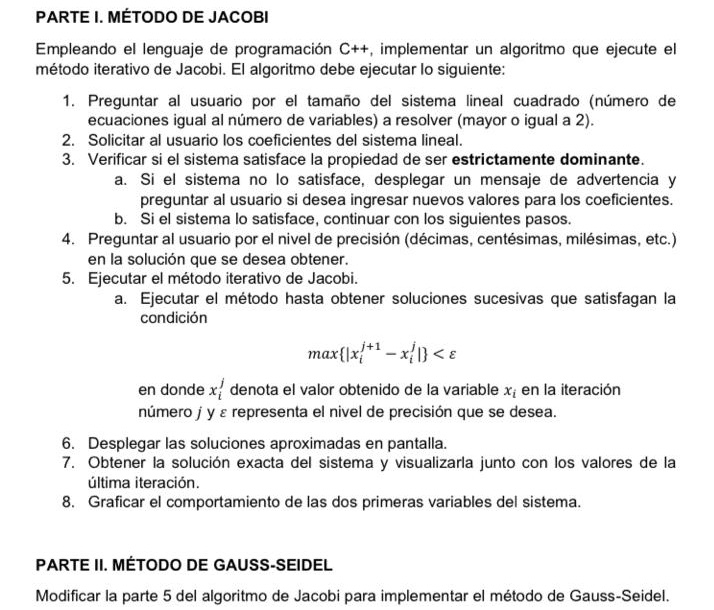
PART I. JACOBI METHOD Using the C ++ programming language, implement an algorithm that executes the Jacobi iterative method. The algorithm must execute the following: 1. Ask the user for the size of the square linear system (number of equations equal to the number of variables) to solve (greater than or equal to 2). 2. Ask the user for the coefficients of the linear system. 3. Verify if the system satisfies the property of being strictly dominant. a) If the system does not satisfy you, display a warning message and ask the user if they want to enter new values for the coefficients. b) If the system satisfies it, continue with the following steps. 4. Ask the user for the level of precision (tenths, hundredths, thousandths, etc.) in the solution to be obtained. 5. Execute the iterative method of Jacobi. a) Execute the method until obtaining successive solutions that satisfy the condition

where  denotes the value obtained from the variable
  in the iteration number j and
  represents the desired level of pressure.
6. Deploy the approximate solutions on the screen
7. Obtain the exact solution of the system and visualize it together with the values of the last iteration 8. Graph the behavior of the first two varibals of the system
PART II. GAUSS-SEIDEL METHOD Modify part 5 of the Jacobi algorithm to implement the Gauss-Seidel method
Transcribed image text
Step by Step Solution
There are 3 Steps involved in it

Get step-by-step solutions from verified subject matter experts
 Study Help