







Question: Trends in the Periodic Table: A Graphical Analysis BACKGROUND KNOWLEDGE: There are 88 naturally occurring elements, and it is impossible to memorise all of the
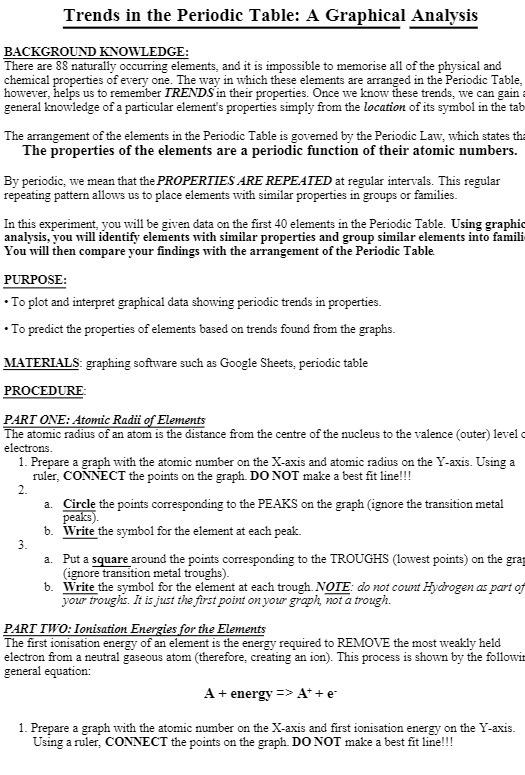
Trends in the Periodic Table: A Graphical Analysis BACKGROUND KNOWLEDGE: There are 88 naturally occurring elements, and it is impossible to memorise all of the physical and chemical properties of every one. The way in which these elements are arranged in the Periodic Table, however, helps us to remember TRENDS in their properties. Once we know these trends, we can gain general knowledge of a particular element's properties simply from the location of its symbol in the tab The arrangement of the elements in the Periodic Table is governed by the Periodic Law, which states th The properties of the elements are a periodic function of their atomic numbers. By periodic, we mean that the PROPERTIES ARE REPEATED at regular intervals. This regular repeating pattern allows us to place elements with similar properties in groups or families. In this experiment, you will be given data on the first 40 elements in the Periodic Table. Using graphic analysis, you will identify elements with similar properties and group similar elements into famili You will then compare your findings with the arrangement of the Periodic Table PURPOSE: . To plot and interpret graphical data showing periodic trends in properties. . To predict the properties of elements based on trends found from the graphs. MATERIALS: graphing software such as Google Sheets, periodic table PROCEDURE: PART ONE: Atomic Radii of Elements The atomic radius of an atom is the distance from the centre of the nucleus to the valence (outer) level electrons 1. Prepare a graph with the atomic number on the X-axis and atomic radius on the Y-axis. Using a ruler, CONNECT the points on the graph. DO NOT make a best fit line!!! 2. a. Circle the points corresponding to the PEAKS on the graph (ignore the transition metal peaks). b. Write the symbol for the element at each peak. 3. a. Put a square around the points corresponding to the TROUGHS (lowest points) on the gra (ignore transition metal troughs). b. Write the symbol for the element at each trough NOTE: do not count Hydrogen as part of your troughs. It is just the first point on your graph, not a trough. PART TWO: Ionisation Energies for the Elements The first ionisation energy of an element is the energy required to REMOVE the most weakly held electron from a neutral gaseous atom (therefore, creating an ion). This process is shown by the followit general equation: A + energy => A* + e- 1. Prepare a graph with the atomic number on the X-axis and first ionisation energy on the Y-axis. Using a ruler, CONNECT the points on the graph. DO NOT make a best fit line
Step by Step Solution
There are 3 Steps involved in it

Get step-by-step solutions from verified subject matter experts
 Study Help