







Question: Treynor-Black model [5 points] Consider the single-index model applied to a stock (or a portfolio of stock) S: Rs.t=as + BsRm.t + est For this
![Treynor-Black model [5 points] Consider the single-index model applied to a](https://dsd5zvtm8ll6.cloudfront.net/si.experts.images/questions/2024/10/66fe534bc1fe7_49966fe534b4bf97.jpg)
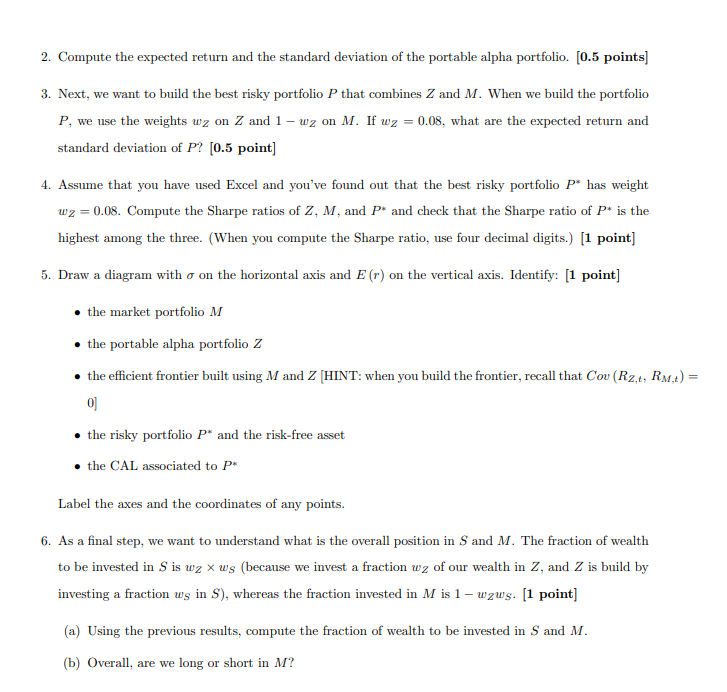
Treynor-Black model [5 points] Consider the single-index model applied to a stock (or a portfolio of stock) S: Rs.t=as + BsRm.t + est For this exercise, we are going to ignore the factors SMB and HML (alternatively, you can think that you run the Fama-French 3-factor model and you obtained Bs sml = 0 and Bs.HmL = 0). Your estimates for the single-index model are as = 2% (and statistically different from zero), Bs = 0.6, V (est) = 0.09. In addition, E (Rs.t) = 6.8%, E (RM,t) = 8%, V (RMt) = 0.0625. The risk-free rate is rj = 1% and let's assume that r; is constant over time. 1. Build the portable alpha portfolio Z. That is, compute the weights ws and wm such that the portfolio Z has zero load on the market factor. [1 point] 2. Compute the expected return and the standard deviation of the portable alpha portfolio. (0.5 points) 3. Next, we want to build the best risky portfolio P that combines Z and M. When we build the portfolio P, we use the weights wz on Z and 1 wz on M. If wz = 0.08, what are the expected return and standard deviation of P? (0.5 point] 4. Assume that you have used Excel and you've found out that the best risky portfolio P* has weight wz = 0.08. Compute the Sharpe ratios of Z, M, and P* and check that the Sharpe ratio of P* is the highest among the three. (When you compute the Sharpe ratio, use four decimal digits.) [1 point] 5. Draw a diagram with o on the horizontal axis and E (r) on the vertical axis. Identify: [1 point] the market portfolio M the portable alpha portfolio Z the efficient frontier built using M and Z [HINT: when you build the frontier, recall that Cou (Rz,t, RM.:) 0 the risky portfolio P* and the risk-free asset the CAL associated to P Label the axes and the coordinates of any points. 6. As a final step, we want to understand what is the overall position in S and M. The fraction of wealth to be invested in S is wz x ws (because we invest a fraction w z of our wealth in Z, and Z is build by investing a fraction wg in S), whereas the fraction invested in M is 1 wzws. [1 point] (a) Using the previous results, compute the fraction of wealth to be invested in S and M. (b) Overall, are we long or short in M? Treynor-Black model [5 points] Consider the single-index model applied to a stock (or a portfolio of stock) S: Rs.t=as + BsRm.t + est For this exercise, we are going to ignore the factors SMB and HML (alternatively, you can think that you run the Fama-French 3-factor model and you obtained Bs sml = 0 and Bs.HmL = 0). Your estimates for the single-index model are as = 2% (and statistically different from zero), Bs = 0.6, V (est) = 0.09. In addition, E (Rs.t) = 6.8%, E (RM,t) = 8%, V (RMt) = 0.0625. The risk-free rate is rj = 1% and let's assume that r; is constant over time. 1. Build the portable alpha portfolio Z. That is, compute the weights ws and wm such that the portfolio Z has zero load on the market factor. [1 point] 2. Compute the expected return and the standard deviation of the portable alpha portfolio. (0.5 points) 3. Next, we want to build the best risky portfolio P that combines Z and M. When we build the portfolio P, we use the weights wz on Z and 1 wz on M. If wz = 0.08, what are the expected return and standard deviation of P? (0.5 point] 4. Assume that you have used Excel and you've found out that the best risky portfolio P* has weight wz = 0.08. Compute the Sharpe ratios of Z, M, and P* and check that the Sharpe ratio of P* is the highest among the three. (When you compute the Sharpe ratio, use four decimal digits.) [1 point] 5. Draw a diagram with o on the horizontal axis and E (r) on the vertical axis. Identify: [1 point] the market portfolio M the portable alpha portfolio Z the efficient frontier built using M and Z [HINT: when you build the frontier, recall that Cou (Rz,t, RM.:) 0 the risky portfolio P* and the risk-free asset the CAL associated to P Label the axes and the coordinates of any points. 6. As a final step, we want to understand what is the overall position in S and M. The fraction of wealth to be invested in S is wz x ws (because we invest a fraction w z of our wealth in Z, and Z is build by investing a fraction wg in S), whereas the fraction invested in M is 1 wzws. [1 point] (a) Using the previous results, compute the fraction of wealth to be invested in S and M. (b) Overall, are we long or short in M
Step by Step Solution
There are 3 Steps involved in it

Get step-by-step solutions from verified subject matter experts
 Study Help