







Question: Trial - and - Error Solution for Heated Hydraulic Drainage. In a hydraulic project a cast iron pipe having an inside diameter of 0 .
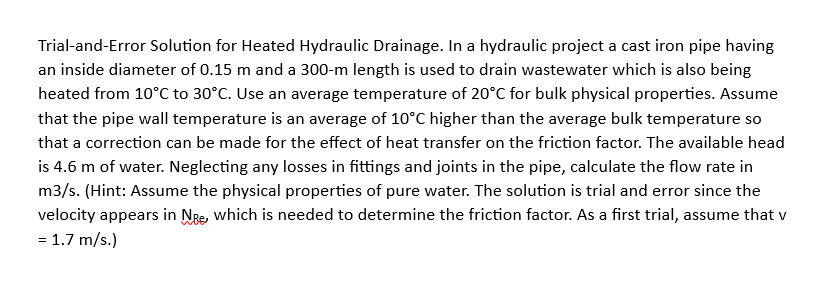
TrialandError Solution for Heated Hydraulic Drainage. In a hydraulic project a cast iron pipe having an inside diameter of m and a m length is used to drain wastewater which is also being heated from deg C to deg C Use an average temperature of deg C for bulk physical properties. Assume that the pipe wall temperature is an average of deg C higher than the average bulk temperature so that a correction can be made for the effect of heat transfer on the friction factor. The available head is m of water. Neglecting any losses in fittings and joints in the pipe, calculate the flow rate in msHint: Assume the physical properties of pure water. The solution is trial and error since the velocity appears in NRe, which is needed to determine the friction factor. As a first trial, assume that v msTrialandError Solution for Heated Hydraulic Drainage. In a hydraulic project a cast iron pipe having
an inside diameter of and a length is used to drain wastewater which is also being
heated from to Use an average temperature of for bulk physical properties. Assume
that the pipe wall temperature is an average of higher than the average bulk temperature so
that a correction can be made for the effect of heat transfer on the friction factor. The available head
is of water. Neglecting any losses in fittings and joints in the pipe, calculate the flow rate in
Hint: Assume the physical properties of pure water. The solution is trial and error since the
velocity appears in which is needed to determine the friction factor. As a first trial, assume that
Step by Step Solution
There are 3 Steps involved in it
1 Expert Approved Answer
Step: 1 Unlock

Question Has Been Solved by an Expert!
Get step-by-step solutions from verified subject matter experts
Step: 2 Unlock
Step: 3 Unlock
 Study Help