



Question: TRIMESTER 1 (2017/2018) (a) Worldwide Interoperability for Microwave Access (WiMAX) is a wireless broadband technology developed on the IEEE 802.16 standard. (i) Explain three function
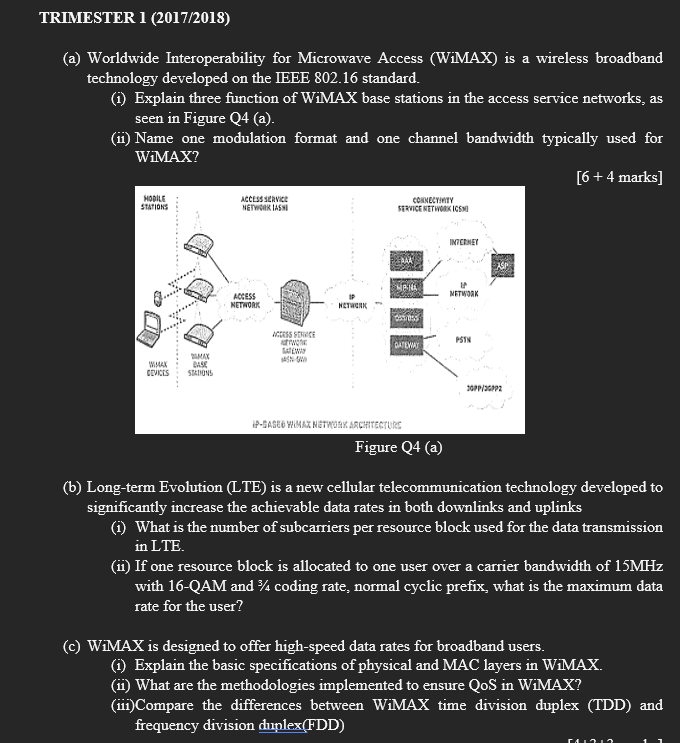
TRIMESTER 1 (2017/2018) (a) Worldwide Interoperability for Microwave Access (WiMAX) is a wireless broadband technology developed on the IEEE 802.16 standard. (i) Explain three function of WiMAX base stations in the access service networks, as seen in Figure Q4 (a). (ii) Name one modulation format and one channel bandwidth typically used for WiMAX? [6+4marks] Figure Q4 (a) (b) Long-term Evolution (LTE) is a new cellular telecommunication technology developed to significantly increase the achievable data rates in both downlinks and uplinks (i) What is the number of subcarriers per resource block used for the data transmission in LTE. (ii) If one resource block is allocated to one user over a carrier bandwidth of 15MHz with 16QAM and 3/4 coding rate, normal cyclic prefix, what is the maximum data rate for the user? (c) WiMAX is designed to offer high-speed data rates for broadband users. (i) Explain the basic specifications of physical and MAC layers in WiMAX. (ii) What are the methodologies implemented to ensure QoS in WiMAX? (iii)Compare the differences between WiMAX time division duplex (TDD) and frequency division duplex(FDD)
Step by Step Solution
There are 3 Steps involved in it

Get step-by-step solutions from verified subject matter experts