



Question: Troubled Asset Relief Program (TRAP). Suppose a bank has assets of 200, capital of 50 and short-term credit of 150. Among the bank's assets are
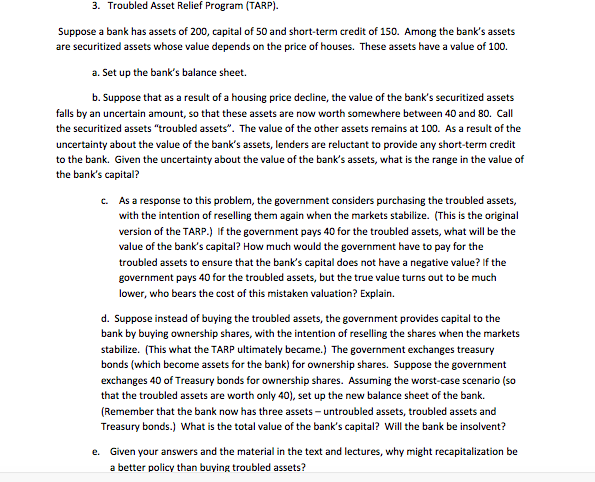
Troubled Asset Relief Program (TRAP). Suppose a bank has assets of 200, capital of 50 and short-term credit of 150. Among the bank's assets are securitized assets whose value depends on the price of houses. These assets have a value of 100. Set up the bank's balance sheet. Suppose that as a result of a housing price decline, the value of the bank's securitized assets falls by an uncertain amount, so that these assets are now worth somewhere between 40 and 80. Call the securitized assets "troubled assets". The value of the other assets remains at 100. As a result of the uncertainty about the value of the bank's assets, lenders are reluctant to provide any short-term credit to the bank. Given the uncertainty about the value of the bank's assets, what is the range in the value of the bank's capital? As a response to this problem, the government considers purchasing the troubled assets, with the intention of reselling them again when the markets stabilize. (This is the original version of the TARP.) If the government pays 40 for the troubled assets, what will be the value of the bank's capital? How much would the government have to pay for the troubled assets to ensure that the bank's capital does not have a negative value? If the government pays 40 for the troubled assets, but the true value turns out to be much lower, who bears the cost of this mistaken valuation? Explain. Suppose instead of buying the troubled assets, the government provides capital to the bank by buying ownership shares, with the intention of reselling the shares when the markets stabilize. (This what the TARP ultimately became.) The government exchanges treasury bonds (which become assets for the bank) for ownership shares. Suppose the government exchanges 40 of Treasury bonds for ownership shares. Assuming the worst-case scenario (so that the troubled assets are worth only 40), set up the new balance sheet of the bank. (Remember that the bank now has three assets - untroubled assets, troubled assets and Treasury bonds.) What is the total value of the bank's capital? Will the bank be insolvent? Given your answers and the material in the text and lectures, why might recapitalization be a better policy than buying troubled assets? Troubled Asset Relief Program (TRAP). Suppose a bank has assets of 200, capital of 50 and short-term credit of 150. Among the bank's assets are securitized assets whose value depends on the price of houses. These assets have a value of 100. Set up the bank's balance sheet. Suppose that as a result of a housing price decline, the value of the bank's securitized assets falls by an uncertain amount, so that these assets are now worth somewhere between 40 and 80. Call the securitized assets "troubled assets". The value of the other assets remains at 100. As a result of the uncertainty about the value of the bank's assets, lenders are reluctant to provide any short-term credit to the bank. Given the uncertainty about the value of the bank's assets, what is the range in the value of the bank's capital? As a response to this problem, the government considers purchasing the troubled assets, with the intention of reselling them again when the markets stabilize. (This is the original version of the TARP.) If the government pays 40 for the troubled assets, what will be the value of the bank's capital? How much would the government have to pay for the troubled assets to ensure that the bank's capital does not have a negative value? If the government pays 40 for the troubled assets, but the true value turns out to be much lower, who bears the cost of this mistaken valuation? Explain. Suppose instead of buying the troubled assets, the government provides capital to the bank by buying ownership shares, with the intention of reselling the shares when the markets stabilize. (This what the TARP ultimately became.) The government exchanges treasury bonds (which become assets for the bank) for ownership shares. Suppose the government exchanges 40 of Treasury bonds for ownership shares. Assuming the worst-case scenario (so that the troubled assets are worth only 40), set up the new balance sheet of the bank. (Remember that the bank now has three assets - untroubled assets, troubled assets and Treasury bonds.) What is the total value of the bank's capital? Will the bank be insolvent? Given your answers and the material in the text and lectures, why might recapitalization be a better policy than buying troubled assets
Step by Step Solution
There are 3 Steps involved in it

Get step-by-step solutions from verified subject matter experts