







Question: True or False? 1. A difference which is highly significant (pavalue less than 1%) can still be due to chance. 0 True, there is a
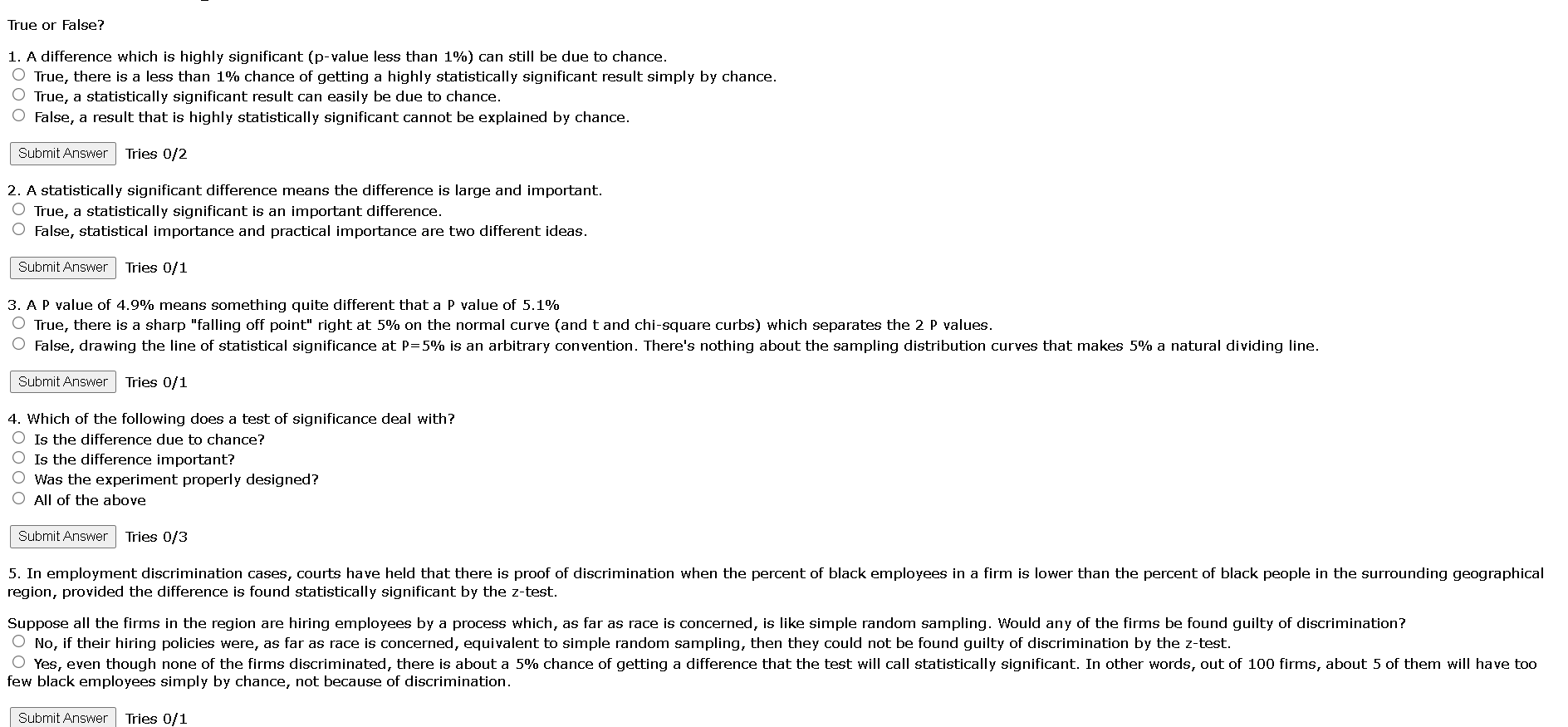
True or False? 1. A difference which is highly significant (pavalue less than 1%) can still be due to chance. 0 True, there is a less than 1% chance of getting a highly statistically significant result simply by chance. 0 True, a statistically significant result can easily be due to chance. 0 False, a result that is highly statistically significant cannot be explained by chance. Submit Answer Tries 0/2 2. A statistically significant difference means the difference is large and important. 0 True, a statistically significant is an imporlant difference. 0 False, statistical importance and practical importance are two different ideas. Submit Answer Tries 0/1 3. A P value of 4.9% means something quite different that a P value of 5.1% 0 True, there is a sharp "falling off point" right at 5% on the normal curve (and t and chiasquare curbs) which separates the 2 P values. 0 False, drawing the line of statistical significance at P:5% is an arbitrary convention. There's nothing about the sampling distribution curves that makes 5% a natural dividing line. Submit Answer Tries 0/1 4. Which of the following does a test of significance deal with? 0 Is the difference clue to chance? 0 Is the difference important? 0 Was the experiment properly designed? 0 All of the above Submit Answer Tries 0/3 5. In employment discrimination cases, courts have held that there is proof of discrimination when the percent of black employees in a firm is lower than the percent of black people in the surrounding geographical region, provided the difference is found statistically significant by the zitest. Suppose all the firms in the region are hiring employees by a process which, as far as race is concerned, is like simple random sampling. Would any of the firms be found guilty of discrimination? O No, if their hiring policies were, as far as race is concerned, equivalent to simple random sampling, then they could not be found guilty of discrimination by the zitest. 0 Yes, even though none of the firms discriminated, there is about a 5% chance of getting a difference that the test will call slatistically significant. In other words, out of 100 firms, about 5 of them will have too few black employees simply by chance, not because of discrimination. Submit Answer Tries 0/1
Step by Step Solution
There are 3 Steps involved in it

Get step-by-step solutions from verified subject matter experts
 Study Help