







Question: TRUE OR FALSE 1. Complex applicant selection systems are most often found in larger organizations. 2. In structurally complex organizations with many job titles but
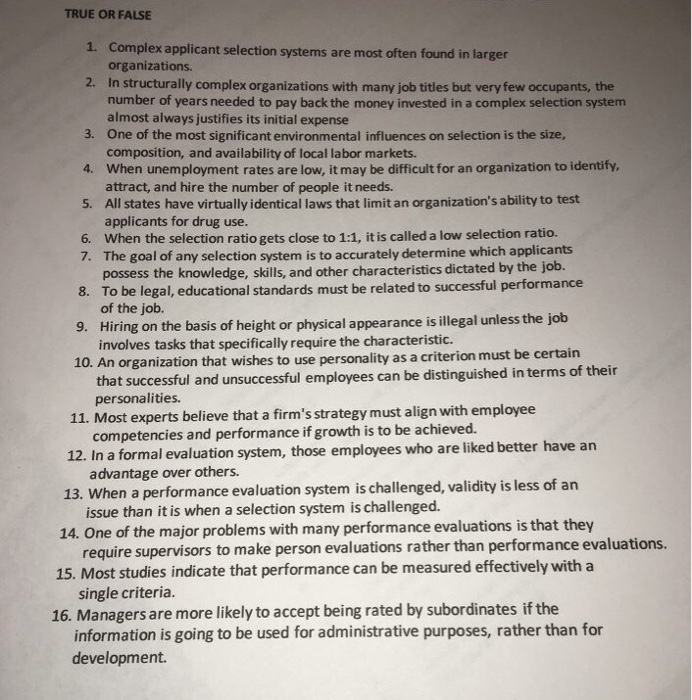
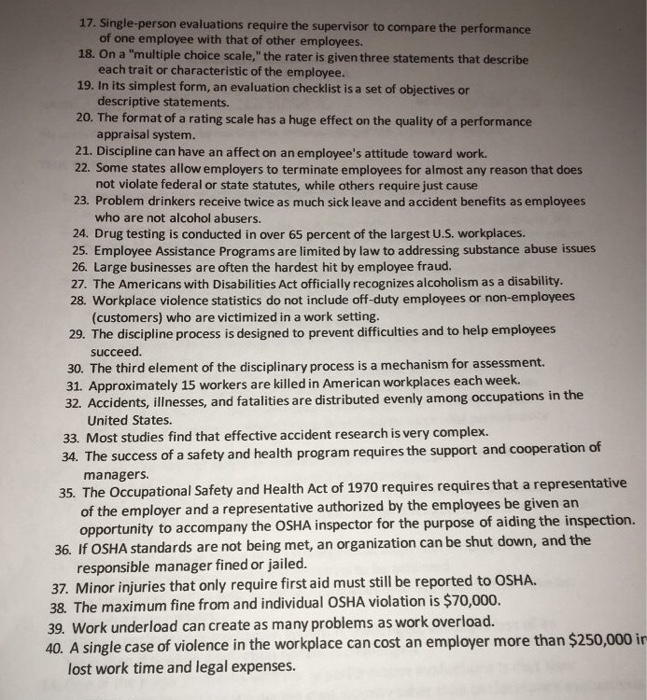
TRUE OR FALSE 1. Complex applicant selection systems are most often found in larger organizations. 2. In structurally complex organizations with many job titles but very few occupants, the number of years needed to pay back the money invested in a complex selection system almost always justifies its initial expense 3. One of the most significant environmental influences on selection is the size, composition, and availability of local labor markets. 4. When unemployment rates are low, it may be difficult for an organization to identity, attract, and hire the number of people it needs. 5. All states have virtually identical laws that limit an organization's ability to test applicants for drug use. 6. When the selection ratio gets close to 1:1, it is called a low selection ratio. 7. The goal of any selection system is to accurately determine which applicants possess the knowledge, skills, and other characteristics dictated by the job. 8. To be legal, educational standards must be related to successful performance of the job. 9. Hiring on the basis of height or physical appearance is illegal unless the job involves tasks that specifically require the characteristic. 10. An organization that wishes to use personality as a criterion must be certain that successful and unsuccessful employees can be distinguished in terms of their personalities. 11. Most experts believe that a firm's strategy must align with employee competencies and performance if growth is to be achieved. 12. In a formal evaluation system, those employees who are liked better have an advantage over others. 13. When a performance evaluation system is challenged, validity is less of an issue than it is when a selection system is challenged. 14. One of the major problems with many performance evaluations is that they require supervisors to make person evaluations rather than performance evaluations. 15. Most studies indicate that performance can be measured effectively with a single criteria. 16. Managers are more likely to accept being rated by subordinates if the information is going to be used for administrative purposes, rather than for development 17. Single-person evaluations require the supervisor to compare the performance of one employee with that of other employees. 18. On a "multiple choice scale," the rater is given three statements that describe each trait or characteristic of the employee. 19. In its simplest form, an evaluation checklist is a set of objectives or descriptive statements. 20. The format of a rating scale has a huge effect on the quality of a performance appraisal system. 21. Discipline can have an affect on an employee's attitude toward work. 22. Some states allow employers to terminate employees for almost any reason that does not violate federal or state statutes, while others require just cause 23. Problem drinkers receive twice as much sick leave and accident benefits as employees who are not alcohol abusers. 24. Drug testing is conducted in over 65 percent of the largest U.S. workplaces. 25. Employee Assistance Programs are limited by law to addressing substance abuse issues 26. Large businesses are often the hardest hit by employee fraud. 27. The Americans with Disabilities Act officially recognizes alcoholism as a disability. 28. Workplace violence statistics do not include off-duty employees or non-employees (customers) who are victimized in a work setting. 29. The discipline process is designed to prevent difficulties and to help employees succeed. 30. The third element of the disciplinary process is a mechanism for assessment. 31. Approximately 15 workers are killed in American workplaces each week. 32. Accidents, illnesses, and fatalities are distributed evenly among occupations in the United States. 33. Most studies find that effective accident research is very complex. 34. The success of a safety and health program requires the support and cooperation of managers. 35. The Occupational Safety and Health Act of 1970 requires requires that a representative of the employer and a representative authorized by the employees be given an opportunity to accompany the OSHA inspector for the purpose of aiding the inspection. 36. If OSHA standards are not being met, an organization can be shut down, and the responsible manager fined or jailed. 37. Minor injuries that only require first aid must still be reported to OSHA. 38. The maximum fine from and individual OSHA violation is $70,000, 39. Work underload can create as many problems as work overload. 40. A single case of violence in the workplace can cost an employer more than $250,000 in lost work time and legal expenses
Step by Step Solution
There are 3 Steps involved in it

Get step-by-step solutions from verified subject matter experts
 Study Help