



Question: True or False? 1. If A, B, and C are sets then An (Bn C) = (An B) n (An C). 2. Suppose S =
True or False?
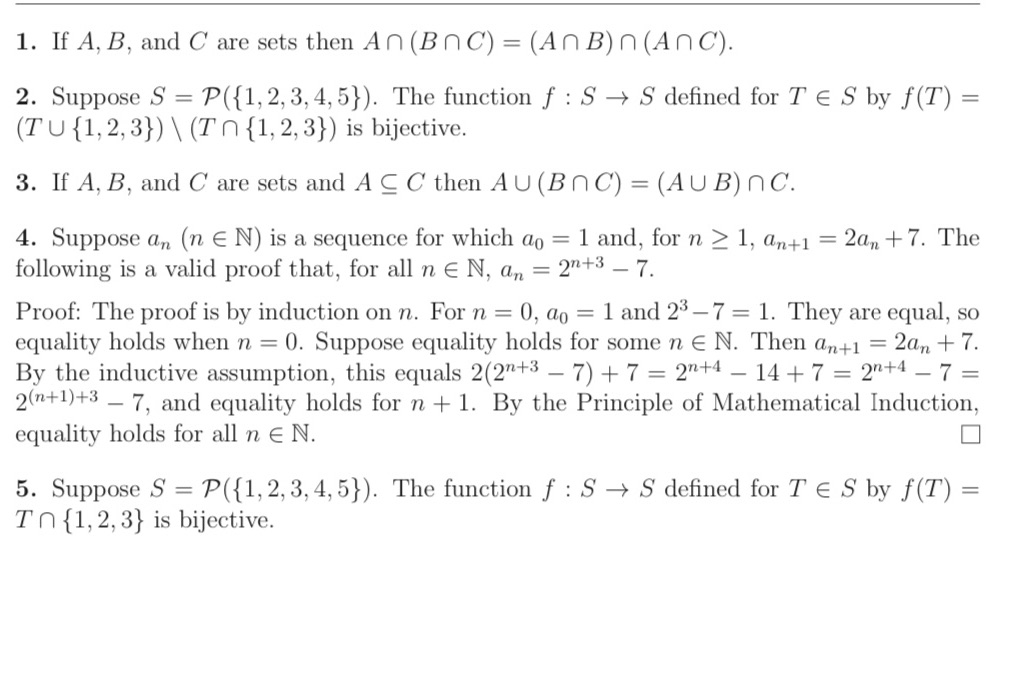
1. If A, B, and C are sets then An (Bn C) = (An B) n (An C). 2. Suppose S = P( {1, 2, 3, 4,5}). The function f : S - S defined for TE S by f (T) = (TU {1, 2,3}) \\ (Tn {1, 2, 3} ) is bijective. 3. If A, B, and C are sets and A C C then AU(BnC) = (AUB) nC. 4. Suppose an (n E N) is a sequence for which do = 1 and, for n 2 1, an+1 = 20, + 7. The following is a valid proof that, for all n E N, an = 2+3 - 7. Proof: The proof is by induction on n. For n = 0, do = 1 and 23-7 = 1. They are equal, so equality holds when n = 0. Suppose equality holds for some n E N. Then anti = 2an + 7. By the inductive assumption, this equals 2(2"+3 - 7) + 7 = 2n+4 - 14 + 7 = 2n+4 - 7 = 2(n+1)+3 - 7, and equality holds for n + 1. By the Principle of Mathematical Induction, equality holds for all n E N. 0 5. Suppose S = P({1, 2, 3, 4,5}). The function f : S - S defined for TE S by f (T) = To {1, 2,3} is bijective
Step by Step Solution
There are 3 Steps involved in it

Get step-by-step solutions from verified subject matter experts