







Question: True or False 1.) The balance sheet is based on cash flow accounting. 2.) When purchasing a bond, accrued interest must be paid to the
True or False
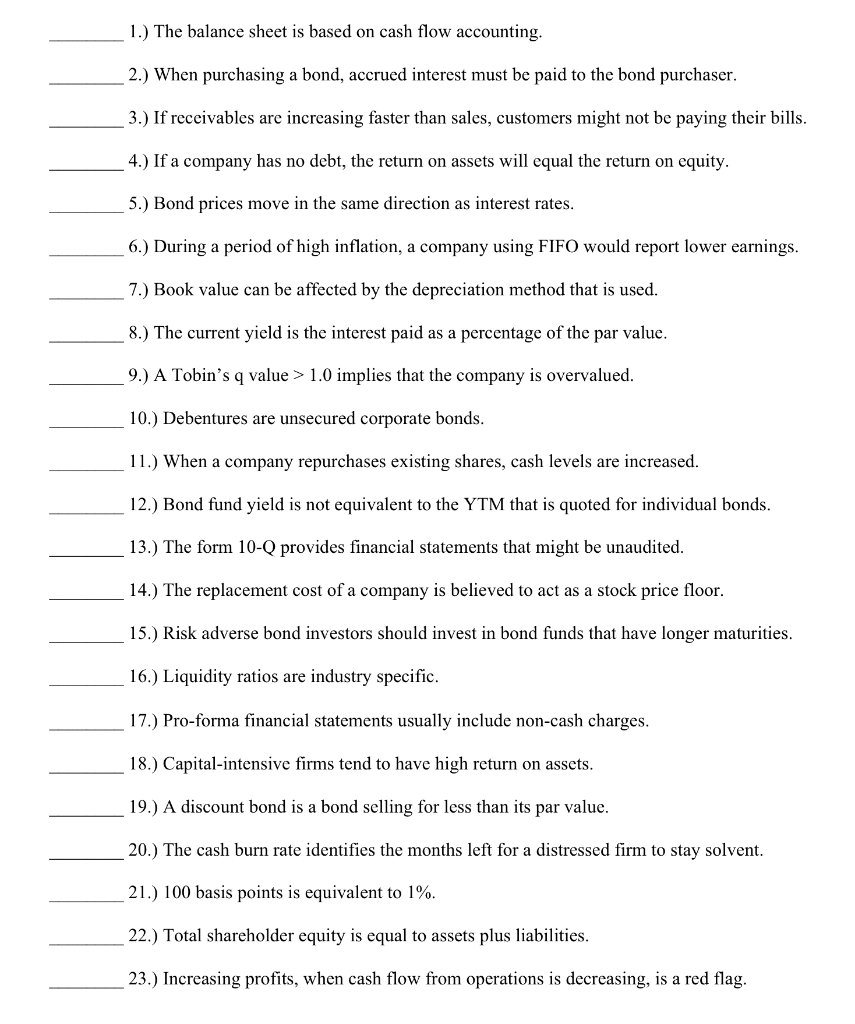
1.) The balance sheet is based on cash flow accounting. 2.) When purchasing a bond, accrued interest must be paid to the bond purchaser. 3.) If receivables are increasing faster than sales, customers might not be paying their bills. 4.) If a company has no debt, the return on assets will equal the return on equity. 5.) Bond prices move in the same direction interest rates. 6.) During a period of high inflation, a company using FIFO would report lower earnings. 7.) Book value can be affected by the depreciation method that is used. 8.) The current yield is the interest paid as a percentage of the par value. 9.) A Tobin's q value > 1.0 implies that the company is overvalued. 10.) Debentures are unsecured corporate bonds. 11.) When a company repurchases existing shares, cash levels are increased. 12.) Bond fund yield is not equivalent to the YTM that is quoted for individual bonds. 13.) The form 10-Q provides financial statements that might be unaudited. 14.) The replacement cost of a company is believed to act as a stock price floor. 15.) Risk adverse bond investors should invest in bond funds that have longer maturities. 16.) Liquidity ratios are industry specific. 17.) Pro-forma financial statements usually include non-cash charges. 18.) Capital-intensive firms tend to have high return on assets. 19.) A discount bond is a bond selling for less than its par value. 20.) The cash burn rate identifies the months left for a distressed firm to stay solvent. 21.) 100 basis points is equivalent to 1%. 22.) Total shareholder equity is equal to assets plus liabilities. 23.) Increasing profits, when cash flow from operations is decreasing, is a red flag
Step by Step Solution
There are 3 Steps involved in it

Get step-by-step solutions from verified subject matter experts
 Study Help