



Question: True or False? 1. The following expression is in disjunctive normal form: (pAq) v (pA-g) V q. 2. One way to state the negation
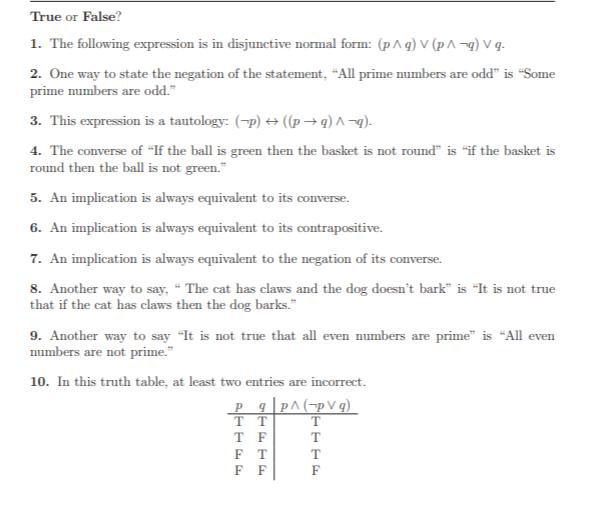
True or False? 1. The following expression is in disjunctive normal form: (pAq) v (pA-g) V q. 2. One way to state the negation of the statement, "All prime numbers are odd" is "Some prime numbers are odd." 3. This expression is a tautology: (-p) + ((p+ 9)A-g). 4. The converse of "If the ball is green then the basket is not round" is "if the basket is round then the ball is not green." 5. An implication is always equivalent to its converse. 6. An implication is always equivalent to its contrapositive. 7. An implication is always equivalent to the negation of its converse. 8. Another way to say, The cat has claws and the dog doesn't bark" is "It is not true that if the cat has claws then the dog barks." 9. Another way to say "It is not true that all even numbers are prime" is "All even numbers are not prime." 10. In this truth table, at least two entries are incorrect. P g|PA(-pVq) T T T F F T
Step by Step Solution
There are 3 Steps involved in it
1 False 2 False ... View full answer

Get step-by-step solutions from verified subject matter experts